Amid controversy, the NWSL stands firm on the High Impact Player rule
Commissioner Jessica Berman says the rule puts "clubs in a position to compete financially." The players' union isn't happy, though.

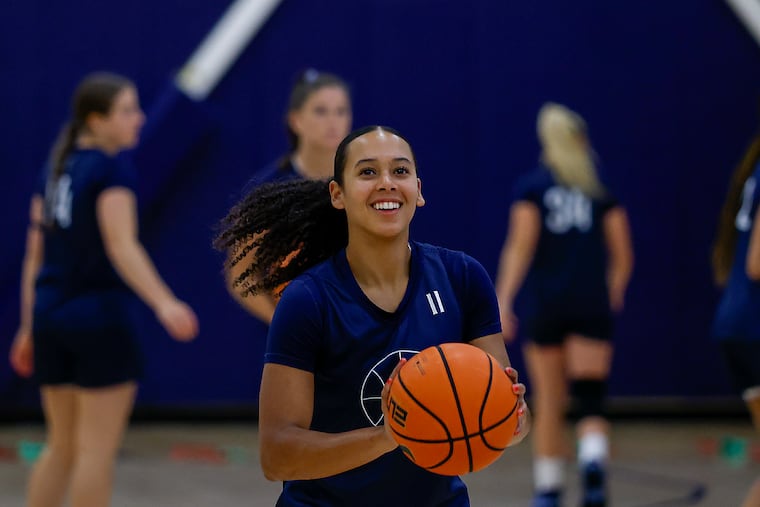
Though Trinity Rodman’s contract saga has at last been resolved with her re-signing, the controversy over the NWSL’s High Impact Player rule likely won’t die down soon.
It remains the subject of a grievance by the NWSL Players Association, which claims the rule should have been collectively bargained; and it remains unpopular with many fans, for a variety of reasons.
The league’s commissioner, Jessica Berman, does not mind being the main target of that ire.
“I very much stand behind the decision and the process,” she told The Inquirer in an interview on Friday. “We intentionally negotiated for the right to do exactly what we did, which is to develop a specific rule for a specific classification of players which there is a reduced salary cap charge, so long as we consult in good faith with the Players’ Association. And I want to reinforce that’s exactly what we did in this context.”
The NWSLPA disagreed.
NWSL Players Association Statement on League’s Unilateral Implementation of the High Impact Player Rule:
— NWSL Players Association (@nwslplayers.bsky.social) December 23, 2025 at 1:43 PM
[image or embed]
“At no point in time in CBA negotiations or any time prior to the end of 2025 did [the] NWSL articulate a plan to impose a separate pot of funds with a new cap and eligibility criteria that were unrelated to roster classifications by any name,” NWSLPA executive director Meghann Burke told The Inquirer via email. “We disagree with NWSL’s representation that it consulted with the NWSLPA.”
» READ MORE: Trinity Rodman signs a new three-year deal with the Washington Spirit, a big win for the NWSL
Burke claimed that the first “written communication” she got on the proposal came on Dec. 11, and the union registered its objections after multiple board meetings in the ensuing days. The league announced the rule on Dec. 23, and said it will take effect on July 1.
Berman acknowledged the grievance in saying that “as in all labor relations in professional sports and otherwise, the union and the league can disagree,” and the league will follow the established procedures for resolving disputes.
“We are very confident in our position,” she said. “We have been contemplating different iterations of a potential rule or policy like this for a long time, and for that reason, we negotiated into the CBA the specific right to move forward with this if and when we believed it was appropriate.”
» READ MORE: Why Trinity Rodman's contract saga has been the biggest story in women's soccer
How the HIP rule works
If there’s enough money going around to give each of the 15 clubs $1 million from the HIP pot, why not just raise the salary cap by the same amount?
“At some point, the board and NWSL are going to have to realize that increasing the cap — while retaining it — is in their own best interests,” said Burke, whose union has been loudly calling to raise the cap. “Until then, we stand ready to enforce the terms that were negotiated.”
Berman started the league’s case by bringing vice president of player affairs, Stephanie Lee on the call to give more context.
Lee, who previously worked in the front offices of Gotham FC, the Utah Royals, and the Seattle Reign, noted that a player who gets HIP money must have a salary cap charge of at least 12% of the teamwide base cap, which for this year is $3.5 million.
» READ MORE: USWNT captain Lindsey Heaps will join NWSL expansion team Denver Summit in June
Teams also can’t get cap relief from the rule unless they hit the cap in the first place. Up to that point, the player’s salary is charged to the regular payroll.
“As they roster build throughout the year and through [transfer] windows and different transactions, there’s flexibility there to how they designate players and take advantage of that HIP [money],” Lee said. “It’s not something that they have to decide at the beginning of executing a player’s contract.”
A league spokesperson added that teams can retroactively apply the money to a player when they hit the cap by signing other players, so they can go over the cap to keep everyone they want to.
Why limit who can get the money?
Then there are the criteria the league laid down to limit which players are “high impact,” from media and marketing rankings to U.S. national team playing time. This also is widely unpopular.
But there’s also a question at a higher level: Why have criteria in the first place? Why not let teams spend the money on whoever they want, as MLS now does with its Designated Player rule, and let teams potentially make mistakes?
» READ MORE: Lindsey Heaps is a natural in Europe's Champions League. But will other USWNT stars fit well there?
“It is the league’s, and in this case our — my — responsibility to be responsible stewards of capital in service of growing the business,” she said. “In this circumstance where we have unlocked the ability for our clubs to spend an incremental $115 million [combined through 2030], it is our job to make sure that it is going to have a relationship to growing our revenue. That growth in revenue will also feed the revenue-sharing mechanism that was negotiated into our most recent CBA, which means that we are incentively aligned with our players to grow this business.”
Burke strongly disagreed.
“Nothing in the CBA,” she wrote, “permits [the] NWSL to create an additional pot of funds (with an entirely new and separate cap) which only some players are eligible for based on ill-conceived criteria unilaterally determined by NWSL, including and especially when those criteria violate the non-discrimination clause in our CBA.”
» READ MORE: The USWNT will return to north Jersey in March to play Colombia
Does Berman see a day when the league would loosen the reins?
“In the most general sense, we will always analyze the health of our business and the health of the game in the NWSL,” Berman said. “If we believe that there are business reasons for us to modify our rules, we will.”
She stood firm again in saying “we feel like we’ve enabled our clubs to invest significantly.” And as she chose her words, she made it clear that the league will push those clubs to invest in specific ways.
“This particular mechanism, that was very prescriptive in what it was developed to address, is important in that it is supposed to help us to target top players,” she said. “Which, as you’ve heard me say many times, is in service of us being the best league in the world. In order for us to be the best league in the world, we need to compete for the best players, and we want this policy to guide the behavior of our clubs so that they can compete financially to attract and retain top players.”
» READ MORE: Philadelphia is on a long list of potential cities for the 2031 women’s World Cup
‘The most strategic mechanism’
It’s no secret that there’s a fair amount of variance in how much money NWSL teams have in the bank. Nor is it a secret that Washington Spirit owner Michele Kang sits at the higher end of the scale. She had long been ready to spend big on Rodman, and Rodman’s agent has said the three-year deal is worth over $2 million per season.
But when Kang first put a contract proposal on the table, Berman vetoed it for violating the league’s salary rules. A source with knowledge of the offer told The Inquirer that the Spirit would not have been able to pay Rodman and also meet the league requirement of a 20-player roster, even if all the others were on the league’s minimum salary.
That has led some outsiders to wonder how much resistance there was elsewhere in the league to raising the cap and whether the HIP rule might have been an easier sell. A two-thirds majority of team owners is required to pass a vote.
“It is in our best judgment that the HIP rule is the most strategic mechanism for us to advance the business,” Berman said.
» READ MORE: Alex Morgan looks back at her history in Chester — and forward to the USWNT’s bright future
Burke took particular objection to this.
“A rule that has been adopted with such a singular focus on generating revenue is not even about soccer, building a competitive roster to win NWSL games, or meeting a team’s performance needs,” she said, “which are obvious functions of a team when they are constructing a roster.”
Another milestone in all this is expected to arrive when the current European season ends in the summer. There’s been much speculation that U.S. national team star Catarina Macario could come home from England’s Chelsea, and Spanish superpower Barcelona reportedly has nine players on expiring contracts — including stars who’ve fueled the club’s three Champions League titles in the last six years.
Will the NWSL be willing to hit the gas pedal to bring them over?
“We developed this rule very intentionally to put our clubs in a position to compete financially with top clubs around the world for top players, and we believe it will put us in a position to do that effectively,” Berman said. “Without naming specific clubs or naming specific players, it is our expectation that when we look back on this, we will have a list of players that we’ve been able to attract and retain by virtue of enacting this rule.”