Why U.S. Soccer’s new national training center will matter long after the World Cup
With 17 outdoor fields, two indoor pitches, fitness facilities, and offices for hundreds of staff across 200 acres in suburban Atlanta, the complex is a worthy home for all 27 U.S. national teams.
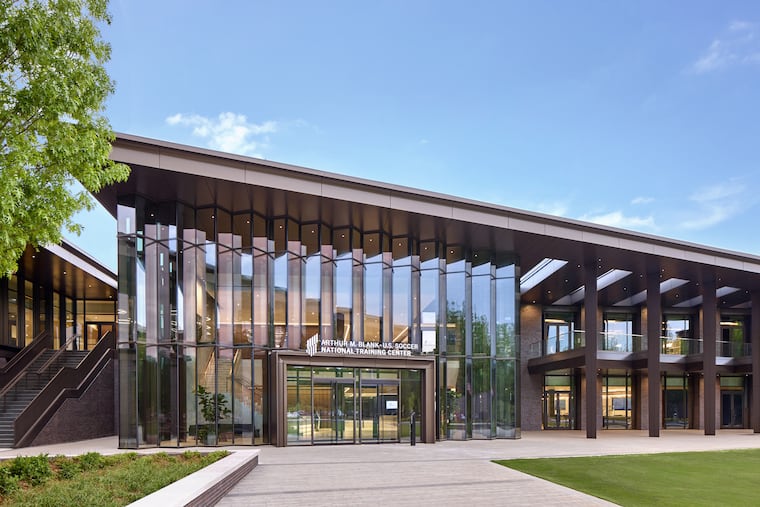
U.S. Soccer CEO JT Batson has many ways to describe the new national training center that opened this month near Atlanta.
To an average fan, those ways might not stand out. With so many great soccer facilities around the country, the merits of a national center has been debated for years, sometimes positively and sometimes not.
But at one point, as Batson earlier this year led a tour of the new complex in Fayetteville, about 25 miles south of Atlanta, he cited someone who always stands out.
“Hearing Mia Hamm talk about [how] she wants young players, when they’re here, to feel the history of U.S. Soccer, and feel the history of soccer in America,” he said.
“That was very powerful, and very much fed into the design of the facility,” Batson said. “Players talked about, our alumni talked a lot about, this feeling like an American soccer home — and that as you walk around, you should really feel like you’re a part of that.”
On that count and many more, the national training center is a clear success. It really does feel like both a top-class training facility and a home for the sport’s governing body in this country.
“And now that we’re going to have our own home — and it’s not just for the [senior] men’s and women’s national teams, it’s for all 27 of our teams and everyone who cares about soccer in this country — having a place where we can come together, where we can aspire for greatness, where we can build community and relationships, and where we all can dream about what’s possible for soccer in this country, it will have incredible impact,” Batson said.
» READ MORE: The USMNT, USWNT, and your kid’s youth team are all different. U.S. Soccer is fine with that.
Big numbers and small details
There are many big numbers that stand out about the place: the $228 million it cost, the 200 acres it spans, the 80 acres that are still undeveloped. But the most important number from a soccer standpoint might be 19 — the number of playing surfaces across the facility.
Three are the showcase fields for the senior national team — fit within a space that allows them to be configured not just sideline to sideline, but end line to end line.
Cross those fields from the training center building, and you’ll find a hill to look down. Past some of the 1,200 trees planted around the property, there are two turf fields, then eight grass training fields for youth national teams.
That order is intentional. Former U.S. Soccer sporting director Matt Crocker, who had a big role in the design, wanted young prospects to be able to look up the hill and dream of being on those fields some day. But he also didn’t want them entirely separated from the stars.
» READ MORE: U.S. Soccer needs your kid’s youth club to help its national teams. Will it happen?
“We want our under-15s to be bumping into Mauricio [Pochettino] and our senior men, or Emma [Hayes] and our senior women,” he said in an interview before he abruptly left the job last month to join Saudi Arabia’s federation.
There are also two grass show fields that can host fans for tournaments held on the property.
Go back inside the building, cross the lobby, and you’ll come to a fullsize indoor field with FIFA-standard FieldTurf. That’s the 18th playing surface.
The 19th is a hardwood court that doubles as a venue for two forms of the game: futsal, the world’s version of indoor soccer, and power soccer for wheelchair users. It can also be used as a ballroom, and no doubt will be.
» READ MORE: The U.S. has the most extended national teams of any soccer federation in the world
Just as impressive is what lies past a door off an end line: dedicated locker rooms for the power soccer national teams, including charging spaces for players’ motorized chairs. Those are among 20 locker rooms of various kinds across the complex.
A 10,000-square-foot workout space sponsored by Nike (a longtime U.S. Soccer partner) opens to the showcase grass fields where the senior national teams will train when they’re in town. Two locker rooms for the senior teams are a short walk away.
Notably, there is not a locker room for the men’s team and one for the women’s team. Instead, there’s a main one that each will use when in town, with a second identical one available for rare times when both are on campus.
Inspiration from around the world
“We spent a lot of time thinking specifically about the journey of the player from when they pull up first thing in the morning to when they leave the facility,” Crocker said.
“How do we make sure that everything that they need in those touch points becomes informal, and a part of the way they flow through the building. … We spent a lot of time thinking about those things, as opposed to how do we make things look good for a photo,” Crocker said.
» READ MORE: Meet Huntingdon Valley-bred Erica Dambach, who built Penn State’s pipeline to the USWNT
The national training center will be the biggest part of Crocker’s legacy at U.S. Soccer. It isn’t a coincidence that when he started one of his previous jobs at England’s Football Association, it had just opened its national training center, St. George’s Park.
“Sometimes you would look at that facility and — I say this respectfully because it’s been an unbelievable job — there was a lot of things that were missing,” he said. “There wasn’t enough locker rooms. The location of the accommodation to where the teams train on a day-to-day basis. The flow of those things weren’t necessarily the things that I think if they reflected now, they would have done then.”
With that in mind, Crocker visited facilities that would go on to inspire U.S. Soccer’s: not just St. George’s Park, but France’s renowned Clarefontaine facility, and various clubs.
“You get inspirational moments of things that you definitely need to do, but also having conversations with those other facilities gives you an opportunity for learning,” he said. “The biggest question you ask them is: What would you do differently next time?”
» READ MORE: What’s the secret sauce at the Union’s youth academy? Here’s a taste of it.
Batson said Crocker “played a very important role in helping us really understand the potential for a facility like this, and how to be thoughtful around bringing it to life, given the experience he had with the FA and St. George’s Park.”
One big difference between this facility and others, especially France’s and England’s, is that it’s both the national training center and the governing body’s headquarters. Here, the second floor is almost all office space, with room for 600 employees.
One of the federation’s former homes in Chicago, a pair of adjacent mansions near Soldier Field, could fit in a quarter of the new space.
Though the southern location was picked to help the odds of year-round play, no one is immune to Mother Nature. So the fields were built atop 10 inches of sand and four inches of rock, with a drainage system that can withstand 28 inches of rain per hour.
The pipes that supply water include a 16-inch main, enough to irrigate every grass field in the place at the same time.
» READ MORE: World Cup turf experts say the grass is greener in Philadelphia, specifically at the Linc
And though Crocker had good reason to care more about substance than looks, the looks have their share of theater. The entrance includes a fancy-looking iron gate, designed to seed a feeling of importance from the moment one arrives.
Tom Norton, the national training center’s general manager, acknowledged that it’s inspired by another Georgia sports institution: the entrance to the Augusta National Golf Club, home to the Masters. It’s fair to say this place wants to be a lot more open than that one.
Why Atlanta specifically?
There are many reasons why U.S. Soccer picked this location over other candidates.
One was weather, for sure: southern warmth for year-round outdoor use, but not the extremes of Texas and Florida. Another was available land that wasn’t too expensive.
» READ MORE: Meet Huntingdon Valley-bred Erica Dambach, who built Penn State’s pipeline to the USWNT
From there, U.S. Soccer’s college sports-style fundraising helped pay the bill, led by a $50 million donation from Arthur Blank, who owns the MLS Atlanta United and NFL Atlanta Falcons.
Major corporate sponsors included Coca-Cola (famously Atlanta-based), Home Depot (which Blank founded), and the Trillith movie studio a few miles south of the training center — reputed to be the largest movie studio facility outside Hollywood in the United States.
Trillith’s founder, Dan Cathy, is also the CEO of Chick-fil-A, which his father founded. The Cathy family owned the land where the national training center was built and donated it to U.S. Soccer.
All those factors helped get the facility built pretty quickly. After years of being envisioned, the groundbreaking was in April 2024, meaning the facility was built in around two years.
» READ MORE: Why Matt Crocker surprisingly left U.S. Soccer two months before the World Cup
A different set of connections offered another reason to pick Atlanta: the ones found at Hartsfield-Jackson International Airport, around a 20-minute drive away. The airport is a huge global hub, with flights to cities across the United States and Europe where Americans play.
It also doesn’t hurt that the big city’s cultural attractions aren’t too far. Though many U.S. Soccer staff chose to leave the organization when it moved from Chicago, the Atlanta region is still a desirable place for plenty of people (including Batson, who was born in Augusta).
Among the questions that aren’t answered yet, one with a pragmatic impact is how the national training center will affect the senior national teams’ travels during standard FIFA windows. They’ll obviously use the national training center to lead up to tournaments, but the average window is only a few days.
Will it be worth a short stop in Atlanta before going to a friendly somewhere else in the country? And will it be worth giving up the publicity generated by spending a few days in another city, such as when both senior teams trained in Chester last fall?
» READ MORE: Where's the money from your exorbitant World Cup tickets going? To FIFA's $14 billion in revenue.
The answer will probably be up to Crocker’s successor, and the national team coaches. But Batson had an opinion that’s worth filing away.
“In a world where we didn’t have a national training center, we had to get good at being a great guest in lots of other people’s homes,” he said. “I would expect that certainly, any FIFA window when the team is playing anywhere that is not terribly far from Atlanta, that they would train at the national training center. … Eighty percent of America is reachable in under two hours from the Atlanta airport, so it’s a large swath of the country.”

Nine nations will compete in five group stage matches this summer, plus two more in a knockout game on July 4. Here’s what you need to know about those countries — and what those fans need to know about Philly. Click here for more.