Where's the money from your exorbitant World Cup tickets going? To FIFA's $14 billion in revenue.
Anger over high prices isn’t just a "rest of the world" thing. With a women's World Cup and perhaps another men's World Cup on the horizon, how long will it take for scars left this summer to heal?
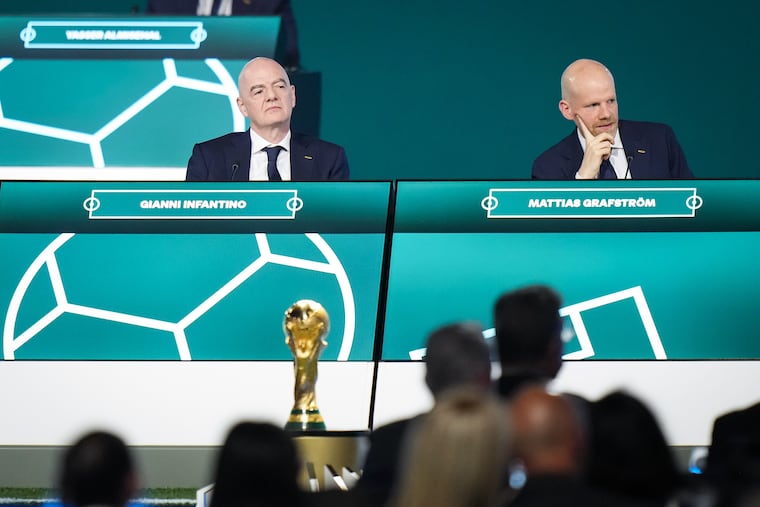
VANCOUVER, British Columbia — If you’re new to soccer, or at least to the circus of a World Cup, you should know that FIFA officials don’t talk to the media often.
For some time now, President Gianni Infantino has only scarcely taken questions from anyone he hasn’t chosen in advance. (His visit to Philadelphia last year was a rare exception, when he needed to hype up the Club World Cup because ticket sales were slow.)
Infantino avoided the press again at the FIFA Congress. So much so, in fact, that on the day before the big show, when a reporter approached him in a hallway at Vancouver’s convention center, FIFA PR staff blocked the reporter from an escalator as the group neared it.
Secretary-general Mattias Grafström did meet the press after the Congress, but was tight-lipped on the day’s biggest subject. Twice asked point-blank if Infantino’s failed attempt to get Israeli and Palestinian representatives together for a photo was planned in advance, Grafström did not give a direct answer.
He was more expansive on a subject that FIFA is happier to talk about: how much money it will make from the biggest World Cup in history.
The first opening came from a question about the tournament’s exorbitant ticket prices. Is it fair for fans to complain?
“Well, I think I will always have understanding for fans and their opinions,” Grafström said. “But I think there are quite a wide array of ticket prices, and some are cheap, some are more expensive, and it’s also the reality of the market in North America.”
Never mind how few “cheap” — as in, the lowest price was $60 — tickets there actually were on sale. Or that the actual “reality” is FIFA inviting itself to do what some commercial entities in the U.S. do with dynamic pricing, but certainly not all.
» READ MORE: FIFA has offered another chance to snag World Cup tickets at face value. It probably won’t be the last.
That’s why Infantino said at a conference of big-money investors in Beverly Hills this week that “you cannot go to watch in the U.S. a college game, not even speaking about a top professional game of a certain level, for less than $300.”
It was patently untrue, not that anyone would have told him. Plenty of sports teams in this country have fixed ticket prices and don’t gouge their fans. Look no further than the college football team that plays in Philadelphia’s World Cup stadium, Temple: its tickets are just over $30 for most games, even on the secondary market.
By the same token, the public anger over World Cup prices isn’t just a “rest of the world” thing. No, there’s plenty of anger here in the United States, and there has been all along.
Following the money
But it didn’t take long for Grafström to get to the real truth. It came in his very next answer, when he was asked if he worries that the prices could tarnish the tournament’s legacy.
» READ MORE: FIFA's president tried to get Israel and Palestine soccer officials to shake hands. He failed badly.
“Well, I think the legacy is also what we will be able to do with the money that is generated from this World Cup in 211 countries,” he said. “This is a true legacy through the Forward program, in order to really develop the game of football in our member associations, and this will have a true impact.”
That was a reference to the development fund FIFA uses to give grants to its “member associations,” as the governing body calls national soccer federations from around the world.
It also was an indirect reference to the thing Infantino cherishes more than anything. This summer’s World Cup will put so much cash in FIFA’s coffers that the governing body will close the quadrennial cycle from 2023-26 with a record $14 billion in revenue.
That’s where your money is going.
» READ MORE: How Philadelphia's World Cup setup became the envy of fans in New York, Boston, and beyond
“And what is important,” Infantino told the Congress, “is that all the revenues that we generate from the World Cup go back to you, go back to the entire world, and finance football in all of your countries.”
Well, not quite the entire world, as the hundreds of thousands of fans who will pay $150 to ride NJ Transit to the Meadowlands this summer can attest. But certainly to the part of the world that likes to eat at the trough FIFA provides.
If that wasn’t enough, the next thing Infantino said was even less subtle.
“You know it better than me,” Infantino said. “In a big majority of our countries, we could not have organized football the way we know it without the grants and the revenues and the Forward program.”
So those in the room surely were over the moon when Infantino announced that payouts from the Forward program will rise to $2.7 billion worldwide over the next four years.
» READ MORE: FIFA president Gianni Infantino insists Iran will play in this summer’s World Cup, and in the U.S.
It was a straight line from there to the standing ovation that greeted his announcement at the end of the Congress that he’s running for reelection again. The Times of London reported on Friday that even before Infantino said it, he’d secured the unanimous backing of all 111 combined nations from the African, Asian, and South American confederations.
That’s a majority right out of the gate. So even if someone else runs — and that isn’t expected — there’s almost no way for anyone else to prevail when the vote comes at next year’s Congress in Morocco.
There is some uncertainty in one area, though: Whether the buildup to this World Cup has scarred FIFA’s reputation in the world’s largest commercial market. That would matter at any time, but especially with the U.S. on track to host the 2031 women’s World Cup and potentially the 2038 men’s World Cup.
Talking about 2038 already?
Yes, the wheels already are turning for the second of those, even though FIFA isn’t close to awarding the hosting rights.
» READ MORE: The World Cup has always been political, but it feels even more so now
The governing body’s rules say that when a World Cup is played on a given continent, that confederation can’t host again until three World Cups later. The 2030 tournament will be spread across Europe (Spain and Portugal), Africa (Morocco), and South America (one game each in Argentina, Paraguay, and Uruguay); and the 2034 tournament will be in Asia (Saudi Arabia).
Unless the rotation rule is changed in the coming years, that will leave only North America and Oceania as eligible. There already was talk last year of New Zealand and Fiji joining with the United States, potentially with a stop in Hawaii along the way. (Australia can’t be involved because, in soccer terms, it’s part of Asia.)
This raises a question that will matter to a lot of people, from Philadelphia to U.S. Soccer’s headquarters in suburban Atlanta to FIFA’s home in Zurich.
There are any number of reasons to think things could be different five or 12 years from now, from politics to FIFA’s willingness to agree to what’s in a bid book. For example, the 2026 bid book proposed far lower ticket prices than what FIFA unilaterally chose; and the 2031 bid book has prices as low as $35 for group games.
“We aim to ensure that all types of stakeholders have access to the tournament experience through tailored ticketing strategies designed to maximize value across both the group and knockout stages,” read the book, which was published last November.
» READ MORE: The USWNT will visit next year’s World Cup host Brazil for two games in June
When Grafström was asked whether FIFA will give some ground for 2031, he didn’t seem to want to talk about it.
“We, first of all, have a bid process for the Women’s World Cup 2031, which is ongoing,” he said at first. But that was something of a cop-out, because FIFA confirmed in November that there’s only one bid for the tournament: the U.S.’ joint effort with Costa Rica, Jamaica, and Mexico.
In fact, the hosts of the 2031 and 2035 tournaments were meant to be confirmed at this Congress, with the United Kingdom the only bidder for the latter. But in March, FIFA chose to postpone that, claiming it wanted to give that moment its own stage.
Behind the scenes
It didn’t take long for more context about that to be revealed. The Athletic reported in early April that the Trump administration is holding back on signing required government guarantees, as it wants FIFA to ban transgender people from women’s soccer.
» READ MORE: A friend of the U.S. navigates the collision of sports and politics leading up to the World Cup
FIFA did at least confirm that the extra Congress required to confirm the two bids will be an online forum on Nov. 23.
That date happens to be the start of that month’s women’s FIFA window. Four days later, the U.S. will take the field in Concacaf’s W Championship tournament, the event that serves as qualifying for the 2027 World Cup and 2028 Olympics. (The U.S. already is set for 2028 as host.)
So, back to Grafström’s answer on giving ground or not.
“I think we will have plenty of time to assess,” he said. “First of all, our focus will be on 2026, [to] make it a big success. But I’m sure that there will be opportunities to have tournaments in North America. We see the passion for the game here, and we’ll make sure that tournaments which will come to North America will be a success.”
» READ MORE: With the World Cup headed to Philly, Safe-Hub has plans to bring the excitement to Kensington
That was it for that.
Unfortunately, no one from U.S. Soccer was around to take questions, as the delegation left the Congress early for a scheduled flight to Dallas for the National Soccer Hall of Fame’s induction’s ceremonies. Nor did Concacaf president and FIFA vice president Victor Montagliani choose to meet with the media in his home city.
But you still could deduce the main point of Grafström’s remarks, even if he only stuck around for five minutes.
At one point, he said of fans angry with FIFA: “Of course we listen, and we take into account the comments. And of course, as for every World Cup, we will review and see how we do it for the next one.”
Whether you’re new to soccer or not, you’re forgiven if you’re skeptical.

Nine nations will compete in five group stage matches this summer, plus two more in a knockout game on July 4. Here’s what you need to know about those countries — and what those fans need to know about Philly. Click here for more.