The designers who restored Aronimink and other greats are Philly guys obsessed with golf — and the Birds
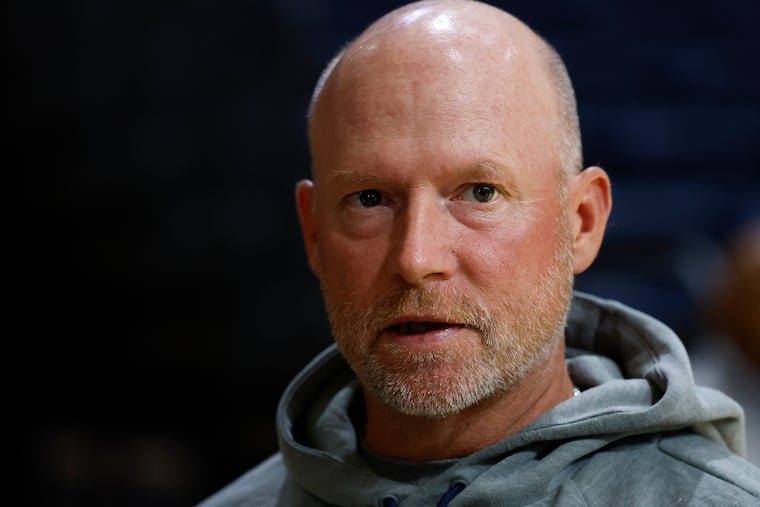
Gil Hanse and Jim Wagner, whose firm redesigned Aronimink, may not be as big as the Eagles in Philly, but they are in the local golfing world.

When Gil Hanse went to Aronimink Golf Club to do a social media video ahead of this week’s PGA Championship, the hat he wore wasn’t from the venerable golf course he restored or any of the many other esteemed courses he either renovated or designed.
It was a kelly green cap with an Eagles logo.
Before Hanse left his Newtown Square home for the five-minute drive to nearby Aronimink, he said, “Go Birds,” to his 6-year-old granddaughter, Peyton.
“And she was like, ‘Are they playing today, Pops?’” Hanse said. “And I said, ‘No, no, we got about four more months until we get to watch the Eagles again.’ And she’s like, ‘Are we gonna have popcorn?’
“It’s become a tradition: Sunday afternoons, popcorn, and watching the Birds.”
Jim Wagner, a “700-level guy” from his days as a Veterans Stadium season-ticket holder, asked the first question when a reporter recently called to interview him. Wagner, Hanse’s design partner, wanted to know about a certain soon-to-be-traded Eagles wide receiver.
“What’s happening with A.J. Brown?” Wagner said. “What are we gonna get in return?”
Hanse and Wagner are more than just diehard Eagles fans; they’re Philly guys. They also happen to be nationally renowned golf architects.
They may not be as recognizable as Rory McIlroy, Scottie Scheffler, or any of the other professional golfers playing at Aronimink. But Hanse, a Long Island transplant, and Wagner, a Delco native, are celebrities in their own right.
» READ MORE: Rory McIlroy lauds Philly as ‘a wonderful golfing city’
Their names will be mentioned occasionally during the PGA telecast during the tournament, not only for the renovation they did at the 98-year-old course on the northwest edge of Delaware County, but also for their work at the as-exclusive Merion Golf Club and other local spots over the last three decades.
Philly golf has been in the spotlight of late. Last year, the Truist Championship came to Philadelphia Cricket Club in Flourtown. This year, it’s the PGA and the U.S. Amateur, which Merion and Philadelphia Country Club will host in August.
And in 2030, the U.S. Open will return to Merion for the first time in 17 years to celebrate the 100-year anniversary of Bobby Jones completing the Grand Slam at the historic Main Line track.
“I make the argument, and I believe it wholeheartedly. I’m not just being a homer,” Hanse said. “Pound for pound, Philadelphia is the best golfing city in the country.”
» READ MORE: Philly’s Rodman Wanamaker started the PGA and provided ‘the voice of Philadelphia’
Soon enough, the completion of the Cobbs Creek project will give Philly its own first-rate golf establishment within city limits. And unlike Aronimink, Merion, and many of the elite courses in the area, it has been and will continue to be open to the public.
Hanse and Wagner have been involved since the onset. Wagner, who played Cobbs Creek growing up, has spearheaded their revamping of the old course into a championship-level 18 holes, with Hanse also designing a shorter nine-holer.
“It’s 100-plus years later, but the theory and the concept is still consistent,” Wagner said. “Philadelphia deserves and should have a great public golf course.”
Hugh Wilson designed Cobbs Creek and both the East and West courses at Merion. They’re located only six miles apart — figuratively more in their ethos. But they were bound together not only by Wilson, but by the “Philadelphia School” of golf architects for which he was a part.
» READ MORE: Donald Ross’ ‘masterpiece’ at Aronimink will again challenge the best at the PGA
A.W. Tillinghast, George Thomas, William Flynn, George Crump, and Wilson designed many of the great courses in the area, but also throughout the country. Each had his own distinctive style, but they also had similar sensibilities and often assisted each other in their undertakings.
Hanse and Wagner became obvious disciples, having renovated some of their courses here and elsewhere. But the Philadelphia School also influenced the original creations since Hanse’s Malvern-based business started in 1993.
He isn’t shy about paying homage.
“So much came out of this area that has been transported and transplanted around the country in the golf landscape, but the contributions that they made are under-reported,” Hanse said. “People don’t talk that much about it.
“I think one of the greatest honors that I can have … is that when people draw a line — it’s a long line chronologically — they say that we were good heirs and custodians of that tradition.”
Earn your stripes
Hanse didn’t necessarily arrive here looking to become a steward for Philly golf, nor did he expect to stay long. He was an assistant under Tom Doak when the elder architect and fellow product of Cornell’s landscape architecture school was chosen to design Stonewall in Elverson, Chester County, almost 40 years ago.
» READ MORE: Brotherly Love in Philadelphia: The fairytale story of Matt and Alex Fitzpatrick at the PGA Championship
Hanse and his wife, Tracey, initially rented a townhouse in Exton and grew to appreciate the people and the area. He also saw more opportunities in the steeped-in-history Philly than he did in Denver, where he was previously based.
“I came to quickly realize that when you’re a young golf architect, no one is going to entrust you with building a new golf course, right?” Hanse said. “You got to earn your stripes. And so, the avenue into establishing your name was through restoration and renovation.”
“Pound for pound, Philadelphia is the best golfing city in the country.”
Wagner didn’t travel as far. He was all-Catholic League golfer at Cardinal O’Hara, but his family, in Broomall, didn’t belong to a club. He was a “fence member” and found his way onto private courses by sneaking in during off hours or tagging along with friends on caddie days.
His route to golf construction and design started the way many success stories do: from the ground up.
“My babysitting was my parents opened up the front door and if we wanted anything in life, we had to work in order to get it,” Wagner said. “So at a very early age — 10 years old or something — I started cutting lawns along with my brother.
“That ended up turning into kind of a landscape company, per se, and that turned into kind of a landscape-design build company.”
Golf remained a passion, though, and he found a way into course maintenance when he hooked up with former Augusta National superintendent Paul Latshaw at Wilmington Country Club. Latshaw was a mentor, but Wagner wanted a more creative outlet.
He met Hanse through a mutual acquaintance and their first project together was at Waynesborough Country Club in Paoli. Nearly 31 years later, Hanse Design has renovated and restored more than 58 courses and designed 30 originals in 20 states and nine countries outside the United States, including for the 2016 Olympics in Rio de Janiero.
Nineteen of the renovations, including Merion (No. 6) and Aronimink (No. 100), are among Golf Digest’s latest ranking of the top 100 courses in the nation. Three of their own, including Ohoopee Match Club in Cobbtown, Ga., (No. 36) are also on the list.
Hanse and Wagner have touched some of the most venerated courses across the country. From East Coast stalwarts like Oakmont and Winged Foot and middle America gems like Oakland Hills and Southern Hills to West Coast pillars like Los Angeles Country Club and Olympic Club, it’s a who’s who of architects they’ve restored.
And many of them, like Winged Foot (Tillinghast) and Los Angeles (Thomas), were from the Philadelphia School. But Hanse and Wagner hold a special place for local crowning achievements Merion and perennial No. 1 Pine Valley, which was conceived and built by Crump 20 miles outside Philly in the sandy terrain of South Jersey.
“If you look at the two golf courses that have probably had the greatest influence on us both, from a design standpoint, it would be Merion, and then from an aesthetic standpoint it would be Pine Valley,” Hanse said.
Inniscrone Golf Club, a public course in Avondale, was their first local original design. Private clubs Applebrook in Malvern and French Creek in Elverson followed and now stand next to the Philly classics beyond the Big 2 they were also modeled after.
“When we were asked to design Applebrook, it was like we want something that feels like it belongs in Philadelphia,” Hanse said. “We can throw a stone and go to Philly Country Club or Huntington Valley or Rolling Green or Gulph Mills.
“We didn’t even have to go to Merion or Pine Valley just to be inspired.”
Wagner concedes that a lot of his inspiration comes from elite clubs. But he said he wants to build playable courses. When he’s riffing off Merion, it isn’t always the famed East he’s borrowing from. And when he’s looking to other courses, they aren’t always private.
“You can’t smoke enough pot to be that creative. You’ve got to draw on this inspiration somewhere,” Wagner said. “And in my mind, I’m drawing on Merion West. I’m drawing on Paxon Hollow [a public course in Media].
“People laugh. Paxon Hollow is probably the toughest second-shot golf course in the country, or at least was when I was a kid.”
Good land forms
But Philly golf goes beyond course architecture and traditions. It’s in the region’s geology.
“Somebody asked me to describe the Philadelphia golf landscape, and I think it’s just ridges and valleys,” Hanse said. “We’ve been blessed with really good land forms for golf here, but we haven’t been blessed with great soil.”
» READ MORE: PGA Championship storylines: The weather’s impact; Justin Rose returns; the elusiveness of Rory vs. Scottie
And like the Philadelphia School and other designers during the Golden Age of golf architecture, Hanse and Wagner are naturalists. Whether it’s with an original or restoration, nothing is decided until they’re on site and in the dirt.
“We’re very limited on paper,” Wagner said. “It’s just enough to get us through permitting. All the real essence of the golf course and how it’s played and the contours of the greens and the bunkers and how they appear in that third dimension in the landscape, that’s all done in our heads in real time.”
Aronimink was a Donald Ross design. Ross, born in Scotland and arguably the most influential golf architect in American history, wasn’t a member of the Philadelphia School. But several from his 400-course portfolio — Gulph Mills in King of Prussia and LuLu in Glenside among them — were built here.
It was Aronimink that Ross would say, 22 years after its completion, that he built better than the masterpiece he intended. Oakland Hills, Oak Hill, Pinehurst No. 2, and Seminole — the select South Florida course Hanse and Wagner are currently renovating — typically rate higher.
But Aronimink has stood the test of time, partly because Hanse and Wagner turned back the clock when they started work in 2016. As they have done with similar restoration projects in this area, they sought out aerial photos taken by golf enthusiast Victor Dallin in the 1920s and 30s to see the course in its infancy.
And what they found were bunkers more in scattershot formations than the large, conventional ones that Ross preferred and were in the original blueprints. Some historians believe the traps ended up that way because of trusted assistant J.B. McGovern’s taste for clustered hazards.
But as Hanse and Wagner know as well as anyone, the naturalistic Ross may have been simply catering the shallower bunkers to the topography to help with drainage. Either way, it’s another lesson that what’s planned isn’t often executed.
“We apply it to ourselves in the hope that in 50 years if somebody is restoring one of our golf courses,” Hanse said, “they might go, ‘Well this time this is what they drew, but this is what they built.’”
» READ MORE: Aronimink’s prestigious history gets the national spotlight at the PGA
Hanse and Wagner did more than add 100 bunkers to the existing 70. They repositioned some off the fairways to test present-day bombers from the tee. They continued the practice of tree removal. And they expanded Ross’s undulating greens to increase the number of challenging hole positions.
The weather forecast called for some rain ahead of Thursday’s first round, but dry and increasing temperatures should have Aronimink as desired by Sunday.
“As long as the weather holds, it should be a really good test,” Scheffler said on Tuesday. “I think when Gil redid this place, I’m sure he imagined it playing firm and fast.”
Scheffler, to some surprise, said he had never been to Philly, let alone played one its courses. The world’s No. 1-ranked player has previously expressed his distaste for the trendy removal of trees. But aside from improving sightlines and turf conditions, the main purpose has always been to restore classics to their original design strategies.
For Hanse and Wagner, their work has been a team effort. They have a comparably small crew, but nearly everyone contributes. As with Ross and McGovern, or the Philadelphia School, most notably with Merion and Pine Valley, the end result is often the work of more than one visionary.
“The important part of what the Philadelphia School did, in the way I look at, is they built a team,” Wagner said. “It’s really what it was. Wilson knew enough to bring in really good guys to work with him.
“The original philosophy of Hanse Golf Course Design is we work as a team.”
Heart and soul
It has taken a team much larger than the Eagles to get Cobbs Creek off the ground and near completion. Tiger Woods’ TGR learning lab began serving local youths a year ago. A two-story driving range and restaurant arrived in December. And a nine-hole short course recently opened.
The 18-hole course is scheduled to be finished by next year, followed by the nine hole course in 2028, but controlling the flooding from the creek that flows into the city and preserving the environment has caused predictable delays.
“We may make 2030,” Wagner said when asked about a more realistic timeline.
Hanse and Wagner also made significant earth-moving changes to a course that had become unrecognizable to the original 1916 version by the time it was closed in 2019.
“We’re going off script a little bit,” Hanse said, “just because [it’s] such a funky golf course, and it was very early in Wilson’s career, even though he assembled Crump and all the titans of architecture, telling Thomas to come over and help him lay it out.”
The plan is to stretch the layout to 7,000 yards and incorporate several holes from the former nine-hole Karakung course in the hopes of attracting a PGA Tour event. But mostly Cobbs Creek, which became one of the first public courses in the nation to welcome all races, is being resurrected for the community.
Hanse said he already saw the impact when he randomly spoke to students from the TGR learning lab at a PGA merchandise tent the other day. They asked him how he renovated the course and what it took to get into landscape architecture.
“In those really small moments, maybe there’s something for one or two kids, and that could make all the difference,” Hanse said. “Golf is perceived in a lot of ways, and maybe correctly so [as] being for the elite. But at the heart and soul of the game, there’s goodness and there’s quality, and there’s respect and tradition.
“And if we can use golf as a vehicle to help people who wouldn’t normally have that opportunity … that’s a great thing.”
Hanse and Wagner were part of a similarly inclusive project at Park West Palm in Florida. Eagles owner Jeffrey Lurie, who lives nearby, donated $1 million to the cause, Hanse said.
The Cobbs Creek Foundation has raised almost 75% of the estimated $180 million needed to finish the West Philly campus. Wagner said he isn’t looking for the Eagles and other local professional teams to donate money so much as he wants them to help spread the word.
“We’re hoping at some point in time they’ll jump in with a little bit more of a vested interest,” he said.
Hanse and Wagner may not be as big as the Eagles in Philly, but they are in the local golfing world. And the PGA Championship has helped shine a light not only on their contributions to course architecture, but on Philly golf.
On Wednesday, Hanse was at Aronimink for media appearances and to address the grounds crew one last time before the event began. He must travel to Florida to Seminole for the weekend.
Wagner, who left for North Palm Beach about 15 years ago, is already there and said he had no plans to head north for the PGA.
“I guess it’s like being the Eagles. You’re graded on how well you played your last game,” Wagner said. “And in our case, we’re graded on our most recent projects.”
The early marks on Aronimink suggest they’ve scored a touchdown.

The 108th PGA Championship returns to Aronimink Golf Club in Newtown Square for the first time in over six decades.
You can watch Marcus Hayes and Jeff Neiburg preview the tournament on Gameday Central from Aronimink, and be sure to check out the PGA Championship Range Show from 12-2 p.m daily, starting Wednesday.
Whether you're going, watching from home, or just curious about what all the fuss is about, we've got you covered with our PGA guide and stories on everything from Aronimink's history and design, to what the players have to say about returning to the Philly area. We even made a golf video game so you can play the course and learn its secrets.
Get it all with our full PGA Championship preview. And follow the latest news and action from the course, right here.