Phillies’ bullpen desperation sets up a perilous trade deadline
How desperate are the Phillies? How desperate should they be?
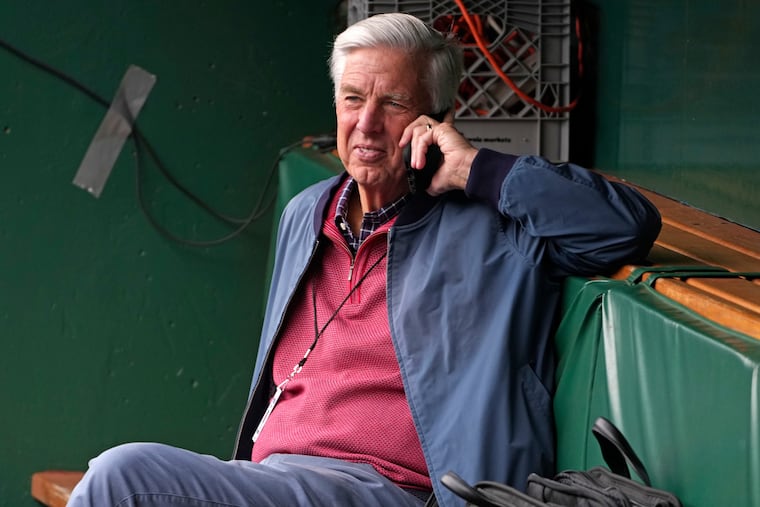
Few things are more toxic than a bullpen that has no good answers.
The Phillies are treading perilously close to that boundary line.
Can they actually fix it?
They can try, sure. They have no choice. With two weeks remaining before Major League Baseball’s trade deadline, the Phillies have exactly one reliever whom Don Mattingly would feel comfortable calling upon in a critical postseason moment. They have one who seems to be earning more of his trust but who would profile more as a dependable middle reliever in a legitimate championship bullpen. After Jonathan Bowlan, they have a couple of arms who are basically a coin flip. After Orion Kerkering and Jose Alvarado, Mattingly can do little more but pray for the best while expecting the worst.
» READ MORE: Phillies look ahead to Dodgers after No. 5 starter Alan Rangel struggles in series loss to Mets
Dave Dombrowski was up against it even before he learned that high-priced free agent set-up man Brad Keller would miss the rest of this season and likely the next one with a UCL tear. Keller’s signing is ironic in the sense that the Phillies will be paying him the same money they would have been paying to Jeff Hoffman had they not allowed the righty to leave for Toronto, in part out of fear of the health of his arm. Further irony: Hoffman is one of the names that has been tossed around for teams in need of bullpen health, with the Blue Jays currently out of contention.
The most important thing to know about the trade deadline is that it isn’t as important as everyone would like to believe. Rare is the team that manages to fundamentally alter its outlook or identity midseason. In the best of cases, it is like the magic mushroom in a game of Mario Kart: a decisive boost deployed at exactly the right time while also eminently finite. The Phillies saw the best of cases back in 2009 with the acquisition of Cliff Lee. The next year brought Roy Oswalt, the year after that, Hunter Pence. They have yet to recapture the glory of 2008.
The question is not binary, in other words. It is not, “Go for broke or stand pat?” The midseason trade market is, first and foremost, a market. All you can do is take what it gives you.
From a decision-making perspective, the second-most important thing at the trade deadline is to stick to your principles. The first-most important thing is to figure out what those principles are.
The biggest question right now:
How confident are the Phillies that they will make the playoffs with the current roster?
A better way to put it: How sure are the Phillies that the Marlins, Nationals, Cardinals, Pirates, and/or Diamondbacks will ultimately fade?
Sounds crazy to ask, given that the Phillies have been one of the best teams in baseball since the beginning of May. But these are strange times in the National League. Nine teams are at 50+ wins. Two more are within two games of .500. The Phillies may only be two games behind Atlanta, but the Braves are playing on a different tier. Consider them booked for the postseason, along with the Dodgers and Brewers. The Cubs and the Phillies are alone in the next tier at 10+ games above .500. Problem is, that next tier is closer and more populous than usual. The Marlins, Cardinals, Pirates, and Diamondbacks all entered Sunday within four games in the loss column. That’s nine teams for seven postseason spots. A sudden losing streak could dramatically change the Phillies’ outlook.
The bullpen would be an issue even if the circumstances were different. But the Phillies could at least be planning for the postseason. As things stand right now, Dombrowski first must decide if he has enough pitching to get him to October.
Something else to ponder: If Gage Wood and Andrew Painter aren’t immediate solutions, are they potential trade chips?
It is a double-edged question. The first edge: Are the Phillies willing to trade their two high-level pitching prospects for short-term help? The second edge: How do other teams value them?
Painter is pretty clearly a lost cause for 2026. His most recent start at triple-A Lehigh Valley: seven runs, one strikeout, four walks, 2 ⅔ innings. In the two starts prior, he allowed just two runs in 10 innings while striking out 10 on three walks. All three outings came on five-plus days rest.
Wood? We’ll see. The numbers look about as good as the Phillies could have hoped when they selected him at No. 26 overall last June. He has 39 strikeouts and nine walks in 28 ⅔ innings since being promoted to double-A Reading. He has also allowed six home runs. The fastball is crispy, but not to the extent that he can get away without locating it in the strike zone. Hard to believe that Dombrowski or anybody else is thinking of him as a potential answer in high-leverage situations.
Speaking of leverage ...
It isn’t in Dombrowski’s favor right now. The idea of buyers and sellers is a false choice. There is a price for everything. The more plausible a team’s denial of having to sell, the higher the price they can sell for. The more teams that could potentially buy at the right price, the higher the price for everyone.
The Phillies enter the trade deadline with a farm system that Baseball America ranked as the 29th best in baseball. Their one no-doubt-about-it, blue-chip prospect has yet to take the field this season. Painter has gone from untouchable to would-anybody-touch-him. Once upon a time, the Phillies traded Spencer Howard for Kyle Gibson and Ian Kennedy.
Are we there yet?
Rather than buyers and sellers, the trade deadline’s real hierarchy is an order of desperation.
How desperate are the Phillies? How desperate should they be?
These are usually losing questions.

Tim Mayza was among the best, most under-the-radar Phillies stories this year. And he's coming back for more after signing a new contract last week. The Lancaster County native joined Phillies Extra, The Inquirer's baseball podcast, to discuss his solid season, building a culture in the bullpen, the origin of his "Sheriff" nickname, and more. Watch here.
You can also subscribe to the podcast version of Phillies Extra on Spotify or Apple Podcasts.
Previous episodes: Aidan Miller | Scott Franzke | Larry Andersen | Matt Klentak | Jeff Francoeur | Luke Murton | Mike Hazen | Tony Gwynn Jr. | Kevin Stocker | Bobby Dickerson