What happened before and after the fatal South Jersey helicopter crash, according to the NTSB
The cause of the crash remains undetermined, but investigators are piecing together a timeline.
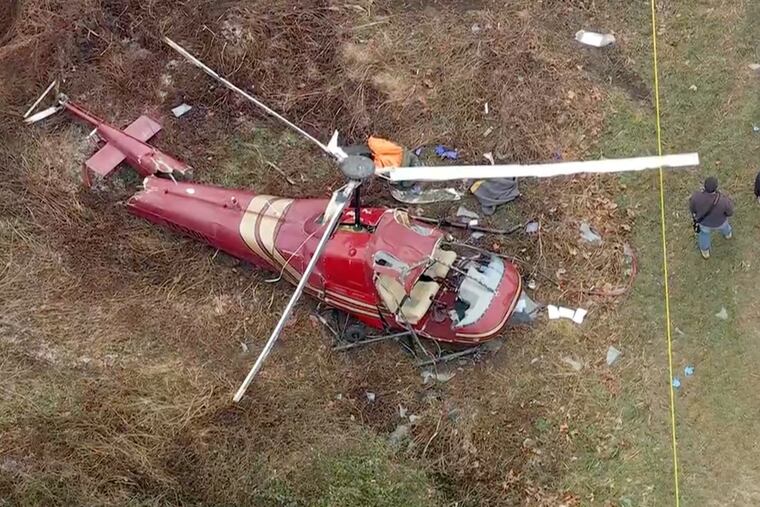
Federal investigators pieced together a timeline for the deadly helicopter crash that killed two longtime friends in Hammonton, N.J., last month.
The National Transportation Safety Board released a preliminary report on Wednesday detailing the helicopter crash that led to the deaths of pilots Kenneth Kirsch, 65, from Carneys Point, and Michael Greenberg, 71, of Sewell. Their aircrafts collided midair on Dec. 29. The two had been known to enjoy their flights together for years.
According to preliminary data, Kirsch and Greenberg started their flight session at the Vineland-Downstown Airport, departing at 9:48 a.m. The pilots, in separate aircrafts, flew in parallel paths to Hammonton Municipal Airport, arriving 10 minutes later.
Investigators are still trying to determine what happened next; there is no preliminary real-time GPS data on their subsequent flight out of Hammonton Municipal Airport.
The preliminary report confirmed Kirsch and Greenberg flew out of the Hammonton airport and collided at 11:24 a.m., almost an hour-and-a-half after they arrived at the airport.
During that time before their final flight, the two men stopped by Apron Cafe, a breakfast spot overlooking Hammonton Municipal Airport’s runway, the owner told The Inquirer. Minutes after they left, Apron Cafe patrons and staff could see one of the helicopters spiraling, engulfed in flames in the distance.
“I looked up, and I could see in the distance the one spiraling down, and then I see the other one coming down,” said the cafe’s owner, Sal Silipino. “It was hard to believe that they were crashing.”
While no data from the aircraft is available, surveillance video captured the fatal crash as it happened, according to the NTSB. The helicopters flew close together shortly before the accident.
Slightly staggered from one another, and heading in the same direction in what investigators liken to a “formation flight,” the helicopters “converged until they contacted each other.”
Investigators say one helicopter immediately began a tumbling descent to the ground, while the other pitched up sharply before leveling out. However, shortly after leveling off, the helicopter began spinning clockwise before descending rapidly to the terrain.
Kirsch was flying an Enstrom F-28A helicopter, and Greenberg, an Enstrom 280C. Both were operating the aircraft for personal flights.
The crash site was 1.5 miles southwest of Hammonton Municipal Airport and included a 1,211-foot debris path, with paint chips, main rotor blades, and the tail cone of one of the helicopters.
Kirsch’s aircraft was found split in half with the tail cone only held together by one tail rotor control cable, according to the report. There were no signs of fire in Kirsch’s helicopter. Major sections of Greenberg’s aircraft were destroyed by a post-impact fire, with the tail cone relatively intact.
The wreckage was recovered and retained for further examination by the NTSB. Investigators noted these were preliminary details, and the cause of the crash is yet to be determined.
A typical NTSB investigation can last one to two years.