After a historic lull, the hurricane season may be getting a second wind. It’s a trend.
In the last 10 years, more hurricanes and tropical storms have been forming after the traditional "peak" period.

Tropical Storm Fernand and Hurricane Gabrielle, which mutated into a monster cyclone, bookended a historically quiet period in the Atlantic Basin hurricane season, but that interval may end up having been the calm before the storms.
Not a single named tropical storm — those with winds of at least 39 mph — formed between the births of Fernand, on Aug. 23, and Gabrielle on Sept. 16. And that coincides with what, on average, has been the peak of the season.
In the era of reliable surveillance, dating back roughly 85 years, such a lull has happened only once before — in 1992, and that was an extraordinary case.
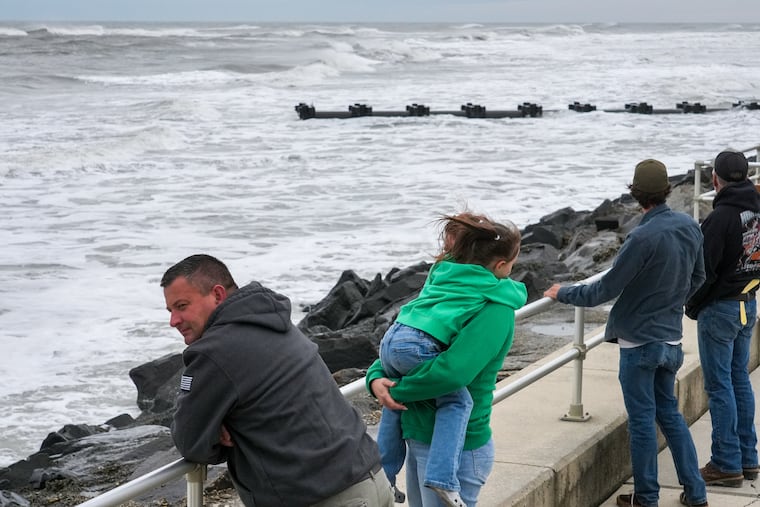
Now, the 2025 season may be gathering a second wind. It is possible that a tropical storm could affect the Mid-Atlantic coast early next week and perhaps generate deficit-dousing rains in the Philadelphia region.
And if recent trends continue, the Atlantic Basin, which includes the Caribbean and the Gulf, may be in for an adventurous several weeks.
Two of the Philly region’s most destructive tropical-origin storms on record — Hazel in 1954 and Sandy in 2012 — struck in October.
What explains the hurricane quiet in the Atlantic?
The general upper-level circulation and concentrations of Sahelian dust have been hurricane-suppressing factors, said Nick Novella, meteorologist with NOAA’s Climate Prediction Center.
And so has abnormal warmth in the high atmosphere. Tropical storms form when warm, moist air rises into cooler air and condenses into clouds and thunderstorms. The air can’t keep rising if it’s warm in the upper atmosphere.
Overall, however, the atmosphere has been moistening recently, he added, and has become more favorable for tropical storms.
In addition to Gabrielle, which on Tuesday was generating peak winds of 130 mph as it spun toward the Iberian peninsula, the National Hurricane Center was watching two more disturbances in the Atlantic likely to become tropical storms this week.
One of them was forecast to pass through the Caribbean and make a turn toward the U.S. East Coast.
“We’re keeping an eye on that one,” said Mike Silva, meteorologist at the National Weather Service Mount Holly office.
The trend in late-season tropical storms
The 30-year averages for storms after Sept. 22 are three named storms and two hurricanes, one of those being “major,” with winds of at least 111 mph.
In the last five years, however, on average, about seven tropical storms have formed after Sept. 22, with four of those becoming hurricanes, and two of them “major.”
Just how much of the increase is related to better observation is unclear.
“Activity was likely missed over the open ocean in the pre-satellite era,” said Dan Brown, hurricane specialist chief at the hurricane center.
Said Philip Klotzbach, hurricane researcher at Colorado State University, the improved observations have helped “detect weak, short-lived storms.”
However, he added that activity in the Caribbean has unquestionably been brisker in recent years. That may be tied to cooler temperatures in the tropical Pacific, which weaken shearing winds that can rip apart incipient storms in the Atlantic Basin.
The peak day for hurricane formation climatologically is Sept. 10, by the hurricane center’s calculation.
Lately, however, “we’ve seen peaks a little later,” said Hugh Willoughby, former director of the hurricane center’s research division and retired Florida International University professor, followed by a “second peak.”
By the way, that was not the case in 1992, the year after the eruption of the Mount Pinatubo, whose aerosols cast a hurricane-quieting veil over the Atlantic Basin — Hurricane Andrew being the notable exception that season.
What role might climate change be playing
That seasonal displacement may be related to the warming planet, said Willoughby, by altering large-scale atmospheric patterns and contributing to above-normal sea surface temperatures in the Atlantic.
Another factor may be the cyclical nature of hurricane activity in the Atlantic Basin, which researchers say has gone through alternating warm and cool periods that have lasted 25 to 40 years. During the warm cycle, such as the one that began in 1995, hurricane activity is considerably more robust than it has been in the cooler or quieter periods.
As for when it will change, “we’re due,” said Willoughby. However, given the changes in the climate, some researchers aren’t so sure the activity is going to slow down anytime soon.
Said NOAA’s Brown, if the ocean does slip to the cool phase, it is unclear whether it “will be sustained.”
Willoughby said the Atlantic Basin remains chary with its secrets.
The outlook for the Philly region over the next several days
It has nothing to do with Gabrielle or anything brewing in the Atlantic, but the region is about to get some relief from a dry spell that has been growing worrisome.
About half the region is in the interagency U.S. Drought Monitor’s abnormally dry zone.
Silva said that between now and Friday, the region should experience a general half-to-one-inch rainfall, with the bulk of that coming Wednesday into Thursday night.
Philadelphia’s September rainfall is well less than half of normal.
Tropical remnants can help wipe out deficits around here. But if they happen, not too much, please.