El Niño has formed officially, and it likely will be one of the strongest on record
It may have a dampening effect on hurricanes.
El Niño has formed officially and it is likely to become one of the strongest on record, with potentially profound impacts on the hurricane season and the U.S. winter, government meteorologists announced Thursday.
As it matures during the summer and fall, it is likely to hold down the numbers of Atlantic tropical storms. And while it is impossible to predict what it might mean for winter around here, some of Philly’s strangest winters have coincided with El Niño.
Scientists with the National Oceanic and Atmospheric Administration see a 63% likelihood that this El Niño will qualify as “very strong” and rank among the elite of the last 75 years.
El Niños occur every two to seven years as part of a natural process as east-to-west trade winds that push water into the western Pacific slacken and massive amounts of warm water move eastward.
In the key El Niño region of the central Pacific, sea-surface temperatures over a 2.4 million-square-mile area become anomalously warm. In this instance, NOAA says, the temperatures may end up being 3.5 degrees Fahrenheit higher than normal.
All that warm water interacts with the overlying atmosphere to disrupt weather-bearing winds worldwide.
The naming has been attributed to Peruvian fishers who lamented the effects of the warmth on the anchovy catch. They called it a Spanish term for the Christ child, since this tended to happen around Christmastime.
El Niño and the hurricane season
El Niño’s impacts can be enormously disruptive, but it’s possible that residents of the Caribbean, Atlantic, and Gulf coasts will catch a break.
The phenomenon can have a dampening effect on hurricanes.
One well-documented effect of the warming is that it generates powerful upper-air winds from the west that can have shearing effects on incipient tropical storms in the Atlantic, thousands of miles away.
On Wednesday, Philip Klotzbach, a researcher at Colorado State University, which developed the prototype for those seasonal hurricane outlooks, reduced the storm numbers in his forecast and is now calling for only five hurricanes. The average is seven.
Some of the quietest Atlantic hurricane seasons on record have occurred during strong El Niño years.
El Niño and the Philadelphia winter
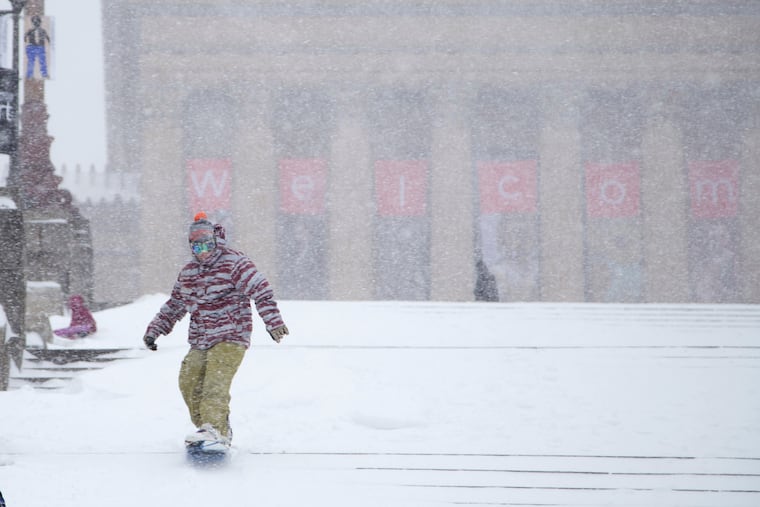
Strangeness is no stranger to Philadelphia winters, but strong El Niños have coincided with extremes of snow — in both directions.
In 1972-73, for example, no measurable snow fell in Philadelphia, and only 0.8 inches accumulated in the 1997-98 winter. Philly was hit with a 21.3-inch blizzard in February 1983 and a 2-footer in January 2016, both during high-end El Niño years.
Unfortunately, in the short term, El Niño isn’t going to be doing anything about this heat and humidity.