Winter is about to return in Philly. Will snow join the party?
Computer models are feuding, but some snow is at least possible during the holiday weekend.
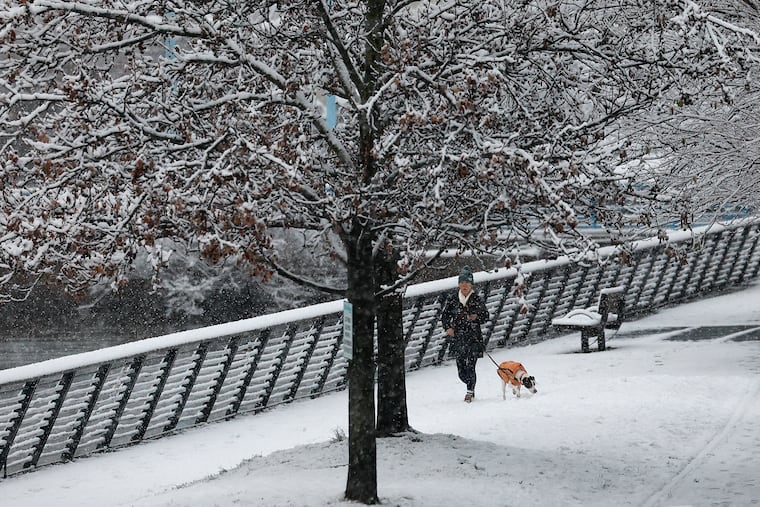
As it approaches halftime, the meteorological winter around here so far has been about as inconsistent as the Philadelphia Eagles’ offense, but it is about to get decidedly colder, if not snowier.
Temperatures on Thursday are due to hover around freezing with a brisk westerly wind gusting up to 30 mph (sympathies to all bikers and runners and those who are navigating those Center City wind tunnels), and then drop into the 20s after sunset with windchills in the teens.
Then, after a modest warmup Friday and Saturday, the forecast turns decidedly colder and potentially more intriguing, as computer models have been going back and forth on snow potential for the Philly region.
Philly’s coldest stretch of the winter so far to begin Sunday
Readings are expected to warm into the 40s on Saturday, but then drop off dramatically during the holiday weekend and may not reach freezing again until Thursday.
They may not get out of the 20s on Tuesday — when wind chills could fall to 0 in Philly — and Wednesday, with overnight lows in the teens.
Will the cold lock in a snow cover?
A few alarm bells went off Wednesday afternoon when the main U.S. computer model suggested potential major snowstorms along the coast all the way to the I-95 corridor on Sunday.
However, other computer guidance wasn’t buying it, nor were forecasters. The computer food fight continued Thursday.
The U.S. model, said Paul Pastelok, longtime seasonal forecast specialist with AccuWeather Inc., “goes wacky all the time.” Maybe not all the time, but a subsequent run of the European model kept the storm offshore.
“We’re kind of in a waiting game,” said Pastelok.
Opined the National Weather Service Office in Mount Holly in its afternoon forecast discussion, the potential system has “high-end potential but also could end up being nothing.”
In other words, situation normal.
The winter so far in Philly and United States
Oddly, the raw stats for the first half of the meteorological winter — that’s the Dec. 1-Feb. 28 period — are not too far from normal for snowfall and temperature.
But that’s the result of quite a cold start to an eventful December, followed by a benign and uneventful January around here.
December temperatures finished at 3.6 degrees below normal at Philadelphia International Airport. And in the first two weeks of 2026, they were 3.6 degrees above normal. Snowfall in December was about an inch above average, but with a paltry 0.3 inches so far this month, the 4.8 total is very close to where it should be.
The early season coolness in Philly and much of the rest of the East was a surprise, said Owen Shieh, warning coordination meteorologist with NOAA’s Weather Prediction Center, in College Park, Md. The West, conversely, was quite warm.
The contrasts were the result of “pattern persistence,” said Tony Fracasso, a weather center meteorologist.
In the East, “This winter started quite strong,” he added, compared with recent winters. “It was not record cold,” but, “it sure felt cold for us.”
What’s ahead the rest of the winter of 2025-26
That likely will be the case early next week, and NOAA’s Climate Prediction Center has chances favoring below normal temperatures and above-normal precipitation in the Jan. 22-28 period.
Pastelok said that upper-air patterns are aligning in such a way that favors importing cold air from northwestern Canada.
The Climate Center’s Laura Ciasto said she does not see a major invasion of the polar vortex in the next few weeks. The vortex circles the Arctic, imprisoning the planet’s coldest air. But on occasion, the winds weaken, the freezer opens, and the contents spill southward.
She said the vortex winds are slightly weaker than normal but are expected to strengthen.
It is possible that lobes of the vortex may stretch on occasion, resulting in short-lived periods of cold in the Northeast, said Judah Cohen, research scientist with the Massachusetts Institute of Technology.
A period to watch would be the first week in February, when a significant disruption of the vortex is possible, Pastelok said.
A sudden stratospheric warming in the high atmosphere in the Arctic, which can lead to cold outbreaks in the contiguous United States “is not out of the question” late in the winter, Ciasto said.
Philadelphia’s peak snow season typically occurs in late January through mid-February.
Of the 10 biggest snowfalls in the city’s history, only three have occurred before Jan 22.