Spring has arrived in Philly, the sun says. Spring weather may be another matter.
Winter may try to linger, but the birds and blossoms eventually are going to win this one.
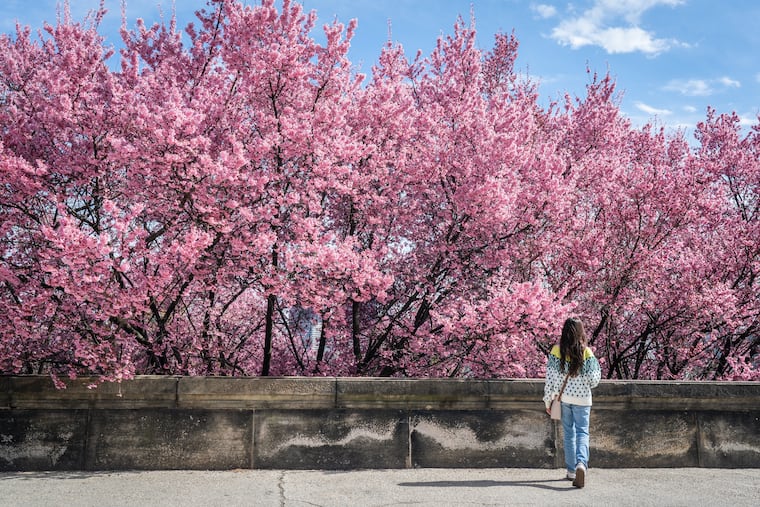
Spring arrived officially at 10:46 a.m. Philadelphia time Friday, the instant when the sun beamed its most direct light on the equator. But whether the atmosphere is prepared to accept that astronomical reality is another matter.
This may well be one of those intervals when winter’s residue is behaving somewhat like a cold that won’t quite give it up. You think it’s gone until you start sneezing and coughing again.
The extended outlooks suggest it’s worth keeping the tissues handy, not offering any big spring warmups in the Northeast the rest of this month, and post-season snows have been fairly common occurrences around here.
But on a landmark day in the annual progression of the seasons, for those who hold that snow should be classified as a controlled substance, keep in mind that winters do have one important characteristic in common with colds: They end.
Soon the cherry blossoms will be exploding and those first magnificent, delicate greens will enliven the tree branches.
On the quasi-movable feast of the vernal equinox, we offer a few observations for a day when the sun will rise precisely in the east and set precisely in the west and will shine on both the North and South Poles. Sunscreen optional.
Philly’s final freeze dates have been coming earlier
Temperatures fell into the 20s early Wednesday, zapping some early blooms, and subfreezing readings are expected next week.
However, the median date for the last freeze this century, March 29, is a week earlier than the median for the previous 25 years, April 5. That may be related to the idiosyncrasies of the airport environment, but it certainly tracks with the planetary warming trends of the last five decades.
After 30.1 inches of snow (and ice), is that all there is for Philly?
While nothing is incubating in the cyber world for now, it has been known to snow around here after the equinox. The “normal” snowfall from here on out is a whole 1.0 inches. Measurable snow has fallen officially in the city as late as April 27, with 0.1 inches in 1967. On April 7, 1982, 3.5 inches was measured at the airport.
An all-timer for any time of year occurred when 19 inches creamed the city on April 3, 1915, and an additional 0.4 the next day, Easter Sunday.
If it does snow, it won’t be Jan. 25 — when 9.3 inches of snow and sleet was followed by Arctic freezes — revisited. With the sun this strong, it would be gone before you could remember where you put the shovel.
The sun is on fire, and the sunsets later and later
The amount of solar energy reaching the top of the atmosphere over Philly increases 102% between the winter and summer solstices.
We are less than halfway there — winter is the shortest season — and the wattage has increased more than 70%. The daily sunrise-sunset intervals are growing by about 2 minutes, 40 seconds daily.
Incidentally, the equinox actually isn’t the day-night break-even point. That happened on Monday.
Suddenly, it’s summer?
A common complaint around here is the atmosphere tends to skip spring and fast-forward to summer. While the data doesn’t quite support that phenomenon, the region has experienced serious heat well before its time.
The temperatures hit 90 degrees on April 7 and 8, 1929 (no wonder the stock market crashed); 92 on April 12, 1977, after a record-cold winter; 94 on April 18, 1976; and 95 on April 17, 2002, during an actual heat wave.
The birds are back, and more are on the way
Weather or not, the birds are far more attuned to the light, and they are back. bustling about like so many college students returning to the dorms with the new school year.
“There are definitely things happening in the bird world. Songbirds are singing and many birds are migrating,” said Keith Russell, program manager at Audubon Mid-Atlantic. And the traffic is about to pick up. “The majority of songbird migration will be in April and May.” he said.
Once-in-a-blue moon sky shows
We’ll be getting three full moons in two months as May will accommodate two of them, on the 1st and 31st, the second being the so-called Blue Moon. They will be preceded by the “Paschal moon” on April 1, marking the beginning of Passover, with Easter following four days later.
They won’t be quite as evident as the moon, but meteor shower connoisseurs may get to see some of the Lyrids. The moon will yield the stage and as many as 10 meteors an hour may be at least faintly visible in a dark-sky location during the early-morning hours of the April 22 peak, said the American Meteor Society’s Bob Lunsford.
Meteors, so-called shooting stars, consist of rapidly falling space debris that become visible when they get cooked by entering Earth’s atmosphere.
Don’t expect anything quite like the spectacular fireball — that large meteor that somehow survived long enough to show off — and sonic boom that rocked the skies over Western Pennsylvania this week. Matt Brudy, a meteorologist with the National Weather Service office in Pittsburgh — he’s an alumnus of the Mount Holly office — said the fireball was captured by a colleague’s home camera.
Same time next year? Not quite.
By the sun’s clock the equinoxes and solstices occur at the same moments every year. So why do the equinox times vary here on earth, by as much as 43 minutes, said Theodore Kareta, astrophysics professor at Villanova University.
While useful, our calendars are imperfectly synchronized with astronomy. Our days actually aren’t quite 24 hours long, and our year consists of 365.24 days. We add a whole day to the calendar every four years, but that still leaves 14.5 minutes unaccounted for. It’s not the sun, which is always on time; it’s us, Kareta said.
The calendar math is such that the vernal equinox has occurred in Philadelphia on March 20 — all at different times — on all but three years this century, when it occurred late on the night of the 19th. It has not occurred on a March 21 since 1979, and won’t again until 2103.