Philly is forecast to get more snow than in recent winters. That isn’t saying much.
This has been one of the most snow-less five-year periods in Philly's weather history.
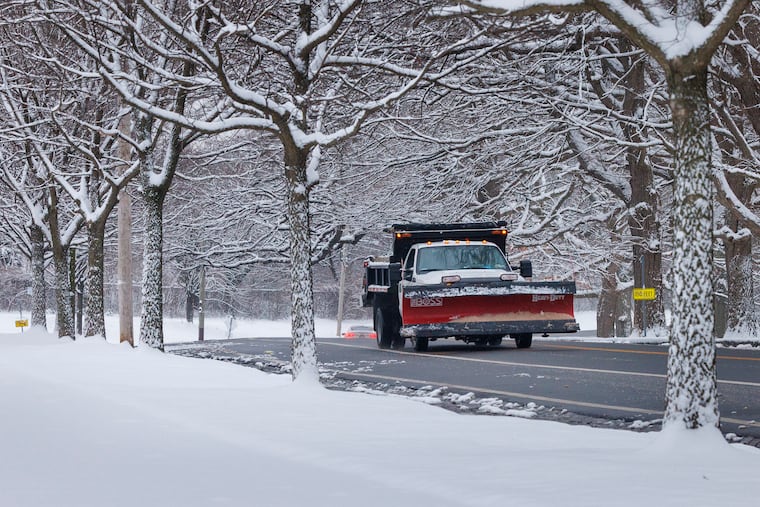
The foliage has yet to flash its peak colors around here, but some adventurous meteorologists already are taking shots at what will happen after the trees shed their leaves.
Some commercial services are predicting that Philly’s snow totals in the winter of 2025-26 will well exceed those of recent years.
While that’s not quite in a league with forecasting earlier sunsets as we head toward the solstice, it’s close. This has been a historically snow-starved era in Philly, with just 8.1 inches measured last winter, about a third of normal.
The National Oceanic and Atmospheric Administration’s Climate Prediction Center — where the scientists continue to work without pay during the government shutdown — issued an outlook Thursday that favors above-normal temperatures for the region during the Dec. 1-Feb. 28 meteorological winter.
As for predicting snow amounts, the climate center meteorologists, as usual, are taking a pass.
History argues that they have sound scientific reasons for doing so, but that’s not stopping meteorologists in the private sector from plowing ahead.
Why are they crawling out on such a tenuous limb?
“That’s all anybody cares about,” said Paul Pastelok, the longtime seasonal forecaster at AccuWeather Inc., which is predicting 14 to 18 inches for Philly.
What is it about snow and the Philadelphia winter?
Nothing else in winter is at once so disruptive and anticipated around here as snow.
Perhaps that’s because the cold can get tiresome, and drives up heating bills. Cold rain is annoying. Sleet balls are like irritating white pebbles from the sky. Ice is about as popular as a power outage.
Snow comes with its own set of hazards, but nothing else in winter has its power to enchant landscapes and fatten supermarket revenues.
And these days, its relative scarcity around Philadelphia has made people forget the tremendous inconveniences that can accompany it.
Snow has been mighty scarce around here lately
In the last five winters, officially an average of only 11.3 inches of snow per season has been measured in Philadelphia, That is half the long-term annual average.
Could the lack of snow be related to Earth’s rising temperatures?
Very possibly, but in 140 years of record-keeping, half of the top 10 snow years have occurred in the last 30 years. And lull periods are not without precedent. In the five winters ending with that of 1931-32, the average was 10.1 inches, and the average was 11.8 in the five seasons that ended with the winter of 1952-53.
Of note, snow deprivation in the Northeast in the early ’50s was an impetus in jump-starting the snowmaking business at ski resorts.
Philadelphia’s annual snow totals are all over the place
In terms of determining what to expect, Pastelok said, the range of Philadelphia’s seasonal snow totals — from 0.0 in 1972-73 to 78.7 in 2009-10 — is not much help.
Along with the snow-starved seasons, Philly has had a handful of winters where it seemed that the atmosphere wouldn’t shut off the snowmaking machine.
Along with 2009-10, another winter that belongs on that list would be 2013-14, when an official 68 inches accumulated.
That happens to be one of the “analog years” — those in which atmospheric patterns may be similar to what is expected in the few months — that Pastelok used for this season’s forecast.
December may offer a hint of what’s to come
No, he doesn’t see a repeat of that winter. Nor does anyone else, so far.
It remained unclear whether La Niña conditions, the anomalous cooling of surface waters in the tropical Pacific, would develop and how much effect they might have on west-to-east upper-air winds that influence weather in the United States, Pastelok said,
The climate center cited potential La Niña impacts in favoring above-normal temperatures near Philadelphia. Weather moves west-to-east, and conditions in the Pacific are crucial for the U.S. winter.
Pastelok said the main driver may be the warmth in the northern Pacific, which favors development of patterns that could drive cold air into the contiguous 48 states. Paul Dorian, a Valley Forge-based meteorologist with Arcfield Weather, concurred.
However, it remains uncertain how much of that would get to Philadelphia, and, as usual, whether any of it would be around when and if potential snow-making nor’easters form.
“I just don’t think we’re in the prime area, again,” Pastelok said.
The winter of 2024-25 passed without a single nor’easter making its way up the Northeast coast. Philadelphia’s total snowfall was half that of Norfolk, Va., and a mere 0.1 inches more than that of New Orleans.
Snow was below normal all along the I-95 corridor from Washington to Boston, but Philadelphia was in a snow hole of its own with the lowest total of any official measuring station.
Worth watching is what happens in December. For whatever reasons, significant December snows correlate well with major snowfalls later in winter. Disruptive snowstorms occurred in December in seven of the 10 snowiest winters in Philly.
Private-sector forecasts see more snow for Philly
Arcfield Weather, whose clients include some government agencies and which correctly predicted that Philadelphia’s temperatures would be slightly below normal in the 2024-25 winter, is calling for something close to the seasonal normal snowfall in Philly, as is WeatherBell Analytics.
OpenSnow, a forecast service for skiers and other winter-sport enthusiasts, says the odds favor above-normal snowfall throughout the Northeast from Philadelphia on north.
The winter of 2024-25 was rough, at least for some of the forecasters who didn’t foresee that snow totals would end up in single digits. Nor that temperatures would average slightly below normal. Arcfield was a notable exception to the temperature whiff.
However quixotic a task, the meteorologists keep trying. “This year, it’s a tough call,” Pastelok said.
A lot like last year.