Tears for Fears, rotary phones, flares: Philly’s Bicentennial babies are turning 50 as America turns 250
"We have a blessing of choices," "The Semiquincentennial isn’t a one-sided story," "I’m grateful for the wisdom for knowing who I am," and more such reflections from women 200 years younger than USA.
Gen Xers watched dial-up phones shrink to pocket size, typewriters turn into touch screens, and appointment TV give way to streaming binges.
But Bicentennial babies are a special group of Xers. Born in 1976, they are celebrating a milestone birthday this year right along with the country. As America turns 250, they are turning 50. And on the cusp of the Semiquincentennial, Philadelphia’s Bicentennial babies are feeling reflective.
1976 was just three years after Roe v. Wade, the landmark Supreme Court ruling giving a woman the constitutional right to end a pregnancy. It came 11 years after the Voting Rights Act of 1965 made it illegal to try to stop Black Americans from voting, and 12 years after the Civil Rights Act of 1964 ended legal segregation.
These changes to the American landscape gave Bicentennial babies a level of personal freedom and agency when they were coming of age during the turn of the 21st century that their parents and grandparents did not have. But in the last decade, they’ve seen the Supreme Court reverse Roe and weaken civil rights laws to the point that Bicentennial babies’ babies now don’t have the same privileges their parents did.
“I had been thinking about 2026 and being a Bicentennial baby,” said Yolanda Wisher, Philadelphia’s third poet laureate and host of the Bicentennial Baby podcast, a part of Art Philly’s “What Now: 2026″ festival.
“I felt like this opportunity was the best way to study this major moment in American history from a personal angle and revisit what it means to be a Bicentennial baby from a Philadelphia perspective,” Wisher said.
Each of the 10- to 15-minute Bicentennial Baby episodes bubbles with late ’80s and early ’90s nostalgia from the cassette tape centered in the podcast’s logo, to the funky theme music lending to its WDAS Quiet Storm vibe, to references to banana clips and acid-washed jeans.
At its core, however, Bicentennial Baby is unapologetically Philly.
Today’s 50-year-olds were in the first grade when Thriller was released, but they also remember 1982 as the year Constance Clayton became the first Black person to serve as the superintendent of Philadelphia public schools. They watched the Flyers on PRISM and music videos on MTV.
Some of them were born in the Booth Maternity Center.
Earlier this year, Wisher put a call out on social media asking Philadelphians turning 50 in 2026 to join her in conversation about their unique perspective as they enter middle age.
“I was interested in finding the diversity of the Bicentennial babies’ experience,” Wisher said. “What does it mean to be a 50-year-old born and raised here? Or to be that person, who wasn’t born here, fell in love with the city, and decided to make it home?”
A dozen applied. Wisher chose six.
They are Laurie Allen, a librarian who lives in South Philly; Maleka Fruean, a community journalist who lives in Germantown and is a mom of four; Kenny Guy, who lives in Mount Airy and is a father of six; Michiko Hunt, a development associate at Greene Street Friends School, who lives in Germantown, and is a mom of two; and Stewart Varner, a manager of the University of Pennsylvania’s Digital Humanities Lab who lives in West Philly.
Naila Mattison, a poet, artist, and mom from West Philly, was the guest on the podcast’s first episode, which aired in late May. She died in February of cancer.
“She came to us with such a sense of urgency,” Wisher said. “She wanted to share her story. I’m so glad we made space for her.”
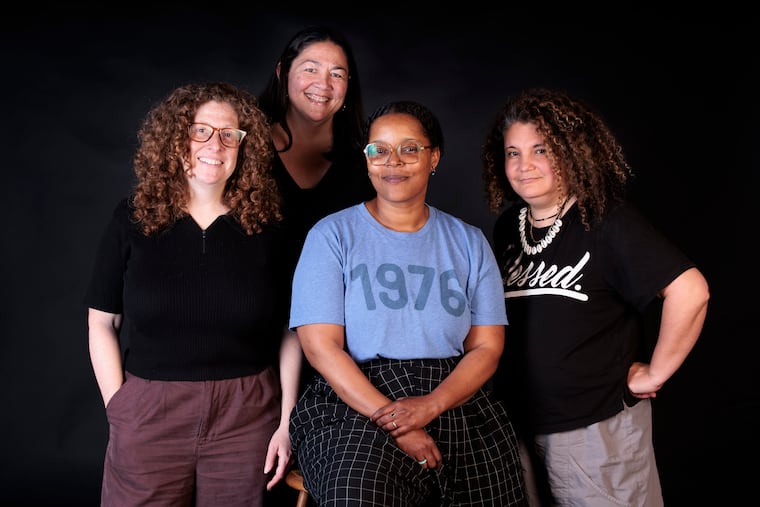
The Inquirer invited the Bicentennial babies to our studios earlier this month for a photo shoot. Allen, Fruean, Hunt, and Wisher — in her blazing blue 1976 T-shirt — came in and shared how being born during the Bicentennial impacted their outlook, is shaping their present, and is setting them up to be cool elders.
The interviews have been edited for clarity.
On Gen X culture
Michiko: In Philly, I was always conscious of being a part of this microgeneration because there were literally less of us. In the 1980s, all the entertainment we watched was focused on our parents, L.A. Law, Hill Street Blues, even The Cosby Show. My parents bought Thriller and Bruce Springsteen. But then when I was in my 20s, everything was teen-focused. I mean, Britney Spears? I was too old for that. There were all these kids who were born in 1982 who loved her. And I just missed it.
On technology
Michiko: I went to my father’s office at 19th and Cherry Streets and typed my college applications on his electric typewriter. It was fancy. You could delete mistakes with correction tape.
Yolanda: My grandmother had a rotary phone. We had a push button phone. I had a pager.
Maleka: And right around our senior year in high school, that’s when cell phones started to come in.
Yolanda: And they were huge, like the New Jack City phone … They were crazy expensive like video recorders. Like, if you had one of those …
Michiko: You were rich!
On fashion
Michiko: It’s true: What’s old is new again. What we called flare, my mother calls bell-bottom, and my daughter calls wide-legged. We had a distinct style though. Fashion bubbled up from specific subcultures like goth or hip-hop. Now everything comes from the internet. It’s really flattened style.
Maleka: And analog is a style now. Analog, as in not digital. It’s a fashion category. Like what people carry in their analog basket is a thing: a pencil and a notebook? That’s just what I put in my backpack.
On music
Michiko: Our music was the best. I still have ticket stubs when I went to see the Roots. We all listened to hip-hop but we also listened to other kinds of music, too.
Yolanda: Tears for Fears!
Maleka: The Eurythmics!
Michiko: MTV!
Laurie: I remember when the radio was the only thing that mattered. Then we went to tapes, then to CDS, MP3s streaming. Each time I was like, I’m not going to do it. Yet every time I made the switch. Every. Single. Time. But I think it’s going full-circle. I miss playing guilty pleasure music without a digital trail of what I listened to.
On working
Yolanda: I watched my mom work hard everyday. When she retired from her job at Merck, all she got was a watch. That said something to me. I watched my mom struggle as a single mom, work her way up, put my siblings and I through college. That job was in the background of our lives our whole life.
Maleka: My children understand [better than I do]. They are not going to break their backs for a pittance. I’ve worked so hard my whole life. Still, I have no idea what my retirement is going to look like.
On learning from elders and turning 50
Yolanda: Womenfolk in my grandmother’s generation were more matronly. My grandmother had a whole closet full of church hats. She kept her house a certain kind of way. She had a routine. She was very straitlaced, at least in public. She had a secret life we didn’t ordinarily see.
Michiko: We have a blessing of choices. My dad’s mom was Japanese American. She was born in California, a first generation immigrant. She was a teenager during the Depression. Her family worked in a packaged frozen food factory. Today she would have been an artist. She made all of our Cabbage Patch Dolls and all of those beautiful doilies. She had the soul of an artist.
Maleka: We have access to so much more information. And because of that we have wonder.
On becoming an elder
Laurie: My body does not look like it does when I was 20, 30, or even 40. And I assumed when I got this age I would want to go back in time. But I don’t. Instead, I’m grateful for the wisdom for knowing who I am. I don’t want to go back to those uncertain times. I may have looked better, but I felt worse.
On being American
Maleka: When I was growing up, I had mixed feelings because I saw so many vulnerable people who needed to be protected. I didn’t have the language to define institutionalized or systemic racism. Now that I do, I want America to do better. But I’m still proud to be an American.
Yolanda: The Semiquincentennial isn’t a one-sided story, but one that celebrates the complicated history of America. The racial, cultural, and social point of view of the people who are running isn’t the only perspective. We should be able to hold all of these voices at the same time and move forward.
"Bicentennial Baby“ is available on Apple, Spotify, and Amazon Music.