More hand-holding, longer hours, no Rocky statue up top: 10 ideas to get the PMA back on the right track
We love the museum. So much so, that I visited it a dozen times recently. Can the museum make it easier for us to love it even more?
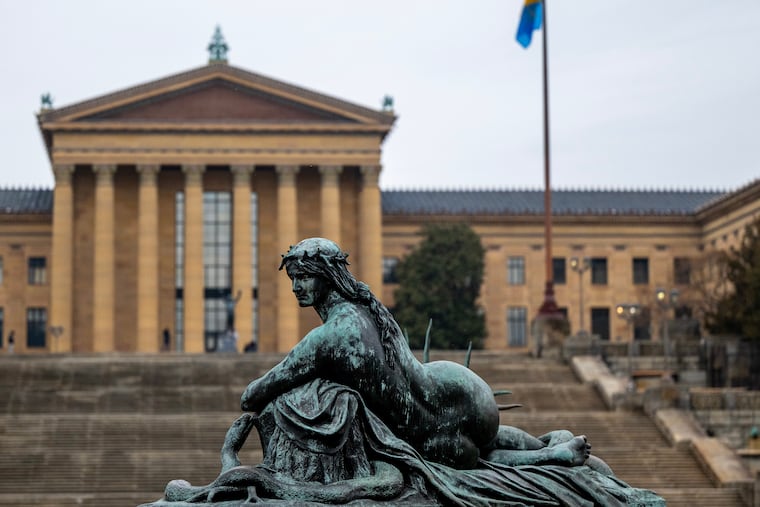
Not long ago, I went to the Philadelphia Museum of Art to visit a particular painting and found the work gone. The guard in the gallery didn’t know where it was, and the museum’s website offered no clues.
I was struck with a feeling equal parts concern and betrayal. Over time, I had committed this work of art to memory, musing in the middle of the night over its microscopic detail and whether the twinkly flowers in the grass were meant to symbolize stars. It had become in a sense “mine.”
To walk in and find it missing was a kind of bereavement.
Understanding that sensation is a key to how the Art Museum can navigate its current rough patch. My relationship with this painting is exactly the kind of relationship that, when multiplied by thousands of other visitors and pieces of art, makes a museum indispensable to a city — not just one more entertainment option.
The museum today is focused on the fact that fewer visitors are coming now than before the pandemic, and the concern is legitimate. But the way back can’t be merely quantitative. What leads patrons through the engagement funnel from first-time visitor to member to donor is the quality of the experience.
Here the museum could be doing better.
Some spaces are empty, while others don’t fully contextualize what you’re seeing. There’s a presumption evident in the way art is presented that visitors possess a moderately high level of preexisting expertise. Many surely do.
But this brings us back to my missing painting.
It turned out Saint Francis Receiving the Stigmata by Northern Renaissance artist Jan van Eyck had been moved back to another gallery after temporary placement in the gallery where I had been visiting it.
The current rehanging, though, misses some major opportunities.
The accompanying label does not explain anything about this tiny, miraculous, nearly 600-year-old work, and there’s nothing telling me that van Eyck was particularly significant, though he is widely considered to be a major figure in art.
There are only 20 or so van Eyck paintings extant, something the museum doesn’t say, even though it should be sending visitors on their way spreading the word that our museum has one. This is a matter of civic pride.
The institution is grappling with a series of big hurdles — how to close the operating deficit, what to do about deferred maintenance and paused expansion plans, among them.
But new director Daniel H. Weiss is also planning a serious look at the visitor experience. I’ve visited about a dozen times in recent months, and while there is a lot the museum is getting right, it’s clear that if it doesn’t get inside the heads of art fans of today, yet more glamorous building additions will bring nothing more than a quick sugar high.
Here are a few observations in pursuit of making sure that doesn’t happen.
Increase hours
There’s sometimes a sense that the museum was made for a different era. Most people work for a living, and yet the museum is open past 5 p.m. just one day per week.
The Cleveland Museum of Art — which is free — is open six days a week, open until 9 p.m. two nights a week, for a total of 50 hours per week. The Detroit Institute of Arts is open six days, for 47 hours a week. Boston’s Museum of Fine Arts is open 52 hours a week, open until 10 p.m. on two nights.
Philadelphia’s art museum is closed two days a week, leaving it open just 38 hours and 45 minutes per week. There is likely pent-up demand.
At a Friday DJ evening in December, a few sat in the Great Stair Hall and one person danced. It hardly felt like an event. But the galleries were packed with families and hipsters looking at art. This suggests they hadn’t come to hear anyone spin discs, but because the museum was open at a time that actually worked for them.
Restore pay-as-you-wish Friday evenings permanently
The museum ended its pay-what-you-wish Friday evenings in summer 2024 and recently announced a restoration for five months starting in April. The program’s continuation depends on finding more underwriting, the museum says, and it makes fundraising-strategy sense to frame it this way. But if the museum stands a chance at becoming more egalitarian, it’s critical that the program continue one way or the other.
More hand-holding, please
The museum needs to make a bigger deal of its treasures. Sometimes the presentation calls out the importance of certain works — like the setting devised for Rogier van der Weyden’s The Crucifixion, with the Virgin and Saint John the Evangelist Mourning, for instance, installed on a churchlike stone structure before a dozen stools set out for contemplation. A lovely and moving bit of theater.
But emotion on this scale doesn’t happen nearly enough. It is oddly easy to walk through the Duchamp gallery and totally miss one of the main events, Étant donnés. It hides behind a corner, with no label directing visitors to what is undoubtedly the museum’s most bizarre and enigmatic experience.
As with my van Eyck, I want the museum to tell me who its stars are and what makes them stars. The first time I walked by J.M.W. Turner’s The Burning of the Houses of Parliament, October 16, 1834, it seemed like a canvas of smudgy color fields. On another visit, though, I focused on the bridge and its colossal, classical white massing, and the next time I noticed the people who took to their boats to view the spectacular disaster.
At that point, something clicked. It looked antique and modern at the same time. The painting was suddenly “true,” as Thornton Wilder might have put it.
The Our Town playwright wrote:
“The response we make when we ‘believe’ a work of the imagination is that of saying: ‘This is the way things are. I have always known it without being fully aware that I knew it. Now in the presence of this play or novel or poem (or picture or piece of music) I know that I know it.’”
The Turner is an acknowledged masterpiece, something the wall label next to the painting doesn’t mention. What would I have missed had I been a visitor from out of town with just one passing chance at this painting?
Personify
Decades ago, Robert Montgomery Scott was the friendly face of the museum, leading bike tours around Fairmount Park. Anne d’Harnoncourt was an institution in herself, weighing in with her honeyed, Julia Child-like voice and moral authority at moments of arts crisis and celebration. Weiss has an opportunity to become one of the city’s great arts leaders at a critical time. Will he seize it? He should.
Lift the veil more often
The museum has a good installation on the picture frame and its oft-overlooked role as a distinct aesthetic contributor. More like this, please. A regular, sustained schedule of exhibitions and programs unlocking the mysteries of art collecting, conservation, and curating could provide even stronger entry points into the art world.
Bring in the thrill
Gilded invitations around the art are all fine and good, but many visitors — especially younger ones — are thrilled when they find art in unexpected places. Curving around the east side of the museum is an underground vehicular bypass leading to the Spring Garden Street Bridge, and it’s lined with an exuberant, constantly changing stretch of graffiti. It sits there waiting, an incredible potential exhibition or event space with a bit of an edge.
Use the Great Stair Hall
Have the Constantine Tapestries become part of the furniture? These vast, centuries-old scenes lining the balcony of the Great Stair Hall are no doubt impressive. But this is prime exhibition space, and shaking up expectations with a more contemporary and varied suite of works would give anyone who thinks they know the museum a reason to come back. Sacrilege, perhaps. But maybe there’s also another way of exhibiting these important tapestries that allows us to see them anew.
Use the vast vaulted walkway
Right now it’s a road to nowhere with very little art. Visitors feel grand as they descend Frank Gehry’s epic, sinuous staircase into the lower level, and then they wander north or south through an architecturally spectacular but often lifeless arcade and wonder why they’re there. This level needs to become a destination worth the journey, populated with art and other experiences.
No Rocky statue at the top of the steps
Whatever a statue at the top of the east steps does for sports, any visual ambassador in a spot that prominent needs to signal what’s going on in the museum behind it. City government calls the shots here, since it owns the land. But whether it’s a piece by Louise Bourgeois, Yayoi Kusama, Anish Kapoor, or, even better, someone we’ve not heard of yet, art needs to dominate the transition between the city and museum, beckoning visitors inside.
Finally, about that logo
There’s nothing inherently wrong with the museum’s new logo, a stylized griffin. But it’s a wasted opportunity to convey something about what’s inside the building. A great logo expresses the feeling of being there. When I’m at the museum, I see color, I feel joy and curiosity. A slightly bellicose griffin rendered in black doesn’t do the job.
One of the aims of the new logo was creating something that could compete in the current visual landscape — social media, in particular.
Ironically, the museum’s former logo by Pentagram whose “A” in “PMA” changed to resemble pieces of art did that exceedingly well. It told me that art is an endless cosmos, and all I had to do was show up in a building where other realms were waiting to reveal themselves to me.

- Even Philly’s crosswalks have hoagiemouth. We found out why for youse.
- How do I trim my neighbor's tree without starting another feud?
- The Penn vs. Penn State mix-up, cheesesteak diplomacy, and a very good boy | Weekly Report Card
- The best things we ate this week
- They paid $259,000 for a South Philly rowhouse with vibes and an ‘eagles nest’ | How I Bought This House
- Big pizza, skyline views, and waterfront strolls in Jersey City, N.J. | Field Trip
- How to have a perfect Philly Day, according to Jill Scott
- Citywide Quest: Do you know where in Philly these garden-themed photos were taken?
- A family from Poland came to Philly for their Rocky steps pilgrimage