Philly Shipyard growth is waiting on action from the White House
Busy as it is, the Philly yard makes only “a fraction of what they do in Korea,” U.S. Sen. Andy Kim said on a recent tour. “We need to move forward.”
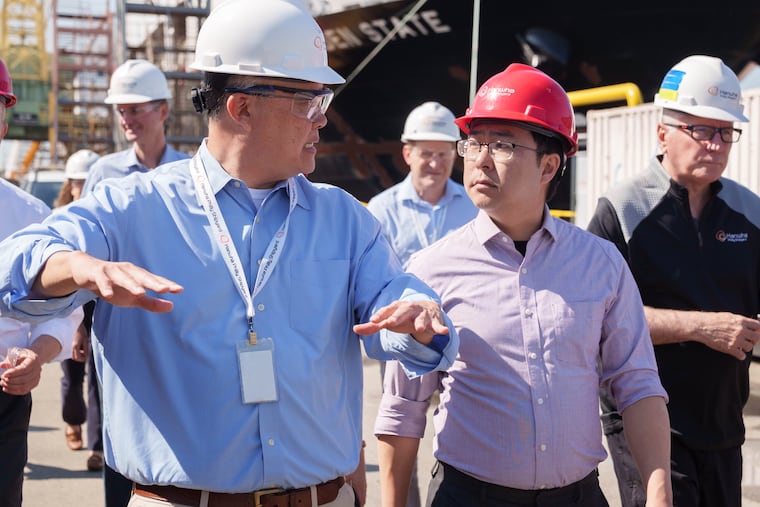
Visitors to Hanwha Philly Shipyard, such as U.S. Sen. Andy Kim (D., N.J.), who toured the South Philly yard for the first time Thursday, are often impressed by the scale of vessels under construction there, welded, wired, and piped into sections in soaring sheds and assembled in the neighboring dry dock by crane operators.
But compared to Hanwha’s mother shipyard on Geoje Island, South Korea, the much smaller South Philly yard has a long way to go before realizing last year’s promises of billions in financial support by the company, made by South Korean President Lee Jae-myung and President Donald Trump, who pledged “Philly Shipyard will become the most successful shipyard in the world.”
Visible from nearby I-95, ships under construction at the yard include:
The first of three 854-foot, dual-fuel containerships, which carry fruit, clothes, electronics, or anything else that fits in a shipping container, among the few built in the U.S. for use between U.S. ports under the federal Jones Act.
The last two of five Philly-built 525-foot National Security Multi-Mission Vessels, bound for merchant marine academies, in Texas this year, and California in 2027.
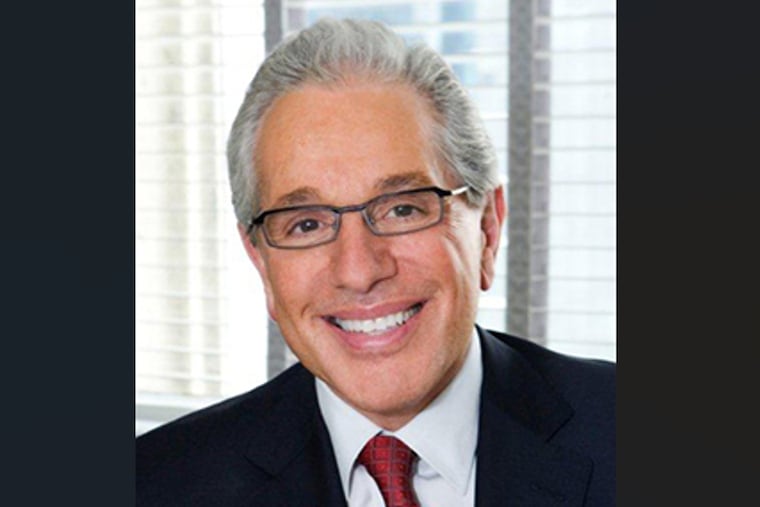
Busy as it is, the Philly yard makes only “a fraction of what they do in Korea,” Andy Kim, the first Korean American U.S. senator, said after meeting with Philly Shipyard CEO David Kim (no relation) and other Hanwha officials. “We need to move forward. I want to see the money flow. We need to unlock that.”
The Philly yard needs updates
The contrasts are clear:
At Hanwha’s South Korean yard, which builds ships at the rate of nearly one a week, steel plates are geotagged with unique digital identifiers for rapid fitting by automated equipment.
At Hanwha’s Philly yard, plates for the handful of ships now being assembled at the rate of two or three a year are marked and read the old-fashioned way — with chalk.
Welding at Geoje Island is “automated 95%,” said Thomas Grunwald, head of commercial shipbuilding at the South Philly yard. In Philadelphia, “our automation is 25%,” using machines installed under the yard’s previous owner.
That owner, Norway-based Aker, sold the former Navy shipyard to Hanwha for $100 million in 2024 — a fraction of what it cost to build and modernize the facility, and a fraction of the $5 billion Hanwha says it needs to spend to make the facility competitive and bring down the high cost of U.S. shipbuilding compared to China, South Korea, and Japan, the global industry leaders.
Vacant lots in the 110-acre yard are piled with 12- to 13-millimeter-thick plates produced by the former Lukens steel mill in Coatesville, now owned by Cleveland-Cliffs Inc., and a few other U.S. Navy and construction steel suppliers.
But the highest quality steel, used to keep the sea from infiltrating the most important, most-stressed parts of a ship, is imported because U.S. mills don’t make it. Nor do U.S. standard platemakers finish their products to shipyard-quality standards, Hanwha officials say.
U.S., South Korean and Hanwha officials pledged to change that, using subsidies and investments for vast new ship construction in modernized facilities. Hanwha says it wants to build Navy ships, starting with oilers and other support vessels and the new generation of unmanned warships and drones. Trump has said the Philadelphia yard could even build nuclear ships.
But the U.S., South Korea, and Hanwha have yet to reach agreement on who’s going to spend what.
“We need the White House to move forward on projects we agree on,” Andy Kim said.
He said the goal — revived U.S. commercial and military shipbuilding — is popular with both parties. He has pledged to work more closely with pro-shipbuilding colleagues like Sens. Todd Young (R., Ind.) and Mark Kelly (D., Ariz.). Andy Kim also plans to accept Hanwha’s invitation to visit its big yard in South Korea.
While they wait
Waiting for investments and contracts that could transform the yard into a much more significant shipbuilding center, Hanwha says it has enough work to keep workers busy, with other prospective orders in sight.
The first of Hanwha’s new Matson container ships has taken shape from sections assembled in Hanwha’s dry dock. Sections of two others are piling up on the adjoining pier, ready for assembly after the first ship is complete.
These ships, like most commercial ships constructed in the U.S. in recent decades, are destined for routes connecting U.S. ports, which must be serviced by U.S.-built vessels, according to the 1920 Jones Act. That law has the effect of guaranteeing some commercial ships are still produced in the remaining U.S. shipyards, such as Philadelphia, despite higher costs compared to their mass-production rivals in Asia.
This spring, Trump temporarily suspended provisions of the act and allowed foreign-built ships to ply U.S. routes in an attempt to ease pressures on energy shipments because of supply disruption caused by the war with Iran.
An end to the Jones Act threatens to dry up the modest demand for such U.S.-built ships, given their higher expense compared to East Asian shipyards.
Hanwha says its multipurpose ship construction program could extend beyond the original five ships that have been placed with merchant marine academies.
Separately, Hanwha is applying to build two multipurpose ships for the U.S. missile agency and also hopes to replace two aging U.S. hospital ships, said Michael Viggiano, Hanwha Defense USA senior director for government relations.
Hanwha is also among U.S. companies that have applied to build new Navy oilers. If Hanwha and its partners win that contract, it could mean the return of U.S. Navy shipbuilding to Philadelphia for the first time since the Navy closed its historic base on the site in 1994. The Navy plans to build hundreds more updated ships and support vessels, and Hanwha hopes to design and build them, whether in Philadelphia or South Korea.
For Hanwha to boost production in the Philadelphia yard to its goal of one or two ships a month, the yard will need more space. Parking and steel storage is already at a premium.
The Navy has begun to move old ships blocking docks on the north side of the yard so Hanwha, its neighbor Rhoads Industries — which builds decks for Columbia-class Navy submarines — and other port employers will be able to add space.
Andy Kim would like to see some of South Jersey’s vacant riverside industrial sites used for shipbuilding support locations as well, though there are no firm plans to do so.