China cuts off Philly Shipyard supplies to punish Hanwha for partnership with U.S. amid trade fight
The Korean shipbuilder is getting squeezed between Chinese suppliers and U.S. customers as President Donald Trump prepares to meet with China’s leader, Xi Jinping.
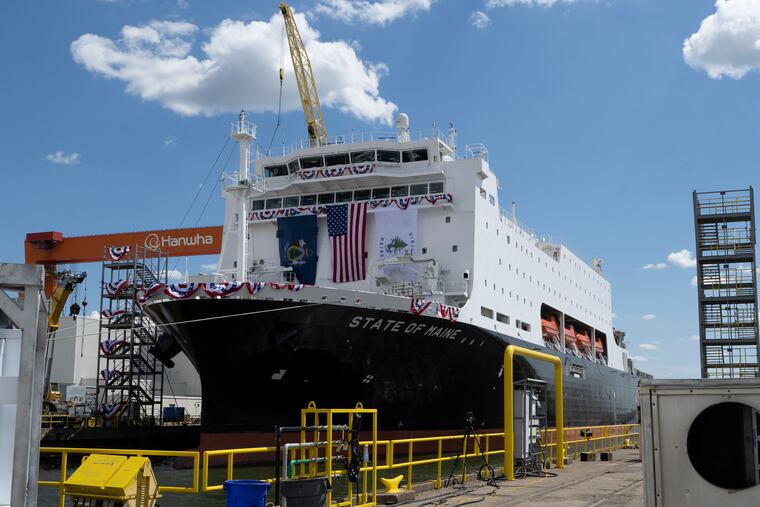
China on Tuesday prohibited factories that supply industries around the world from doing business with Hanwha Philly Shipyard and four other subsidiaries of Korea’s Hanwha industrial group.
China’s Ministry of Commerce accused Hanwha of having “assisted and supported” U.S. trade investigations that the Trump administration used to justify new $50-a-ton port fees against China-built ships and other fees and restrictions that “severely damage” Chinese companies.
China’s cutoff, as President Donald Trump and China leader Xi Jinping move toward a scheduled meeting in Korea at a trade conference on Halloween, squeezes Korea and its key shipbuilding industry between its Chinese materials suppliers and its U.S. shipping customers. Hanwha is seeking U.S. Navy contracts and rapid expansion of the Philly yard.
Shares of Hanwha Ocean, the company’s shipping and shipbuilding group, fell 6% Tuesday as Hanwha officials said they are reviewing the potential impact of losing its Chinese suppliers.
“We are aware of the announcement by the Chinese Ministry of Commerce, and we are currently reviewing the details,” Hanwha said in a statement. The company “will continue to provide world-class maritime services to our customers, including through our investments in the U.S. maritime industry and via Hanwha Philly Shipyard.“
U.S. sanctions against China, including punitive ship docking fees scheduled to take effect Tuesday, “seriously violate international law and basic norms” of world trade, China’s export agency said in a statement. China has retaliated with its own port fees against U.S.-flagged ships, though relatively few call at Chinese ports.
The Trump administration has said its fees and tariffs protect U.S. strategic and economic interests and punish China’s own “targeting” of U.S. maritime industries.
China is the world’s leading shipbuilder, and the Republic of Korea is the second-largest, measured by ship cargo space. The United States has partnered with Hanwha and other Korean companies in an attempt to invigorate U.S. commercial shipbuilding and speed an expanded Navy to sea.
Korean President Lee Jae Myung, in Philadelphia last month, pledged to invest $5 billion in the Philadelphia shipyard, which Hanwha purchased last year for $100 million from its European owner, Aker.
The investment is part of a much larger pledge to finance expanded shipbuilding in the United States, though talks are ongoing on whether Korean government and industry will make large equity investments in U.S. facilities or arrange loans to finance expansion.
The Hanwha group, which operates much larger shipyards in Korea, wants to boost the Philadelphia yard’s production from its recent one civilian ship every eight months to 20 commercial and Navy ships a year.
It plans to add dry docks, cranes, robotic welders, and other capital equipment and expand into nearby properties on the former Philadelphia Navy Base and other available facilities. It expects the workforce to more than double to 4,000 in the next several years.

- This admiral, a New Jersey native, aims to bring Navy shipbuilding back to Philadelphia
- Philly shipyard owner hires ex-Trump aide as it seeks clarity on immigration and investment
- Hanwha details plan to speed Philly shipbuilding with more piers, dry docks, cranes, and robots
- South Korea’s president and Trump aides to visit Philly Shipyard as Hanwha seeks U.S. work
- Hanwha wants to build a lot more ships in Philly as U.S. seeks to stimulate domestic industry
- Philly Shipyard owner Hanwha says it needs more space and workers to build U.S. Navy vessels