150 years, 2 world wars, 32 mayors, and 28 presidents later, a store still thrives in a bankrupt city
When the Phillies started playing in 1883, McCall’s already was seven years old.
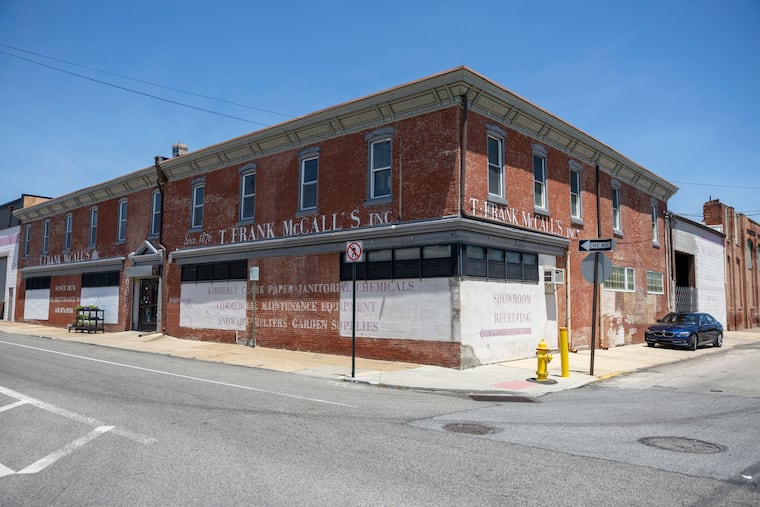
Humans still answer the phones. The business is family-owned and run by women. But perhaps the most remarkable aspect of T. Frank McCall’s is the reality that the store is still there, next to the railroad tracks in the Delaware County riverfront city of Chester, where it has been since 1876.
It has somehow survived through the administrations of 28 presidents, 32 governors, and 32 mayors; two world wars; the Great Depression; and the collapse of Chester’s economy that has climaxed with a rare municipal bankruptcy, By the time the Philadelphia Phillies played their first game in 1883, McCall’s had been in business for seven years at Sixth and Madison Streets.
The building has retained the faint odors of the company’s seed-and-grain roots. But these days the houses that had lined the streets are long gone. The nearest neighbor is a remnant of a factory that once was part of the city’s industrial might. The store’s owners are bemused by the unused bicycle lane on the other side of Madison Street, and the superfluous parking restrictions.
McCall’s sells janitorial and cleaning supplies, but rather than a traditional “jan/san” business, it is more like a hybrid wholesale general store. That its website features a snowfall image is fitting: It made a killing selling ice-melters this winter to SEPTA, Philadelphia, and other customers.
The assortment evidently continues to work; McCall’s generates about $10 million in annual revenue, said owner Lisa Witomski, whose father bought the company from the family of the original owners in 1957 in a decade when businesses were pulling out of Chester.
What explains the staying power?
In part, Witomski said, McCall’s sells things people have to have. “Nobody really wants to buy janitorial supplies, but if you have customers or employees, you need them.”
Staying in the one location in Chester, even though only a tiny percentage of the revenue comes from in-store sales, has been an asset, Witomski said. Customers know where to find them, and the company owns the 50,000-square-foot facility outright; the mortgage was paid off in 1880.
The county estimates the property’s value at about $850,000, and the company contributes about $17,000 annually to the city and the Chester-Upland School District in property taxes. It also pays a 6% sales tax to the city, and the 16 employees pay earned-income levies. The size of the workforce has not changed much through the years.
Most of the building’s space, which includes a former stable for the horses that delivered the company’s goods in the wayback when Chester was transforming from a rural outpost to an industrial power, is devoted to warehousing. About 95% of the company’s business is shipped on McCall’s trucks, Witomski said, and the location has outstanding road access, close to I-95 and the Blue Route.
When customers call during business hours, “a human being always answers the phone,” she said. “People are shocked when you say, ‘Hello,’ and they’re waiting for ‘press 1.’”
Being a family business that has resisted corporate takeover has given McCall’s an edge with customers, said Witomski, who recalled playing hide-and-seek among the store’s galvanized trash cans as a kid.
“Unlike almost all our competition, we haven’t sold out.”
The original McCalls
George McCall started his feed-and-grain business in 1876, when Chester’s population was growing rapidly. He eventually turned over the keys to his son Thomas, who later passed on the business to his sons under the name T. Frank McCall.
A breakthrough came in the 1880s when nearby Scott Paper — on the Chester riverfront, the company that is believed to have been the first to market toilet paper on a roll and disposable paper towels — hired McCall’s as its distributor. (The plant now bears the Kimberly-Clark name, but the Scott brand name survives.)
Along with Scott products, through the years it would sell and distribute a wide variety of janitorial and other products while remaining in the seed-and-grain business.
The McCalls would run the company for 80 years.
McCall’s today
They sold the company in 1957 at a time when Chester was entering a postwar decline: In the 1950s, the number of apparel and general merchandise stores in the city fell from 68 to 19, according to Chester Planning Commission documents.
Brothers Edward and Charles Witomski purchased the business on the advice of a member of the legendary Pew family, founders of the Sun Oil empire. The brothers had owned a bar in Essington and were looking for an enterprise that would be more family-friendly, Lisa Witomski said.
Like the McCalls, they continued the tradition of selling and distributing a wide variety of products, including paints and even baby chicks at Easter time. Eventually the business was passed on to Charles Witomski’s daughters, Marcie and Lisa, the company president. Marcie Witomski’s daughter, Lisa Claire, is the office manager; Marcie’s son Chas Wiley manages the warehouse.
In recent years their regular customers have included casinos throughout the region that have needs for paper and enzyme cleaning products. (Gamblers have been known to make a mess.)
And ice melter has been a source of considerable cold cash — this winter in particular.
“It was a doozy,” Claire said. It wasn’t just the 30 inches of snow, but the subsequent Arctic freezes that locked in the snow-and-ice coverage. The result was the sale of mass quantities of calcium chloride melter.
On occasion, a motorist along Madison Street, which is part of Route 320, stopped in to buy some melter, Lisa Witomski said, but the store never was heavily trafficked even when the neighborhood was well-occupied in the 1950s and ’60s.
Save for a few incidents — one person tried to walk off with a lawn mower, another tried to make off with a 100-pound barrel that he couldn’t carry — crime has not been an issue, Lisa Witomski said, even when the city went through a period a decade ago when it had the nation’s highest per capita homicide rate.
“We are not exactly in a populated area,” she said.
Cars parked in front of the store these days are anomalies. “We think the two-hour parking is very funny,” she said.
Said Michelle Cubler, the purchasing manager, “We’ve never seen them actually ticket on this street.”