Inside the battle over King of Prussia’s 4.6 million square feet of proposed data centers
Developer Brian O’Neill says the data centers would “change the world for the better.”
Five data centers totaling more than 4.6 million square feet have been proposed for a small swath of King of Prussia, across the Schuylkill River from the site of another potential 2-million-square-foot data center in a neighboring township.
Main Line developer Brian O’Neill’s MLP Ventures is behind all these plans. At a packed and at-times unruly Upper Merion Township Planning Commission meeting Wednesday, O’Neill called his vision “an opportunity to change the world for the better” through AI-powered biotech that would complement his existing life-sciences complex, Discovery Labs.
But many area residents say these data centers don’t belong in their neighborhoods. The massive cloud-computing facilities would upend their daily lives, they say, and threaten their long-term health.
“We don’t want to be guinea pigs,” said Courtney Smith, a 35-year-old tax accountant whose family lives less than a half-mile from one of the largest proposed sites.
Hundreds of people packed Wednesday’s four-hour meeting, expected to be the first of many on the subject, and thousands have signed an online petition opposing the King of Prussia facilities.
Opponents note the combined square footage of these centers would be larger than the Philadelphia International Airport, which encompasses 3.2 million square feet of terminal space, and the 2.9-million-square-foot King of Prussia Mall.
» READ MORE: Human reporters explain why AI data centers are so controversial in the Philly suburbs and beyond
These plans have garnered more community feedback than any other in recent Upper Merion history, according to local officials and community leaders.
Similar pushback has been seen in municipalities across the Philly region as a growing number of data centers have been proposed in recent years.
Here’s what to know about the plans in King of Prussia.
Where are data centers being proposed in King of Prussia?
Data centers of various sizes are being proposed at the following spots in King of Prussia’s Swedeland section, a small area of residential and industrial development between West Conshohocken and Bridgeport:
A nearly 2 million-square-foot data center is proposed for 2201, 2301, 2501, 2701 & 2901 Renaissance Blvd., which is occupied by office buildings and woods in the Renaissance business park partially owned by O’Neill.
A 1.7 million-square-foot data center is proposed for 411 Swedeland Rd., a property O’Neill bought from pharmaceutical giant GSK. GSK still operates there as a lessee alongside O’Neill’s life sciences company, Discovery Labs.
A 450,000-square-foot data center is proposed for 600 River Rd., vacant land near a FedEx distribution center and the shuttered Inquirer printing plant, which O’Neill bought in 2021.
A 371,000-square-foot data center is proposed for 3200 Horizon Dr., which is currently occupied by an office building owned by O’Neill.
A 188,000-square-foot data center is proposed for 2100 Renaissance Blvd., an office building owned by O’Neill on a remediated Superfund site.
Why are so many data centers proposed in one area?
“It’s not unusual,” said John Quigley, a senior fellow at University of Pennsylvania’s Kleinman Center for Energy Policy.
He pointed to the six data center campuses proposed for 14% of the land in one tiny borough near Scranton and said developers often want to scoop up available space for multiple developments.
But nationwide, “so much of this is speculative,” Quigley said. “There are already projects falling by the wayside.”
Who would operate the King of Prussia data centers?
O’Neill’s team has not said who would run the King of Prussia centers.
“We’re definitely leasing most of these buildings to tenants,” O’Neill said. However, “we want some of those buildings for our own business.”
In the Swedeland office complex, O’Neill’s Discovery Labs already runs a cell and gene therapy manufacturing facility that it says pursues cures for certain diseases and cancers.
O’Neill recently told Upper Merion Township officials that he would disclose the potential data center tenants to them if they signed a nondisclosure agreement, Township Manager Anthony Hamaday said Tuesday in an interview. Township officials declined, Hamaday added, because “they didn’t believe it was proper.”
O’Neill has said the data center he proposed in Plymouth Township, near Conshohocken, would be operated by a tenant related to the life sciences.
What is the latest on the data center proposed near Conshohocken?
Across the Schuylkill from the King of Prussia sites, O’Neill wants to build a 2-million-square-foot AI data center on the outskirts of Conshohocken. He resubmitted this plan to Plymouth Township officials last month.
A similar proposal was abruptly withdrawn in the fall due to legal issues over an agreement of sale for the 900 Conshohocken Rd. site, which operated as a Cleveland-Cliffs steel mill until last summer.
This revived data center plan is set to be discussed by the Plymouth Township zoning hearing board, a quasi-judicial body that would need to grant a special exception for O’Neill’s Conshohocken-area project to be built in the heavy industrial zone. The first of several hearings on the subject is set for June 25, the township announced Thursday.
If an exception is granted, the plan would then go through the land development process, which includes more hearings, reviews, and approvals.
» READ MORE: Controversial AI data center proposal has been resurrected outside Conshohocken
Do O’Neill’s King of Prussia data centers need zoning exceptions?
O’Neill said his King of Prussia plans are allowed under current zoning, and he does not intend to ask for any variances.
But township officials on Wednesday disagreed on whether data centers are allowed in all three zones where O’Neill is planning to build.
Hamaday, the township manager, had said Tuesday that there’s always a chance a project could require a variance.
First, however, the plans must be reviewed by the Planning Commission, which will make a recommendation on whether the Board of Supervisors should approve the plan. Hamaday said this process will likely require several Planning Commission meetings over the next few months.
Does Upper Merion Township have a data center ordinance?
Yes.
Upper Merion Township recently enacted an ordinance that regulates the noise, energy, and water consumption of new data centers; limits a facility’s size and height; and requires “significant residential setbacks and noise and visual buffers,” the Board of Supervisors said in a recent statement.
But O’Neill’s plans were submitted before the ordinance, meaning they are not required to abide by these new standards, according to the supervisors.
O’Neill said Wednesday that he plans to comply with those conditions anyway.
What do King of Prussia residents say about the proposed data centers?
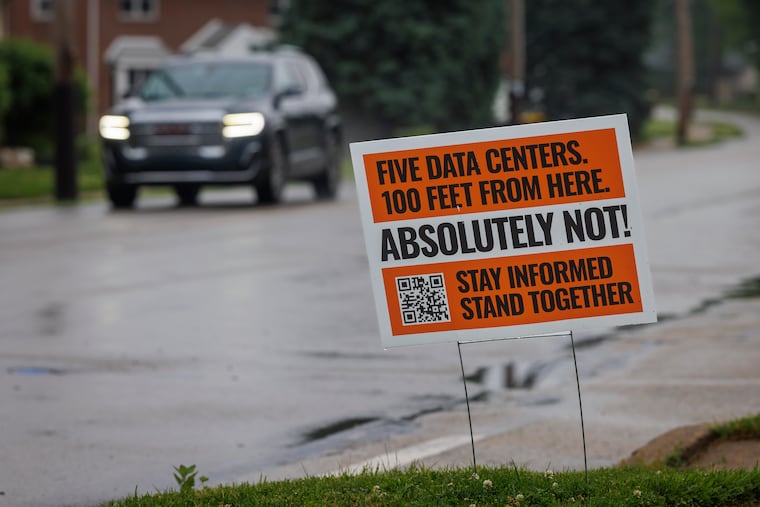
In Swedeland neighborhoods, including Hughes Park and Gulph Mills, some homeowners display bright orange lawn signs that read: “Five data centers, 100 feet from here. Absolutely not!”
Patti Erickson, who helps run the Hughes Park Civic Association, said she can’t recall another issue bringing out such a large response in her 25 years of community organizing.
“Everybody in Upper Merion understands that a hyperscale data center could impact all of us,” said Erickson, 62. “Why would you do this to a thriving community? There has to be a better spot for something like this.”
Kaitlin Hartung, 36, who moved to Hughes Park six years ago, said she wants her 15-month-old daughter to play outside and walk the area’s trails without inhaling pollutants or hearing the constant hum of a data center.
“My daughter has been the main inspiration — the thought of her growing up 100 feet away from something we don’t know anything about the long term effects of,” Hartung said.
» READ MORE: A massive and controversial AI data center is under construction in South Jersey
How has Brian O’Neill responded to residents’ concerns?
O’Neill said the centers won’t use any water because they’ll rely on a closed-loop system. They’ll provide their own power, he said, and offer excess back to the grid.
O’Neill said his team is spending billions of dollars on emissions control equipment, and the centers will comply fully with noise regulations, emitting the sound equivalent of a moderate rainfall. The current buildings on those properties emit much more light than the data centers will, O’Neill said.
While most data centers result in very few permanent jobs, O’Neill said the King of Prussia facilities will “create 10 times the jobs of the development of the Comcast Tower.” And “not a single use on this planet that will make as many tax dollars,” he said.
During public comment, Upper Merion tax collector Evelyn Ankers disputed O’Neill’s tax-revenue numbers.
“This is an amazingly privileged township to live and work,” O’Neill said. “The extra tax revenue that we can provide can take a great thing and maybe make it even a little better.”
What do experts say?
Quigley, of Penn’s Kleinman Center, said residents’ environmental and quality-of-life concerns are “absolutely real,” especially given the “cumulative impacts” of several large data centers in one area.
When it comes to the potential impact of 4.6 million square feet of data centers compared to, say, a single 2-million-square-foot facility being built in a community, “it’s more than one plus one equals two,” he said. “It’s one plus one equals four.”
Editors Note: This story has updated with new information about the Plymouth Township zoning hearing board meeting.