What does Montco’s PJM have to do with data centers and why is Gov. Shapiro always so mad at it?
PJM plays a major role in getting data centers powered and connected to the regional electrical grid. Consumer advocates say the data centers are forcing consumers to pay for the new power plants.

Pennsylvania Gov. Josh Shapiro spotlighted energy affordability and the rapid expansion of data centers during his annual budget address Tuesday, singling out PJM to speed up new electrical connections for the centers.
PJM Interconnection — the region’s dominant electric grid operator — is poised to play a central role in the expansion of data centers, as the independent organization has been shoved into the national spotlight and subjected to mounting pressure over the last year.
It has been a frequent target of Shapiro, officials from other states, consumer advocates, and the federal government.
In many ways, PJM may be one of the most consequential Philly‑area institutions that most residents have barely heard of, even though their electricity supply and monthly bills hinge on its decisions.
The organization has faced escalating scrutiny nationwide and across the region because of its position as the country’s largest independent grid operator and the challenges tied to surging energy demand.
What is PJM?
Based in Audubon, Montgomery County, PJM manages the minute-by-minute flow of electricity for 67 million people across 13 states and the District of Columbia.
It helps keep the lights on for 13 million Pennsylvanians.
Why are there concerns about PJM and data centers?
Concerns have risen over the cost to consumers posed by hyperscale data centers — the massive server farms needed to run artificial intelligence — that are poised to come online across Pennsylvania and the U.S.
PJM plays a major role in getting those data centers powered and connected to the regional electrical grid.
Consumer advocates say the data centers are forcing consumers to pay for the new power plants and equipment needed to keep up with that demand. And they fear that huge demand could result in electrical outages during times of peak demand.
Already, consumers have seen electricity prices spike — and that’s before most of the proposed data centers are even built.
How much consumers pay is influenced by an annual auction held by PJM designed to get enough commitments from power producers so that the electrical grid can meet forecast demand for several years and to ensure power during peak times. That is known as grid reliability.
Why is Gov. Shapiro critical of PJM?
Shapiro and other governors have been sharply critical of how PJM has designed its auction, saying the process lacks transparency.
In a 2024 lawsuit, Shapiro’s office referred to PJM’s decisions as “inept” and responsible for “the country’s most snarled interconnection queue,” in reference to projects lined up for approval to be added to the grid.
After the 2025-26 auction, Shapiro reached an agreement with PJM on a price cap that he said would save consumers over $21 billion and avoid historic price hikes. The cap limited the increase of wholesale electricity payments to power plant owners.
PJM held another auction in December for 2027-28, in which it failed to procure enough supply to meet forecast demand next year.
PJM forecasts that data centers will drive a need for more than 30 gigawatts of peak electricity capacity by 2030 — enough to power more than 20 million households, or approximately all the homes in New Jersey, Pennsylvania, Ohio, Virginia, and Maryland, according to the Natural Resources Defense Council (NRDC).
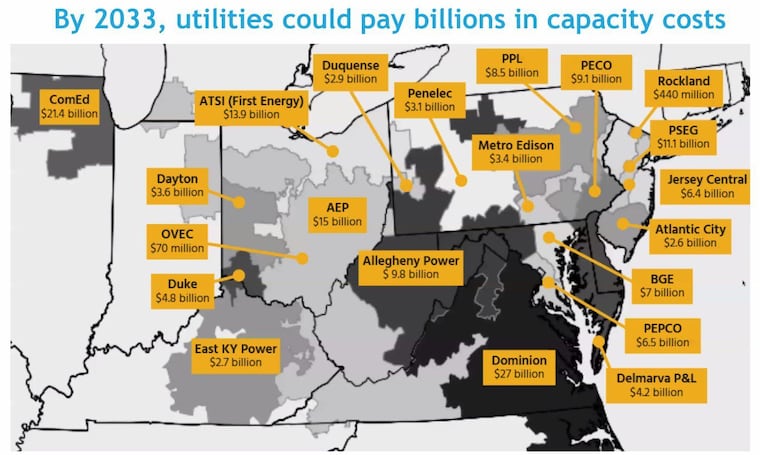
The NRDC says that could lead to another spike in electricity costs through 2033 and cost homeowners and businesses an estimated extra $70 per month.
As a result, Shapiro and federal officials have urged PJM to extend the current price cap another two years.
Why is there a push for more data centers?
At the same time, however, officials are also pushing PJM to fast-track data centers.
Late last year, the Federal Energy Regulatory Commission issued an order on so-called colocation that will allow tech companies to plug their data centers directly into power plants.
In January, the Trump administration and a group of governors, including Shapiro, urged PJM to move quickly to boost power supplies and keep bills from rising.
They also want PJM to hold a separate power auction in which tech companies would bid on 15-year contracts to build new power plants. That way, data center operators, not regular consumers, would pay for the power.
Data centers that do not have their own power source and do not volunteer to be cut off from the grid during power emergencies should be billed for the cost of new power plants, they said.
Why do people resist data centers near their homes?
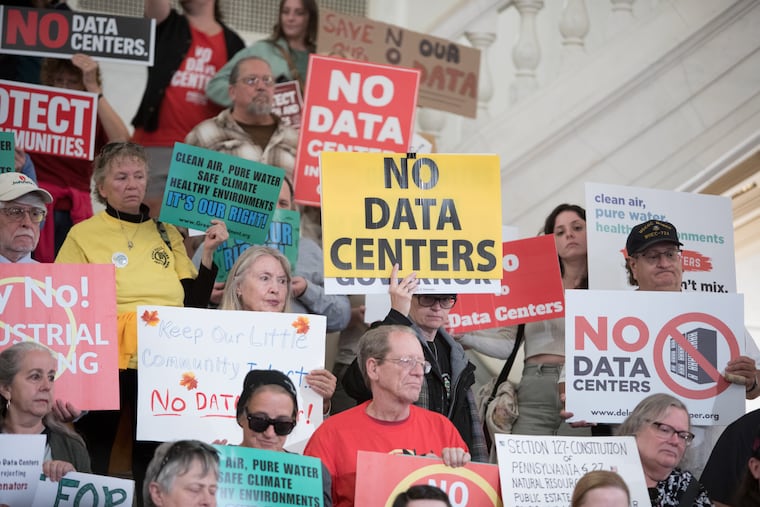
The quick rise of data centers has met stiff resistance from residents who fear the projects will radically alter the character of rural neighborhoods, increase electricity and water costs, and harm the environment.
Developers have submitted applications for at least 20 hyperscale data centers in Pennsylvania. PJM would have to find a way to make sure they can be powered and connected reliably to the grid, or provide their own power.
At least six data centers are being planned or proposed in the Philadelphia region, with some reaching 2 million square feet. Residents have fought the proposals, some of which have run into zoning and planning problems.
Data centers are proposed in Falls Township, Bucks County; East Vincent and East Whiteland in Chester County; Limerick in Montgomery County; and Vineland, N.J. A proposal for a data center in Plymouth Meeting, Montgomery County, has been withdrawn, but another proposal could be submitted at any time.
Residents of some of those communities are alarmed by a new Pennsylvania House bill (HB 2151), which is backed by Shapiro. It provides a model ordinance designed to speed data center development.
Opponents believe the bill is an attempt by the tech industry to get data centers approved.
“HB2151 would undermine Pennsylvanians’ herculean grassroots efforts to keep dirty data centers out of our communities — it must be stopped," said Ginny Marcille-Kerslake, an organizer for Food and Water Watch, an environmental advocacy nonprofit.
“This bill pushes Shapiro’s reckless embrace of data centers even further onto communities struggling to grapple with Big Tech’s land, power, and water grab,” she said, calling it a part of “backroom deals” the state is making.
A vote on the bill before the House Energy Committee is scheduled for Wednesday.
What’s next?
Environmentalists and other groups, including some legislators, say a process by PJM to fast-track electricity-producing projects excludes clean energy and gives special treatment to fossil fuel power plants, allowing them to cut ahead in the queue over renewable sources that have waited years to connect to the grid.
Meanwhile, PJM recently released its much-anticipated plan for how to deal with the demand created by data centers.
That plan calls for changes in PJM policies to bring new power online quickly by providing a streamlined path for state-sponsored power generation projects, improving load forecasts, giving a bigger role in the process to states, and offering ways for data centers to bring in their own power generation while curtailing power in times of system need.
The plan, PJM said, “will also help address the supply-and-demand imbalance that has the potential to threaten grid reliability and is currently driving up wholesale costs that can impact consumer bills.”
Jeff Shields, a spokesperson for PJM, said the imbalance has been created as sources of power generation are being retired without enough new generation coming online to keep pace. At the same time, demand for electricity has increased substantially due to the proliferation of data centers.
“PJM is doing its part to bring new generation onto the system, and any suggestion otherwise is just not true,” Shields said.
He also noted that while PJM does run wholesale power markets, it does not directly set rates for residential, commercial, or industrial customers. Those rates are set by utilities, such as Peco, along with government agencies, such as the Pennsylvania Public Utility Commission.