The making of ‘the Guru’: How creating the AP women’s basketball poll changed Mel Greenberg’s life
There's no book yet, but after graduating from Temple, Greenberg helped launch women's basketball into a national spotlight that's grown brighter in the past 50 years.
These days, when traveling for WNBA coverage or big women’s college basketball games, a conversation with the Uber or Lyft driver may touch on the event.
To my surprise the dialogue often extends to my 40-plus years at The Inquirer, which culminated in the spring of 2010. The driver, especially if they’re knowledgeable of sports, may ask, what is your name?
When given, the immediate response might be Oh, I’ve read your stuff, or Yeah, I know you. You’re a legend!
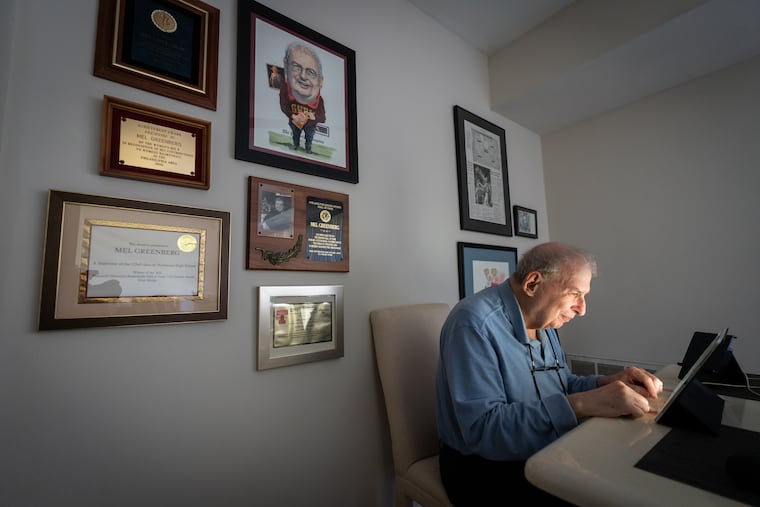
Similar discourse may occur if I’m writing the overnight roundup for my blog on my iPad in a restaurant or sports bar.
And perhaps I shouldn’t be shocked when recognition comes up in Connecticut when covering the dynasty built by Norristown’s Geno Auriemma.
These are moments that would not have occurred long ago.
In fact, I might have mentioned employment at The Inquirer, but with little or no reference to women’s hoops, since those once involved with the sport were a limited sect of participants and other media, covering their own teams.
So now it’s the 50th anniversary of the Associated Press women’s basketball poll, begun by yours truly at The Inquirer.
» READ MORE: Born in The Inquirer’s newsroom, the AP women’s basketball poll ‘has stood the test of time’
Since there are now lots of years of involvement that include lots of tales along the way, many have urged me to author a book.
There’s no book yet, but what follows are moments along the way to becoming the trip lever to a sport now heavily attended and watched by millions on TV.
My interest in journalism in my formative years and time as a manager for the Temple men’s basketball team — in the heyday of the Big 5 when the Owls won the 1969 NIT — were backgrounds when applying for a copy boy slot at the paper down Broad Street, which a few days later turned into a promotion to an editorial clerk on the business page.
The thought of being in sports was nonexistent then since in those days beats were held by longtime veterans.
Now it’s the fall of 1975, and the late Jay Searcy becomes sports editor. He’d been writing a women’s column at the New York Times and was very aware of Immaculata, which was winning national titles, and he asks me to basically create the women’s beat.
A formal role on the writing staff came much later. My “day job” was in other duties, which is its own tale.
I used to joke with women’s basketball coaching legend C. Vivian Stringer, “I’m like you. I teach gym and coach, and all they’re interested in is make sure l’m on time in the morning for gym class.”
» READ MORE: How Inquirer staffer Mel Greenberg’s poll changed women’s college basketball forever | Claire Smith
But of course, pioneering a beat had its luxury.
When time came to start the poll, I used the way presidential elections were covered on TV, making knowledgeable sources in the nine regions of the Association for Intercollegiate Athletics for Women, which governed women’s sports before the NCAA took over.
Ed Jaworski, then the media contact for Queens College in New York, was my go-to.
He was so thrilled in the first month of the poll that he wrote a piece for Editor & Publisher, the weekly bible for newsroom executives, that became a two-page center spread under the headline “You May Ask, What is The Greenberg Poll,” which was a stunner to The Inquirer’s bosses when the edition arrived on their desks.
What the poll did initially, as I said at the time, was give teams an identity. That created an early impact: The day after Texas hosted Stephen F. Austin, now a top-five contest, a call came from the Lone Star State telling of the massive crowd at the annual game.
When I’d make calls in the early days, they’d start like, “Hi, my name is Mel Greenberg,” “Who?” “At The Philadelphia Inquirer.” That quickly evolved to a Hey, how are you doing? before I could finish my introduction.
In the spring of 1976, Penn State was hosting the AIAW’s 16-team national finals.
In spending hours writing a preview, I thought, If I’m going to get into this, I’m doing it for every writer coming after me who won’t go through the same agony.
This is still in the last stages in the world of typewriters.
I added my own top 20 and noted four key potential upsets in the first round.
That night, a call came from State College. All four had happened.
I thought, this is fun but if I’m going to do a poll, I need someone to blame it on — hence coaches because there wasn’t enough media to be weekly voters.
Five weeks into that first season, I wasn’t keeping records, which caused the late N.C. State coach Kay Yow to call and lecture me, saying I’m going to be the keeper of history moving forward.
Fortunately, a double floppy disc software program called Reflex came along. Those original files from me have migrated into thousands of lines on spreadsheets of Microsoft Excel that enable to note that this week, No. 901 in Year 50, UConn’s Auriemma passed retired Stanford coach Tara VanDerveer with 655 appearances. His Huskies have been ranked a record 622 consecutive weeks dating to preseason 1993-94, a year before their first national title season.
» READ MORE: What’s it like to face one of Geno Auriemma’s UConn teams? Ask Villanova’s Denise Dillon.
Two years into the rankings, the Collegiate Sports Information Directors Association urged the AP to start running the poll, which began the relationship, with my name attached, and appearing with stories in papers across the nation.
I once told coaches in the early days to be patient. Newsroom executives are getting younger and have daughters in athletics.
Things took a dramatic turn internally when Gene Foreman, our No. 2 in the newsroom, said his daughter, a swimmer at Virginia, also was going to be a trainer on the women’s basketball team, where she and North Philly native Dawn Staley became friends.
Soon, the nicknames started, mainly Mr. Women’s Basketball, but soon enough to Women’s Hoops Guru, the name of my blog, and just when in person, simply Guru.
» READ MORE: Unrivaled’s Philadelphia spectacle delivers not just a big crowd, but a profitable one
I recently noted when accepting a special achievement award from the Philadelphia Sports Writers Association at the annual dinner, like Woody Allen in the movie Zelig being at many moments in world history, l’m the equivalent in women’s hoops.
I helped in the AIAW evolve the tournament into a Final Four format for better media and public understanding; together with retired St. Joseph’s coach Jim Foster and retired Villanova coach Harry Perretta, helped formalize women’s Big 5 play; saw the launch of ESPN and the WNBA; and remained deeply involved in the coming of NCAA women’s competition.
Players I’ve covered have become coaches such as Villanova’s Denise Dillon, St. Joe’s Cindy Griffin, and Drexel’s Amy Mallon, while younger media types have gravitated, too.
Yes, there’s much more to tell, but the word limit, even for the internet, is approaching, and so is the deadline.
In later years the many awards have been nice, but it’s the friendships that have made it all worthwhile.