Iwo Jima is a thing Trump should read about | Will Bunch Newsletter
Plus: Can “No Kings” pull off the first U.S. general strike?
There are only two kinds of days in late March. Either you get a ridiculously balmy afternoon like Thursday’s Phillies home opener, which sends your mind whistling past the graveyard of climate change, or Saturday’s bitter cold that was apparently meant to forge a spiritual bond between local “No Kings” marchers and their Minnesota brethren. You’d be a fool not to welcome the arrival of April.
If someone forwarded you this email, sign up for free here.
Trump’s disastrous Iran ground troop plan is ignorant of history
Frank Mirabella wasn’t supposed to be in the first wave of troops who came ashore on Iwo Jima on Feb. 19, 1945, in a Marine-led attack on the small Japanese-controlled volcanic island that was home to two strategic airfields. A U.S. Army radar operator, Mirabella abandoned his ship when it was struck by a Japanese kamikaze pilot, ended up on a landing craft, and was thrust into one of the bloodiest battles of World War II.
In 2016, the Brooklyn-born veteran told a U.S. Military Academy historian about a day of surprises, from the unexpected silence when he came ashore to sinking in the black, putrid volcanic sands. But the biggest shock came near the base of Iwo Jima’s Mount Suribachi: thousands of enemy troops lying in wait, in caves and holes and thick pillboxes.
“We got inland, and all hell broke loose,” Mirabella recalled more than 70 years later.
Hell is an understatement. In taking the critical mountain, historians say that one Marine was killed for every yard that was gained. “It was terrible, the worst I can remember us taking,” another survivor recounted. “The [Japanese] mortarmen seem to be playing checkers and using us as squares.”
Today, most living Americans know one thing about the Battle of Iwo Jima: the iconic photo by the Associated Press’ Joe Rosenthal of Marines raising a large American flag on the peak of the mountain, the image that would later be reproduced in Washington, D.C., in statue form as the U.S. Marine Corps War Memorial. For more than 80 years, this iconic shot has defined American heroism and might.
What few people today know is the human price that came before that shutter snap. Taking Iwo Jima and its airstrips led to 24,000 wounded or dead Americans, which was one of every three troops who came ashore. Some 6,000 of those were killed. An account for the National World War II Museum noted that the 5th Marine Division needed 22 Marine transports to storm the island, but only eight to bring the survivors home.
I think of the long-ago, ultimate sacrifice of these Greatest Generation soldiers every time I hear about the Trump regime and its scheme to turn around its badly botched-so-far war of choice in Iran by sending thousands of American troops into ground combat in the Persian Gulf, possibly including an all-out assault on Kharg Island.
Kharg Island doesn’t have a mountain peak, or a web of caves, or malodorous quicksand, but it does have oil — a massive storage facility, and the port that exports 90% of Iranian crude shipments — and, much like Iwo Jima, soldiers who will fight to the death to defend it.
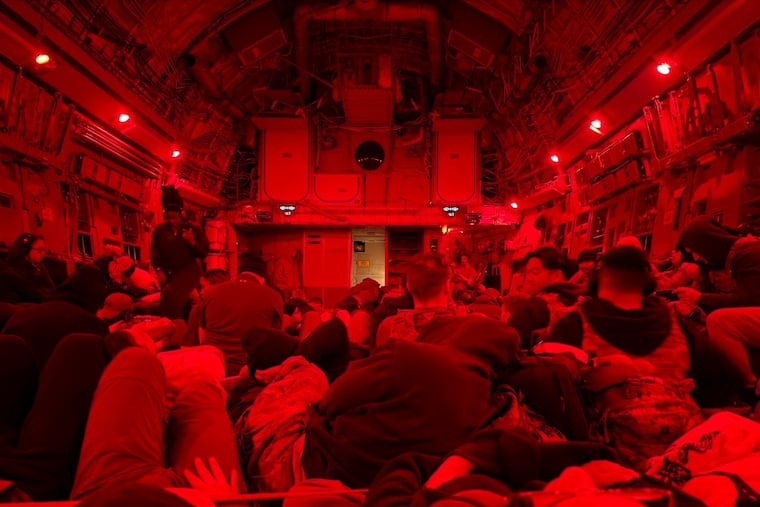
The oil oasis is just one site the Trump regime is weighing for a ground attack. Thousands of American service members who specialize in combat missions such as amphibious landings are currently arriving in the Persian Gulf, with 2,500 Marines and sailors aboard the USS Tripoli, as well as units of the elite 82nd Airborne Division. Experts have speculated these troops could also fight to secure land adjoining the Strait of Hormuz shipping lane, or even undertake a daring raid to seize Iran’s hidden stockpiles of material to make nuclear weapons.
Deploying these forces would cross a border, but also a psychological point of no return that Americans arguably are not ready for. An AP-NORC poll last week found about six in 10 voters “strongly” or “somewhat” oppose sending ground troops into Iran, including nearly half of Republicans — and for good reason.
CNN reports that the Iranian military has been installing a layered defense on Kharg Island, strikingly similar to what Marines once faced on Iwo Jima. This adversary has moved additional shoulder-fired, surface-to-air guided missile systems known as MANPADs to Kharg, while anti-personnel and anti-armor mines are placed around the island, including the beaches where U.S. troops would attempt to come ashore. Once again, America could be facing casualties in the thousands.
“I would be very worried about this,” retired Adm. James Stavridis, the former NATO commander, told CNN. “Iranians are clever and ruthless. They will do everything they can to inflict maximum casualties on U.S. forces both on the ships at sea and especially once ground troops are anywhere in their sovereign territory.”
The loss of American lives is far from the only thing to worry about. Any operation to seize either Kharg Island or the Strait of Hormuz shoreline would likely take weeks, and thus make a mockery of Trump’s claims that the U.S. and Iran are involved in negotiations seeking a speedy end to the conflict. A prolonged standoff, some experts predict, could send crude oil prices as high as $200 a barrel, which would trigger a global recession and send prices at the gas station as high as $7 a gallon.
In World War II, Americans understood — and broadly supported — the need for home-front sacrifices like gasoline rationing or planting “victory gardens” as contributions to a war against German fascism and Japanese imperialism. But any hardships for this war — that a majority of the nation did not want and does not understand, and that our leaders can’t even be bothered to adequately explain — could spark massive unrest.
What’s particularly striking about the Iran war is the Trump regime’s willful ignorance of military history and the lessons of a tortured past, and not just Iwo Jima. In Vietnam — the war that a young, wealthy Trump avoided in 1968 by finding a doctor to write up his “bone spurs” — Pentagon officials escalated from a handful of training officers to 16,000 “boots on the ground” to ultimately a vast army of some 500,000 U.S. soldiers, always promising citizens there was “light at the end of the tunnel.”
After the war became a quagmire, U.S. objectives became less about maintaining a noncommunist government in South Vietnam and more about ending the conflict in some way that could preserve America’s prestige as a world superpower. Richard Nixon became president in 1969 while lying about a “secret plan” to end the war before he prolonged it for four years, as 20,000 more young Americans died not for freedom, but to help Nixon avoid the embarrassment of losing a war.
Does this sound familiar?
The use of American ground troops in Iran is a red line that absolutely should not be crossed. It is a potential calamity that must be opposed by any means necessary — perhaps with Congress finally standing up to invoke the 1973 War Powers Act, which was itself inspired by the Vietnam fiasco, and cutting off funding for this illegal war. It also wouldn’t hurt if everyday Americans continued to apply pressure by taking to the streets in protest, as eight million did last Saturday.
Just over 81 years ago, the young Frank Mirabella was most fortunate. Although he watched his comrades gunned down on Iwo Jima, he told the 2016 interviewer that “those 22,000 [Japanese] did not have a bullet with my name on it.” In 2026, some Americans would not be so lucky on Kharg Island if we do not learn from our past.
Yo, do this!
The mid-20th-century British author and essayist George Orwell somehow always feels relevant, but especially so today with a U.S. government that tosses history down a memory hole, rants in Two Minutes Hate against its enemies, and changes war objectives mid-sentence. Perfect timing, then, for the new documentary, Orwell: 2+2=5, which is available to rent on major streaming services. Watch and learn why 1984 was less prediction, more eternal truth.
Regular readers have probably taken note of my belief that history explains the present, but especially the society-changing upheavals of the 1960s, with much of that energy centered on then-booming college campuses. That’s the intriguing premise of a new book, Revenge for the Sixties: Sam Alito and the Triumph of the Conservative Legal Movement, that looks at how a future U.S. Supreme Court justice’s disgust with campus protesters and hippies at Princeton in the early 1970s led to his present of denying abortion rights and other right-wing causes. The past is never really past.
Ask me anything
Question: “Is Trump’s building a bunker under that new ballroom?” — @pollyfitch.bsky.social via Bluesky
Answer: The short answer to this one is … apparently, yes. The information “has come out recently because of a stupid lawsuit that was filed, but the military is building a massive complex under the ballroom, and that’s under construction, and we’re doing very well,” Trump told reporters on Air Force One on Sunday. One has to think that the construction of a huge underground bunker next to his residence isn’t going to stop the frequent comparisons on Bluesky to a certain German strongman of yesteryear. It also might explain the obscene $400 million cost of this unsightly vanity project, but the implications are what’s really stunning. Why would our president need to go underground like a 1960s revolutionary? I could speculate, but the answers are not good.
What you’re saying about …
Much as I expected, last week’s question about a potential Trump impeachment drew a big response. Most of you also agree with me that the list of high crimes and misdemeanors is overwhelming, although potential counts about the illegal war in Iran and the grift that has enriched the president and his family with billions of dollars were specified by many. Most believed more broadly that impeachment is important. “You may call this retribution but I want this nation and the world to see that we do believe in the rule of law,” Evan Steinberger wrote. A few were more cynical, like frequent writer Mary Ann Petro. “If there is not enough votes for him to be [convicted] by the Senate then I’m not sure what the point would be,” she argued.
📮 This week’s question: As discussed in the item below, the “No Kings” organizers are calling for a nationwide general strike on May 1. Will you participate, or are you in a situation where walking off the job would be too risky? Please email me your answer and put the exact phrase “general strike” in the subject line.
History lesson on the lack of U.S. general strikes
The organizers of the massive “No Kings” protests against Donald Trump’s authoritarianism made history Saturday in attracting an estimated eight million-plus protesters to more than 3,300 rallies across the nation and around the world. But to take down an American dictator, the movement’s leaders are now looking to organize something that has truly never been done before: stage a one-day national general strike on May 1. Indivisible’s Ezra Levin told the flagship rally in St. Paul, Minn., this weekend that the plan for that Friday is to declare, “‘No business as usual.’ No work, no school, no shopping. We’re going to show up and say we’re putting workers over billionaires and kings.”
A successful nationwide general strike has happened many times — in France and other countries around the world, but never in the United States, a land where capital seems to always hold most of the cards in its perpetual battle with labor. For many Americans in a nation in which unions have steadily declined in power since the post-World War II era, missing work for a protest isn’t always protected by labor laws. And in a nation without safety nets like universal health insurance, the risk of unemployment is a tightrope walk many would fear to take.
In times of rising labor strength and postwar upheaval, there have been citywide general strikes in the United States. In Seattle in 1919, a four-day job action that started in the city’s shipyards and spread to some 60,000 workers was ultimately put down by National Guard troops, and — in a climate of “Red Scare” anti-communism — weakened the future labor movement in the Pacific Northwest. Likewise, 1946’s massive job action in Oakland, Calif. — which started as a clash between store owners and unions seeking to represent underpaid, mostly female retail workers — may have been the last straw for Congress to pass the anti-labor Taft-Hartley Act.
Today, it’s even less clear how a general strike would work in a more decentralized postindustrial economy. But the “No Kings” organizers believed they saw a glimpse of the future on a Friday in late January, when protesters shut down wide swaths of Minneapolis and St. Paul, including 700 places of business, for a metro-wide action that included demonstrations at the airport and the headquarters of Target.
Can that Minnesota one-day action work on a national scale? Five weeks is a relatively short window to plan and promote such a large-scale protest, even in the age of social media. But the bigger question is, how many Americans will risk ticking off their boss or having a school suspension on their college application? An oft-repeated saying since Trump’s 2016 election is that whatever you think you would have done to fight European fascism in the 1930s or U.S. racial segregation in the 1960s is what you are doing right now. That will be put to the test on May Day. Stay tuned.
What I wrote on this date in 2023
It was exactly three years ago today (yet it feels like a half-century) when I wrote a column celebrating what should have been the beginning of the end for Donald Trump — his 34-count indictment on business fraud charges in Manhattan tied to his use of 2016 campaign dollars to pay off an adult film star with whom he’d had an affair. Over the next 20 months, Trump would become a convicted felon and the 47th president of the United States. I wrote on March 31, 2023, that “if America is to be a nation with liberty and justice for all, then the law that applied to [ex-Trump lawyer Michael] Cohen needs to apply to Trump.”
Read the rest and weep: “Trump indictment is one night of ‘karma’ in a nation of injustice.”
Recommended Inquirer reading
Taking a week off to deal with a family project and clear my head actually helped! I returned with a Sunday column that looked at a 24-hour slice of Donald Trump’s America, with a jetliner crash at one of the nation’s airports amid interminable lines and militarized ICE agents, while the president’s cronies were apparently grifting off his pointless Iran war and climate change burned unimpeded. This weekend, I went to a “No Kings” rally in Delaware County and took on the political naysayers who don’t get the spirit of hope and community that is defying dictatorial despair.
The good news is that Major League Baseball is back in town to mark the real arrival of spring. That’s arguably also the bad news, as the Phillies are off to a typically horrendous 1-3 start, with a batting crew that looks more than a year older than last year’s nearly identical lineup that occasionally belonged on a milk carton. But baseball in Philadelphia is less a sport than a way of life, which is how The Inquirer covers it. Last week, readers learned not only about the Phillies’ dismal doings at the plate, but also the stunning fact that third baseman Alec Bohm is suing his own parents over money, the corporatization that killed the popular Harry the K’s eatery out past left field, the latest TV broadcast shake-up, and more. It’s going to be a long, strange trip for the next six or so months, so knock a hanging curveball over the paywall and subscribe to The Inquirer to read every story, win or lose.
By submitting your written, visual, and/or audio contributions, you agree to The Inquirer’s Terms of Use, including the grant of rights in Section 10.