Putting the Joe Frazier statue in the shadow of the Rocky statue is a low blow
We should not be elevating fiction over reality in Philadelphia as the federal government is attempting to erase our historical facts.
I thought the absolute nonsense around the Rocky statue being permanently exalted to the top of the steps of the Philadelphia Museum of Art couldn’t be any more embarrassing for Philly. Then, the people in charge of these decisions ripped open my eyes, like Mick, to prove me wrong.
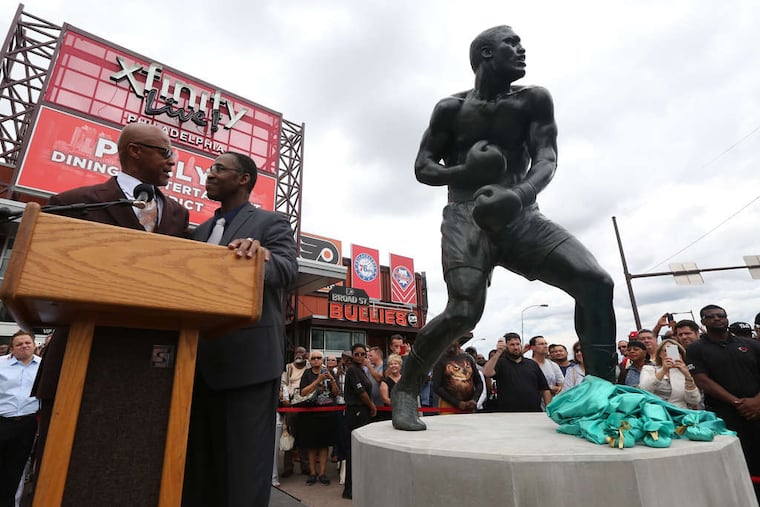
On Wednesday, the Art Commission approved a proposal from Creative Philadelphia, the city’s office of arts and culture that maintains and preserves Philly’s art collection, to move the statue of legendary Philadelphia boxer “Smokin’” Joe Frazier from the stadium complex, where it’s been since 2014, to the base of the steps of the Art Museum.
This would normally be a great thing — the Art Museum is in a much more prominent place in the city and Frazier deserves that honor — except that in this case, the Frazier statue is getting the Rocky statue’s leftovers. It’s a bigger smack in the face than a sucker punch in the ring.
Creative Philadelphia didn’t think the nice little cove at the base of the Art Museum steps where the city’s Rocky statue has been displayed since 2006 was good enough for it anymore. So last month — despite an informal Inquirer poll that showed it was the last thing Philadelphians wanted — the commission approved Creative Philadelphia’s proposal to permanently move the city’s Rocky statue to the top of the steps. (There are currently three Rocky statues in Philadelphia; don’t even get me started on that.)
At the January meeting, commissioner Rebecca Segall said of the Rocky statue: “I believe it’s one of Philadelphia’s most meaningful monuments, and I believe we should just get him out of the bushes and put him up top.”
Creative Philadelphia and the Art Commission decided “the bushes” weren’t good enough for Rocky, but will be good enough for Joe Frazier. They will put the statue of the real legendary Black boxer right there near a shipping container called the Rocky Shop that sells Sylvester Stallone-licensed products, as if it were some Black History Month consolation prize.
I mean, c’mon! Do they even hear themselves?
If any statue belongs at the top of the steps, it’s Frazier’s.
I’m not the first to point out that Frazier deserves the recognition this city gives to Rocky, and if history is any indicator, I sadly won’t be the last.
In a letter of support for the move of Frazier’s statue, Mayor Cherelle L. Parker wrote that putting it at the Art Museum “affirms Philadelphia’s commitment to honoring real-life achievement alongside cultural mythology.”
But when President Donald Trump’s administration is removing historical facts about slavery from the President’s House Site, why should mythology get top billing?
At this time, we should not be elevating fiction in Philadelphia as the federal government is attempting to erase our facts.
Yes, Rocky is a fictional Philadelphia icon, but Frazier, a former world heavyweight champ, was a real-life inspiration for the character, according to Creative Philadelphia, which mentioned it in its recent proposal.
Frazier, who worked at a Philly slaughterhouse, claimed in a 2008 interview with the Guardian that he’d “go down that long rail of meat and work on my punching.”
“That’s how [Sylvester] Stallone got the same idea for Rocky — just like he used the story about me training by running up the steps of the museum in Philly," Frazier said. “But he never paid me for none of my past. I only got paid for a walk-on part. Rocky is a sad story for me.”
Frazier wasn’t just one of the inspirations for Rocky, he was one of the greatest heavyweight pugilists ever. In 1964, he won the Olympic gold medal in heavyweight boxing with a broken thumb, and in 1970, he won the world heavyweight title. Here in Philly he gave back, purchasing his own gym in North Philadelphia where he didn’t charge rent and trained a new generation of boxers who found community there.
Putting the Rocky statue at the top of the steps is clearly designed to appeal to tourists, but those steps are not just a tourist attraction. They are the very place where Philadelphians go to celebrate and protest.
It’s where the Eagles celebrated their Super Bowl wins and where Live 8 took place. It’s where people gathered during the protests against the murder of George Floyd in 2020 and I saw the lyrics of Woody Guthrie’s “All You Fascists” written on the steps in chalk. It will be the center stage for the nation’s 250th birthday celebrations on July Fourth, and in the center of it all will be the Rocky statue.
Did Frazier not suffer enough slings and arrows in his life that even in death, this city is choosing to exalt the fictional character he inspired over the very man himself?
That’s a sad story for Philadelphia.
I understand why those who love and respect Frazier wrote letters of support for his statue’s move from the sports complex to the base of the Art Museum, where it will have more visibility and more people will get a chance to learn about him.
But we can and should do so much better to honor Frazier’s story, and Philadelphia’s. It should not have taken moving the Rocky statue to the top of the steps to get Frazier’s at the base, and when it does go there later this year, it should not be overshadowed by a fictional character based, in part, on him.
The truth — especially about Black history in this country — is too important.