Smaller portions, fewer second drinks: How restaurateurs are adapting to changing consumer trends
Diners’ preferences have changed in recent years, amid economic uncertainty and the rise of weight-loss drugs that curb appetites.
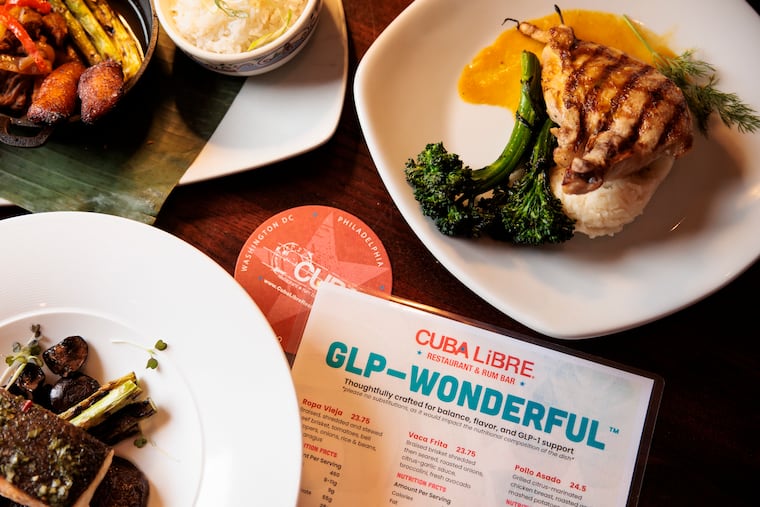
In October, Cuba Libre became one of the country’s first full-service restaurants to unveil a GLP-1 menu, available at the request of diners on the increasingly popular weight-loss medications.
Next month, the Old City establishment will also roll out a “lighter portions, lighter prices” section of its regular menu.
This is all to keep up with the evolving preferences of Philly-area diners, said Barry Gutin, cofounder of Cuba Libre.
“We said, ‘We should put something on the menu for all sorts of people watching their diet and their money,’” said Gutin, whose staff has noticed GLP-1 users and nonusers alike requesting these options more over the past year. This trend has also been seen at Cuba Libre restaurants in Atlantic City, Washington, and Orlando, as well as at its Paladar Latin Kitchen and Bomba Tacos locations in the Philadelphia suburbs.
» READ MORE: Cuba Libre group now owns restaurants in Bucks, Chester, and Montgomery Counties
For customers, an added perk is that they pay less for these smaller-portioned menu items, Gutin added. He said diners have become more focused on value amid broader financial uncertainty.
“The economy dictates that we have a diversity in pricing that meets more people’s needs,” Gutin said. “You think about the way people look at menus online. They’re scanning through prices as well.”
In August, more than a third of U.S. diners said they were dining out less frequently than they did a year ago, according to a survey from YouGov. Of the less-frequent diners, 69% said they were eating out less in part because of the perceived cost of restaurant meals, the survey found.
Lower-income consumers were most likely to have cut back on dining out, according to the survey, while middle- and higher-income folks hadn’t changed their habits substantially.
This jibes with what executives at the Federal Reserve Bank of Philadelphia are hearing, too.
“Even individuals with discretionary income to spend are being careful,” Anna Paulson, president of the Federal Reserve Bank of Philadelphia, said Wednesday. “For example, although people are still eating out in Philadelphia, contacts tell us that less expensive options on the menu are becoming more popular.”
“The only exception to this trend is at more upscale restaurants,” Paulson added. “High-income households, bolstered by a strong stock market, appear to be driving elevated consumption growth.”
At the same time, restaurants nationwide are rethinking their menus amid a rise in the use of GLP-1 medications like Ozempic and Wegovy, which suppress appetite. In recent weeks, Olive Garden, Shake Shack, and Chipotle are among chains that have rolled out special menus with higher-protein, smaller-portioned meals. Smoothie King launched a GLP-1 Support Menu in October 2024.
As of November, about 1 in 8 U.S. adults were taking a GLP-1, according to a survey from the nonprofit Kaiser Family Foundation. GLP-1s can be used for weight loss and to treat chronic conditions such as diabetes.
At the bar, consumer habits have also changed.
Alcohol use among adults has plummeted, with just 54% of respondents saying they drink in a July Gallup survey. That’s the lowest percentage in at least 90 years. It likely drops even lower this month as some people abstain from alcohol as part of the Dry January trend.
» READ MORE: A massive, first-ever Dry January bar crawl launches in Philly this weekend
Philly-area diners are spending ‘differently’
All of these trends are on display at Philly-area bars and restaurants. And owners are trying to keep up.
“We’re definitely at a time of dramatic shift in people’s preferences and tastes,” said Avram Hornik, owner of FCM Hospitality, which runs about a dozen venues in the region. They include Morgan’s Pier, Harper’s Garden, Craft Hall, and Concourse Dance Bar, as well as seasonal cocktail and beer gardens such as the traveling Parks on Tap.
“I don’t think people are spending less or going out less,” Hornik said, “but I just think they are doing it differently.”
At Hornik’s restaurants, overall sales have been consistent year over year, he said. Some customers are looking for smaller portions, he said, and late-night business has dropped precipitously. But group dining and special events have made up for losses in other areas, he said.
When customers decide an outing is worthwhile, Hornik said, they generally aren’t sparing expenses.
People are “looking for more of an experience when they go out to eat,” Hornik said. “It’s really about value: Am I getting a good value for the money that I’m spending?”
To retain customers, Hornik said his restaurants are leaning into weekly specials, such as $1 tacos at Rosy’s, and happy-hour deals.
At Cuba Libre, Gutin said he sees the GLP-1 menu, as well as the forthcoming lighter-portions menu, as a way to make his restaurants as appealing as possible for all diners.
At each location, only about a dozen people request the GLP-1 menu each week, he said. But if a group is considering dining at Cuba Libre and one person is on a GLP-1, the special menu could make or break their decision. He said it could keep the GLP-1 user from exercising their “veto vote,” sending the entire group to dine elsewhere.
Dining trends differ by location
In the Philadelphia suburbs, restaurateurs said dining trends vary depending on location and type of restaurant.
Joe Monnich, co-owner of Stove & Co. restaurant group, said food sales are up at his higher-end restaurants, including Joey Chops steakhouse in Malvern. But farther from the Main Line, in more “blue-collar” Lansdale, he said, Stove & Tap’s business is less steady of late.
There, “I feel more economic up and downs,” Monnich said. He felt similarly about his Al Pastor restaurant in Havertown, which is now closed after a local buyer came in last month and offered Monnich cash on the spot for the building.
At his more casual concepts all over the region, people are spending less on average, he said, and about the same at the higher-end spots. Recently, he added, staff have noticed diners being more mindful of how much they’re consuming.
“People aren’t getting that second drink,” Monnich said. “People aren’t getting dessert. People aren’t getting that appetizer.”
Changing drinking habits have hurt alcohol sales, too, Monnich said. In recent years, many customers have turned away from local microbrews and gravitated toward canned cocktails and “macro beers” like Michelob Ultra and Miller Lite.
“Three years ago I barely sold Michelob Ultra and right now it’s one of my top sellers,” Monnich said. As are canned cocktails. “Surfsides are expensive, and I don’t make a lot of money off them.”
Stove & Co. executives have talked about creating special menus catering to these evolving consumer preferences, Monnich said, but he gets anxious about making portions smaller. So for now, he too is leaning into happy-hour deals and other value-focused items.
“I try not to be too focused on trends because trends come and go,” Monnich said. “I do see the current trend, these weight-loss drugs, I don’t see that going anywhere … [and] people are going to be drinking less-octane alcohol."
Staff writer Ariana Perez-Castells contributed to this article.

Have you been eating out less frequently? Have you changed your habits when you do go to restaurants or bars? We want to hear from you. Email consumer reporter Erin McCarthy at emccarthy@inquirer.com. She may contact you for a future story.
