DA Larry Krasner’s office asks court to throw out AG’s Office appeal of overturned convictions
The Pennsylvania Attorney General’s Office appealed the case of three men who were freed from prison after 28 years in what local prosecutors now say was a wrongful conviction.
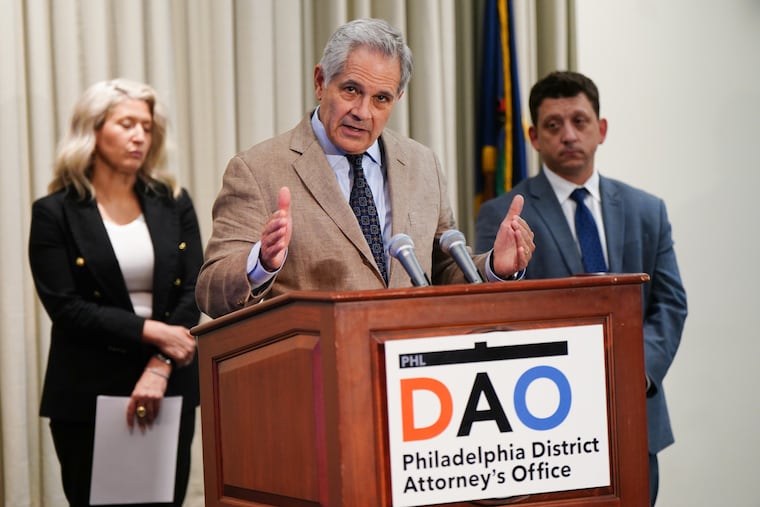
The Philadelphia District Attorney’s Office has asked a state appeals court to block the Pennsylvania Attorney General’s Office from reopening a case that freed three men who spent nearly 30 years in prison for murder, saying state officials are overstepping their authority.
The request is the latest chapter in a legal fight over the scope of the attorney general’s newly expanded power in Philadelphia post-conviction cases. The dispute could determine whether the office can step in only before a judge acts — or whether it can challenge closed cases that are still within the window for appeal.
Common Pleas Court Judge Jennifer Schultz vacated the convictions of Marc Brittingham, Jermal Shuler, and Rasheed Turner in the 1997 killing of Essie Mae Thomas in May, after Philadelphia prosecutors and defense attorneys presented newly uncovered evidence that she said undermined confidence in the jury’s verdict.
The district attorney’s office declined to retry the men, and they were released from prison after 28 years.
Weeks later, after the Pennsylvania Supreme Court issued a landmark decision expanding the attorney general’s role in Philadelphia post-conviction cases, state prosecutors sought to intervene and appeal Schultz’s ruling.
In a motion filed Friday, the district attorney’s office said state prosecutors are twisting the high court’s decision and trying to bypass longstanding rules.
The decision gives the attorney general’s office the chance to weigh in before a judge grants a request supported by prosecutors to change a past conviction or sentence.
But Schultz issued her ruling in the men’s case weeks before the high court’s decision, and the window for state intervention had already closed, prosecutors Matthew Stiegler and Rebecca McDonald wrote in Friday’s filing.
The district attorney’s office argued that Pennsylvania Attorney General Dave Sunday knew this to be true, because he had said so an interview with The Inquirer.
In that interview, Sunday said that cases in which people have already been released from prison “are done.”
Attorneys for Brittingham, Shuler, and Turner made similar arguments in separate filings. They have also argued that reopening the case would unfairly upend the lives the men have begun rebuilding since their release.
The men were convicted of murder in 1998, a year after Thomas, 73, was found stabbed to death in her North Philadelphia home. But the testimony of the lone witness who placed them at the scene was discredited after new evidence upended Thomas’ time of death.
A spokesperson for the attorney general’s office did not immediately respond to a request for comment Friday.
In earlier court filings, the attorney general’s office has taken a different view, writing that the high court’s decision gave state prosecutors the right to independently review Philadelphia cases — even if a judge ruled before the office had an opportunity to participate.
And in his interview with the Inquirer, Sunday also said his office would “have to take a look” at “cases that are still going through the appellate process.”
Philadelphia prosecutors contend that the Supreme Court has already rejected that reasoning, citing past decisions in which justices said that a case is closed with a judge’s final order — regardless of whether the deadline to appeal has expired.
The attorney general’s office has not challenged the newly discovered evidence that prompted the district attorney’s office to support vacating the convictions.
That evidence included information about the disciplinary history of Bennett Preston, a former assistant medical examiner whose trial testimony about Thomas’ time of death helped to corroborate the account of the only witness who linked the men to the killing. Two independent forensic pathologists later concluded Preston had incorrectly estimated when Thomas died. The experts said Thomas was likely killed as many as two days later than Preston had said.
State prosecutors, however, said they found “troubling inconsistencies” between the findings of Preston and the other pathologists, and believe the case warrants review.