Johnny Doc took the stand and asked a federal judge to release him from prison early to care for his ailing wife
Convicted former Philadelphia labor leader John J. Dougherty occasionally choked back tears while detailing his wife's many health challenges.
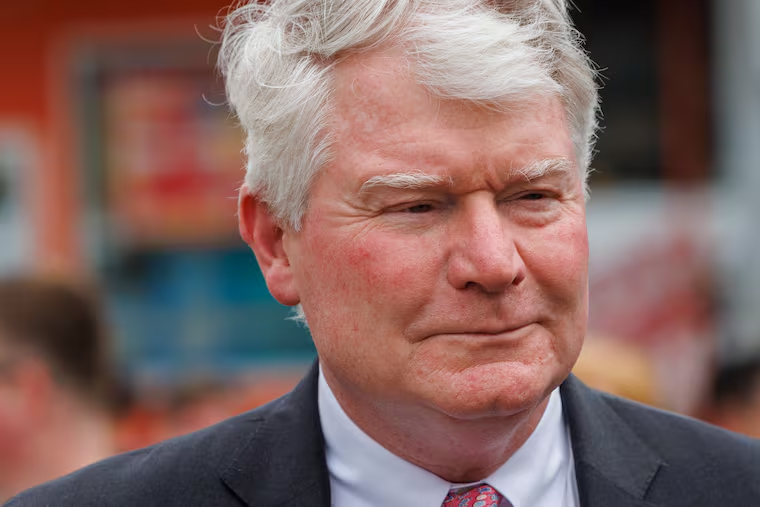
READING — Johnny Doc pleaded for mercy.
At a hearing Monday before U.S. District Judge Jeffrey L. Schmehl, convicted former Philadelphia labor leader John J. Dougherty took the witness stand and asked that his six-year prison term be cut short so he could provide care for his gravely ill wife — reiterating a plea he’s been making in court documents for months.
Wearing a dark prison jumpsuit and speaking for more than an hour, Dougherty occasionally choked back tears while telling Schmehl about his wife’s significant health challenges. And he outlined efforts he’s made from behind bars to help her — sending her dozens of letters each week, using all his allotted monthly phone minutes to call her, and singing her lullabies over the phone.
Dougherty said, his wife, Cecilia — who for years has suffered from a debilitating brain injury — has a litany of needs he can’t fulfill while incarcerated. He detailed many of them in a granular, stream-of-consciousness style while testifying, including by discussing how he helped her stand, eat, bathe and use the bathroom, and how he calmed her with music. At one point, he sang a few bars to illustrate the point.
And he told Schmehl that his adult daughters are not equipped to be full-time caregivers; that his father-in-law, who also provided assistance, recently died; and that a trust fund he established to pay for private aides is about to run out of money.
“This really is a life or death hearing,” Dougherty said.
The testimony served as the latest development in Dougherty’s ongoing bid to have his prison sentence reduced to a term of house arrest so he can care for his wife, who is paralyzed, can’t speak, and has a compromised immune system. Dougherty has been making the request in emergency motions since last year, saying in court documents — and reiterating in court — that if he isn’t permitted to care for her, she’ll likely die.
Prosecutors have consistently opposed Dougherty’s request. And they did so again Monday, asking Dougherty and other witnesses — including his daughters — about whether they’d looked into alternative care arrangements, such as assisted living facilities or options that might be covered by Medicaid or other insurance.
Assistant U.S. Attorney Bea L. Witzleben said an untold number of families across the country would undoubtedly benefit from having an incarcerated defendant released to provide care for loved ones. But she said: “The standard is, ‘Is he the only available caregiver?’ and with due respect, he has not shown that, and they frankly cannot show it.”
Schmehl did not issue a ruling Monday, and asked the attorneys to submit additional briefs before he did so. It was not clear how long it might take him to reach a decision.
He has already denied Dougherty’s request once, but scheduled Monday’s hearing after Dougherty’s attorney appealed.
Dougherty, 65, was sentenced in 2024 to six years in prison after being convicted in separate trials — the first in 2021, after a jury found that he had spent years bribing former Philadelphia City Councilmember Bobby Henon, the second in 2023 over nearly $600,000 he and others embezzled from the union.
The former leader of Local 98 of the International Brotherhood of Electrical Workers, Dougherty was known as a gregarious and chatty political player, with influence from City Hall to Harrisburg. And some of those traits were evident during Monday’s hearing, including the fact that one of the spectators in a crowded gallery was his brother, Pennsylvania Supreme Court Justice Kevin Dougherty.
John Dougherty’s testimony was also reminiscent of the freewheeling style he displayed before he was incarcerated. He delivered long anecdotes about his wife’s condition, which dates back to 1999, and described ways in which he sought to care for her, including by living with her at rehabilitation facilities for years before his federal indictment.
Both of his daughters testified about his dedication to his wife’s care, and about the challenges they’ve experienced trying to match it since he reported to prison.
“I do not hold a candle to what he provided and how he provided it,” said his younger daughter, Tara Chupka.
His attorney, George Bochetto, said Dougherty was “not looking to make his life easier” by seeking release after serving only about a quarter of his time behind bars. He was simply seeking to fulfill his role as a husband and a caregiver, Bochetto said, and to avoid sending his wife down a path that could worsen her fate.
“He’s suffered, he’s been punished, he’s been disgraced,” Bochetto said. “Now he just wants to take care of his wife.”