This Philly-area school district is standing by its decision not to take phones away from kids
Garnet Valley restricts phones instead of taking them away from middle and high school students. But Pennsylvania lawmakers are pushing for a statewide requirement for "bell-to-bell" bans in schools.
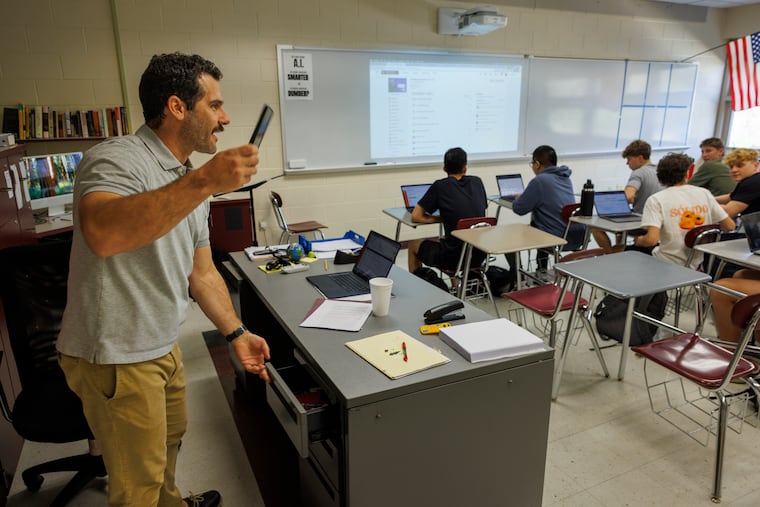
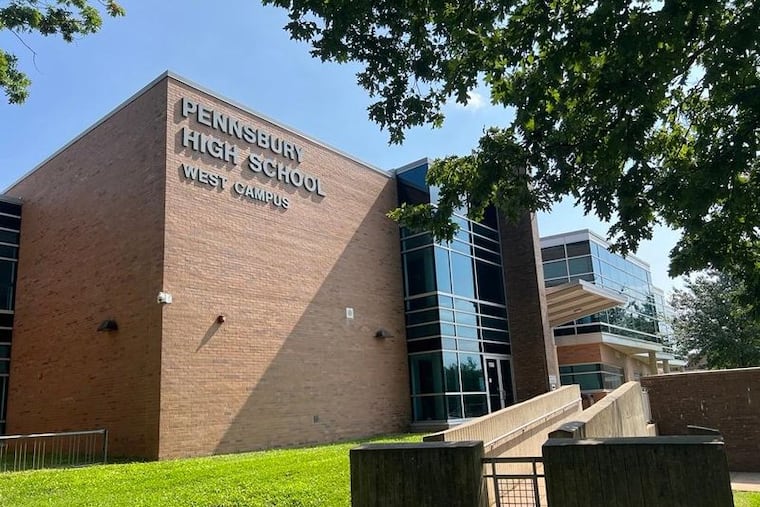
Like many teachers, Marc Panepinto wanted to get cell phones out of his classroom. Now, he is not sure that’s the best approach.
Panepinto, a social studies teacher at Garnet Valley High School who has worked in the district for 17 years, saw how distracting phones could be in class. After reading The Anxious Generation, Jonathan Haidt’s book tying smartphones to a youth mental health crisis, he grew even more convinced that schools should ban phones.
But his views softened after serving on a district committee tasked with producing new rules around screens in school. Instead of outlawing phones, Garnet Valley decided to restrict them — in the hopes of teaching students how to manage technology.
At the high school, students are expected to keep their phones in their backpacks during class — or in a designated holder, depending on the teacher’s policy — without succumbing to the temptation of checking them.
“Phones aren’t going anywhere,” Panepinto said. Given that reality, he began to come around to the idea of a “middle path” of placing limits on phone use, rather than forcing kids to give them up.
State legislation could soon force a change.
Amid mounting pushback against screens in schools, Gov. Josh Shapiro has pressed lawmakers to pass a bell-to-bell ban on cell phones in schools — saying it’s “time to get distractions out of the classroom and create a healthier environment in our schools.” Across the country, 28 states, including New Jersey, have enacted bell-to-bell bans, according to Education Week. Eight other states have prohibited students from using phones during class time.
A bipartisan bill that would ban phones in Pennsylvania schools has passed the state Senate and is now pending in the House. It would require school districts to craft policies barring students from accessing phones for the entire school day, with exceptions for students with certain medical conditions or special needs.
Garnet Valley Superintendent Marc Bertrando agrees that kids are on their phones too much. But taking away phones at school does not mean kids will no longer experience social media addiction, he said.
In 2024, Garnet Valley formed a committee of administrators, teachers, students, parents, and board members to decide what the district should do about phones.
“It became very, very clear that just banning phones was not going to do anything to solve the upstream problems,” Bertrando said.
Students involved in the committee also raised logistical concerns, Bertrando said: A sixth grader involved in performing arts said she needed her phone to know who would be picking her up from school. High school students said they routinely received texts from coaches or bosses that they needed to check.
“We cannot deny that these students’ lives, and parents’ lives, are built around this technology,” Bertrando said.
The district ultimately banned phones at the elementary school level, but decided that middle schoolers could use them during lunch. At the high school, it established more formal rules around phones being in backpacks or in holders during class; previously, some teachers had let students keep them facedown on their desks, Panepinto said.
The high school “came out pretty strong with the rollout” this past fall, and students largely accepted it, Panepinto said. He noted that younger students were more receptive than upperclassmen, who had been used to having more freedom.
Pushback against phones in schools
While momentum has been building in favor of phone bans, Garnet Valley is not the only area district that does not have a bell-to-bell ban. The Lower Merion School District, for example, does not let high school students use phones during instructional time, but allows them access at lunch and during free periods.
At a school board committee meeting this week, Lower Merion Superintendent Frank Ranelli said that given the structure of the high schools’ Lunch and Learn, where students have an hour to eat lunch and meet with teachers anywhere in the building, administrators would have “an interesting time” trying to enforce a phone ban.
He also said that some students use their phones during lunch to listen to music and “de-stress.”
Some parents who have been calling for a bell-to-bell ban on cell phones in Lower Merion pushed back on his comments.
“We went for thousands of years, educating people, de-stressing … without the internet,” said Anna Shavin, who lives in Bryn Mawr and has children in first and fifth grade in a private school, but has been planning to send them to Lower Merion in the future. Allowing kids access to phones and internet at school only adds to the work parents are doing to regulate screen time, Shavin said.
“We let the devil in the door, and I think as adults we have to clean up the mess now,” she said.
In Garnet Valley, Bertrando said he has not heard from parents calling for a full ban.
Gaining student buy-in
Zander Sereni, a senior and student council president at Garnet Valley High School, said a bell-to-bell ban would be “extremely unpopular” with students.
By listening to students and taking a more moderate approach, Garnet Valley gained student buy-in, said Sereni, 17, who was part of the committee that deliberated on the phone policy.
He thinks the rule about putting phones away in class is working, saying more kids are talking to each other before and after classes.
“The hallways were silent a few years ago — everyone was on their phone, scrolling," Sereni said. He has also noticed students occasionally policing each other if someone pulls out a phone during class: “People will actually say, ‘Put that away, man,’” he said.
Along with adopting its phone policy, Garnet Valley has emphasized digital citizenship lessons — including by dispatching high school students like Sereni to warn elementary schoolers about excessive screen time.
“A big thing we emphasize is ‘touch grass,’” Sereni said, invoking internet slang often used in response to someone who spends too much time online. “Make sure you get outside and play.”
He thinks that advice means more coming from students who have “lived through The Anxious Generation, so to speak,” said Sereni, who said he has had a phone “since I was 7 or 8 years old.”
Navigating ‘a tech society’
Cell phone bans do not allow young people to reach their own conclusions about excessive screen time, said Desmond Patton, a professor at the Annenberg School for Communication at the University of Pennsylvania who studies the impact of social media and artificial intelligence on youth mental health.
“We can’t just say you no longer have a digital life in this context, when half their life is in this context,” said Patton, who favors efforts to push social media companies to build safer platforms, rather than banning cell phones.
Like Garnet Valley leaders, Patton thinks schools need to adapt to technology rather than eschewing it.
“We are a tech society: cell phones, social media, AI,” Patton said. “If we don’t get serious about how we integrate these tools into our lives, I think they are going to overtake us.”
Panepinto, the Garnet Valley social studies teacher, acknowledged it would be easier for teachers if the district had a strict ban.
But since the current rules were adopted, “I haven’t heard teachers complaining nearly as much as they were” before, Panepinto said. Bertrando said that so far this year, he is aware of one disciplinary infraction at the secondary level involving a cell phone.
Students have been suspended for sending threatening text messages, Bertrando said — incidents that he said all happened between 9 p.m. and 1 a.m.
While “still a skeptic” about phones, Panepinto said, he is viewing the policy as a chance to prepare students for life after high school — allowing them to learn “when I go to college, I put this in my bag.”
He views the district’s approach to crafting its policy through a social studies teacher’s mindset.
“States are little laboratories of democracy. Schools can be like that,” he said.