Cheltenham has completed its review of its football scandal. Here’s what we know.
Recommendations will be discussed during upcoming school board policy committee meetings, Interim Superintendent Chris McGinley said. And all high school students will receive safety trainings.
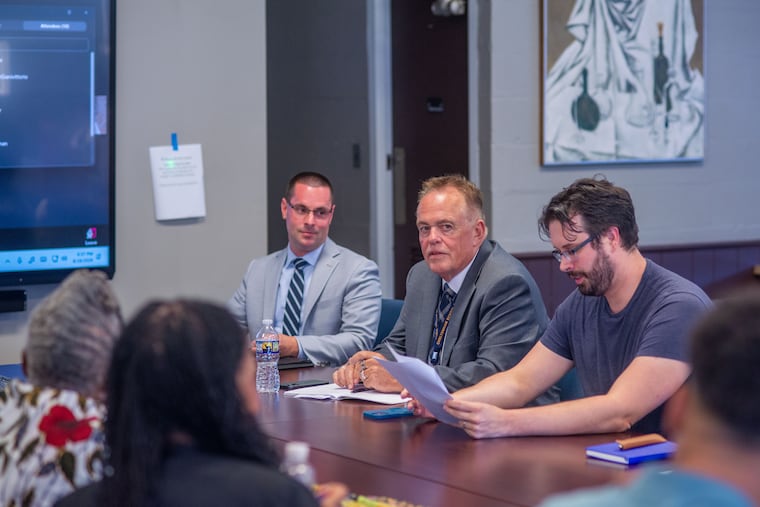
The Cheltenham School District said it has findings from a lawyer the district commissioned to conduct a review of policies after four football coaches and six players were charged this summer in connection with two alleged assaults on a teammate in a high school locker room.
What the lawyer recommended, however, is still unknown. Interim Superintendent Chris McGinley said in a written response to questions this week that Leigh Dalton’s findings were “not a formal report,” but “it contains recommendations for specific changes to individual policies.”
Recommended changes will be discussed during upcoming school board policy committee meetings, McGinley said.
It’s also unclear whether the review made any findings about the actions of district administrators in response to alleged assaults in fall 2025, which led the district to cancel both last year’s and the current year’s football seasons. A county grand jury that recommended charges said staff members failed to properly investigate when they learned of assault allegations.
Criminal cases against the four coaches and two former players are proceeding in Montgomery County court.
The district has been focused on prevention efforts, according to administrators, with anti-hazing sessions for all student-athletes and training about child abuse for staff. And administrators say they are also doing spot checks of locker rooms, to ensure supervision.
“We were in a spot we never wanted to be in and can’t return to,” Sam Sheridan, vice principal and athletic director at the 1,400-student Cheltenham High School, said during a school board meeting last week.
Here’s what we know about the completed review and how the district says it’s improving safety:
Recommendations for ‘more than 25 policies’
The football scandal erupted this summer, after a Montgomery County grand jury recommended charges in connection with two incidents in August and September 2025 in which Cheltenham football players allegedly attacked a teammate and poked a broomstick toward his buttocks.
Prosecutors said coaches learned the player had been beaten up and instructed him not to tell his parents what happened.
When the teen told his mother he’d been jumped, and his mother reported it to a high school administrator, employees downplayed the report and took the word of the then-head football coach, according to the grand jury’s report.
Cheltenham’s superintendent, Brian Scriven, resigned Aug. 6, a little more than a week after the charges. The school board then hired McGinley, a longtime school administrator, as interim superintendent.
At an Aug. 11 meeting, board president Leah Mulhearn also announced it had enlisted Dalton — a York, Pa.-based lawyer who was previously tapped by Central Bucks to investigate special education abuse allegations — to conduct a review of policies and procedures that would “include consideration of the grand jury’s findings and how to address them.”
Mulhearn said the board intended to move quickly, and had tasked Dalton with producing recommendations in 60 days.
Asked whether Dalton had recommended any personnel changes or disciplinary actions, McGinley said this week that “the external review focused on policies as the board committed.”
All of Dalton’s recommendations will be taken up at upcoming policy committee meetings, McGinley said.
He said there was no single written document issued by Dalton, but “more than 25 policies” emailed separately.
“They are now all drafts for our consideration,” McGinley said. “One by one or five by five, they will be shared in public meetings.”
Dalton did not immediately respond to a request for comment Wednesday.
Training on ‘speaking up’
Students and staff this fall have been undergoing a variety of trainings, which McGinley and Sheridan described at an Oct. 13 school board meeting.
All fall sports teams, and activities like the pep band and color guard, are receiving four 30-minute training sessions during their practice times conducted by the Mission Kids Child Advocacy Center, Sheridan said. The sessions — with topics including personal safety and boundaries, healthy relationships, recognizing concerning behavior, and identifying trusted adults — will continue with winter and spring sports, Sheridan said.
“If we had 20 students who were unwilling to speak to an administrator or feel like they couldn’t speak up when they saw something clearly wrong was happening, that’s something we need to do everything in our power we can to prevent,” he said, referring to students who witnessed an alleged assault in the football locker room.
All high school students, meanwhile, will receive hourlong sessions on consent, personal boundaries, peer pressure, and healthy relationships as part of their advisory blocks, starting Oct. 28, Sheridan said. The district is working with the Victim Services Center in Montgomery County to develop the curriculum, he said.
“We’re doing this not just to check a box — we want this information to stick,” Sheridan said.
Coaches, club sponsors, and teachers leading after-school activities have been trained on mandatory reporting protocols, to make sure they know “the buck stops with them,” Sheridan said. He also said administrators were doing spot checks of locker rooms at the start and end of practices, confirming whether kids were being supervised by coaches.
Coaches during last year’s football season were not using an office in the locker room, according to the grand jury report.
McGinley said the district had “trained administrators on how to conduct investigations that are compliant with the law.” In an email, he said the training was conducted by lawyers from Wisler Pearlstine, the firm that employs district solicitor Ed Diasio, with help from assistant superintendent Kendra Johnson.
All employees have received training on child abuse, McGinley said.