Closing this school to expand Masterman would displace neighborhood children, supporters say
Laura W. Waring Elementary School in Spring Garden would close and its building would be modernized to house a new middle school for Masterman students beginning in 2034 under the district's proposal.
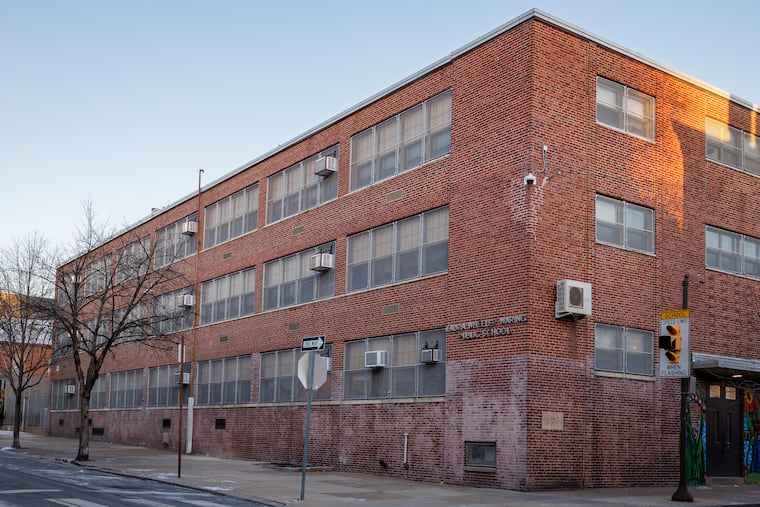
Families and staff of Laura W. Waring School were upset to learn this winter that the district aims to close their school — and even more dismayed that its building will be used to expand one of the district’s gems.
Waring, a K-8 school in Spring Garden, is one of 18 Philadelphia public schools facing closure.
The Philadelphia School District’s facilities plan calls for repurposing it into a new middle school for Julia R. Masterman High School, a prestigious magnet school that currently educates grades 5-12 in one building.
Waring would close beginning in the 2031-32 school year under Superintendent Tony B. Watlington’s proposal, and its students be reassigned to Bache-Martin School, along with students from the closing Robert Morris School.
Since Masterman is a magnet school, many of its students come from outside of the neighborhood to attend. To the Waring community members, the closure plan feels like the district is displacing neighborhood Black and Latino children to benefit its more-heralded school of majority white and Asian children.
“We live here, we work here, we invest here … and we want to see our kids thrive in our own community,” said Gloria Castro, the parent of a Waring second grader with autism and a regular school volunteer.

Wholesale changes are coming to the Philadelphia School District, with the school board passing a $3 billion facilties plan that aims to close 17 schools permanently, and renovate 169.
Superintendent Tony B. Watlington Sr. presented the plan to the school board Feb. 26 and it immediately faced strong opposition. After some amendments, the board passed the plan April 30. Here's what we do and don't know about it.
And to see the proposed list school closures and check how your school could be impacted, use our interactive charts.
Each of the schools proposed for closure has its own story. Find them all here.
Questions about investment in the Waring building
Declining enrollment was a key factor in planning to close Waring. The school has 170 students enrolled this year, down more than 40 students since the 2023-24 school year, which the district categorizes as “severely underutilized” capacity.
District officials also graded both Waring’s building at 1801 Green St. and its programming as “poor” quality. The school is 73% Black, 12% Hispanic, and 10% white.
While Waring would close later than some schools facing the same fate, the extended runway is hardly a consolation for staff and families. At a community meeting last month with district officials, some raised the possibility that the timeline would end up hurting the school as it waits, with fewer parents deciding to send their children to a closing school and the district avoiding investing in a space that wouldn’t be repurposed for nearly a decade. (The district plans to open the Masterman middle school in Waring’s building for the 2034-35 school year.)
District officials pointed to recent improvements in electrical distribution and air-conditioning as evidence they would continue caring for the school. They promised upkeep would continue until Waring closes and encouraged parents to hold them to it.
“I don’t think they’re trustworthy,” Castro said. She was skeptical of the district’s promise, and believed it would largely allow Waring to deteriorate, because that’s what it has mostly done to this point.
“To think they’re going to invest in it makes no sense. Because why haven’t they invested in it over the years?” she said.
Castro and other Waring supporters argued the district’s unwillingness to put significant money into the school was why enrollment has declined and the building has deteriorated. Waring teachers said enrollment dropped after its pre-K program was eliminated years ago, but they weren’t able to acquire enough funding from the district to restart it.
They were frustrated the district instead plans to put its resources into a $54 million renovation project to expand the nearby Bache-Martin School. Unlike Waring, Bache Martin is already crowded but is slated to take in students from Waring and Robert Morris.
A system that works
Waring teachers said the school has turned its smaller class sizes into an asset, especially for the school’s special education students and others whose families are refugees and asylum seekers. Waring’s success wouldn’t necessarily transfer as students move to Bache-Martin, the teachers said, because students would be in larger classes.
“We know every single kid in this building, we know their parents,” said Katrina Culley, a kindergarten teacher at Waring. She said the push to consolidate schools was misaligned with the school district’s often repeated goal to be the fastest-improving large urban district in the country.
“Do you really think that’s going to happen when there’s 30 to 33 kids in every classroom?” she said.
Waring is an integrated piece of the neighborhood, and its closure would disrupt a system that works for families, Castro said. The Roberto Clemente Park and Playground across the street has affordable afterschool and summer programs where Castro and other parents send their children. She said it makes their lives easier knowing they can drop off their children before work at 8 a.m., and they’ll be seamlessly cared for until 6:30 p.m.
At the close of the community meeting, Waring principal Amanda Strain made the case that the school was actually on the rise, the district’s evaluation notwithstanding.
Despite Waring’s overall declining enrollment, kindergarten enrollment has increased, with nine more students this year than last, she said.
And over the past three years, Waring has nearly doubled its percentage of students scoring proficiently on state math exams to 19%, and held a steady 31-32% proficiency in reading and language arts exams.
“This is a special place doing really hard work,” Strain said, “and I think doing it well.”