Penn demonstrators defy order to disband encampment as tents remain on College Green
The Penn encampment was set up Thursday, the same day as a faculty and student walkout and a campus listening session held by university leadership.
Protests over Israel's war against Hamas have spilled onto college campuses in the Philadelphia region and across the country. Follow live updates Sunday.
The University of Pennsylvania's interim president ordered pro-Palestinian protesters who set up an encampment to disband immediately, citing legal and university violations. It's not clear what action the university might take against the protesters, or when.
The Penn protesters are calling for the university to disclose its financial holdings, divest from any investments in the war, and provide amnesty for pro-Palestinian students facing discipline over past protests.
Encampments were also set up at Swarthmore, Haverford, and Bryn Mawr Colleges. At Princeton, two students were arrested and about a half-dozen tents were taken down by protesters voluntarily.
Penn encampment continues as protesters defy university orders
Pro-Palestinian protesters maintained their on-campus encampment Saturday for a third day — with no signs of disbanding — defying the Friday night order by Penn’s interim president to end it “immediately.”
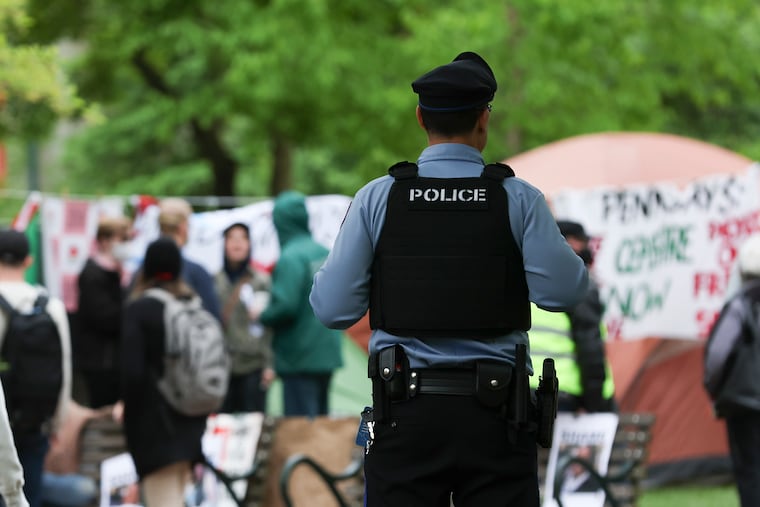
Late on an overcast, chilly Saturday afternoon, only a handful of security officers were near the site with no evidence of any move to evict the protesters, who are demanding that Penn divest itself of any Israel-related investments and provide amnesty for pro-Palestinian students who might be subject to discipline over past protests.
About 400 people were gathered at College Green on Saturday evening, where about 35 green, orange and gray tents had been pitched. Supplies of fruit, vegetables, water, almond milk, coffee, and pudding were on hand for those who were staying around or making a night of it.
Encampment leaders meet with school administration: 'These demands are not unreasonable'
Two student encampment leaders and four professors met with school administration Saturday, including the interim president, to discuss their demands.
“We're disappointed that university administration has not given our demands the time of day,” said an encampment spokesperson. “These demands are not unreasonable.”
Encampment leaders would not disclose what the university asked of them.
— Ximena Conde
24 hours after order to disband encampment, dozens of tents remain
Twenty-four hours after Penn's interim president ordered the pro-Palestinian encampment to disband, the dozens of tents remained in place and the third night of the demonstration carried on with a light police presence in the background.
A man played the oud and led some protesters in song, while other students found more removed spots on the College Green to catch up on homework.
In between moments of robust chanting and food breaks, protesters could also pick up a book from the makeshift Refaat Alareer Memorial Library.
Penn faculty, local officials urge school administration to negotiate 'in good faith with student leaders'
Penn faculty were joined by several state and city elected representatives Saturday in urging the administration to respect the rights of pro-Palestinian protesters who set up a campus encampment and negotiate “in good faith with student leaders.”
The elected officials and faculty issued a joint statement noting that student activism and organizing have long been at the forefront of calls for peace and justice. Unlike other protests elsewhere in the country where there has been violence and arrests, the Penn demonstration has remained peaceful, they said.
“Our rights to assemble and to freedom of expression have been crucial tools to build our most important social justice movements, including the Civil Rights movement, the movement to end the Vietnam War, and Occupy Wall Street,” the statement said.
Pro-Israeli group's demonstration at encampment lasted about two hours
For the second night in a row, a group of about 15 pro-Israeli counterprotesters gathered at the encampment, setting up U.S. and Israeli flags and phots of hostages.
For Nathaniel Weneck, a junior at Penn, said pro-Palestinian protesters “can get in your face” and “use slurs … especially the ones that are not associated with the campus.”
Encampment organizer Emma Herndon said that she was able to confirm that not everyone at the encampment is a student.
Group of counterprotesters leaves encampment area with police escort
A small group of counterprotesters that formed across the way from the Penn encampment left with a police escort around 7 p.m. The group posted photos of hostages taken during the Oct. 7 attack in Israel in barricades across the College Green.
At moments one counterprotester chanted, “Rape is not resistance.”
As the group left the College Green wrapped in Israeli flags and with a police escort, the encampment chanted them goodbye, continuing with chants of “free, free Palestine.”
— Ximena Conde
Penn faculty group objects to order to disband encampment: 'They have a right to demonstrate'
Penn Faculty for Justice in Palestine, the group that held a walkout on Thursday as tents were erected on Penn’s campus, added its objections to Penn president J. Larry Jameson’s order to disband the encampment.
They wrote that Jameson and other university leaders have done an “about face” and have not observed due process.
“Clearly, the Gaza Solidarity Encampment is a principled and peaceful demonstration,” they wrote. ”We bear witness that students have not violated any policies or contributed to a hostile environment. They have a right to demonstrate. They have kept noise down at night; they have de-escalated the aggressive behavior of counter protestors...”
Protest is 'something all universities should encourage,' retired Penn prof says
George Lakey, 86, is a retired Penn professor who came by to check how students at the encampment were doing.
“I am impressed by the amount of self-discipline and the amount of organization they have put into this,” the former social movements professor said.
As the crowd chanted for the liberation of Palestine, Lackey pointed to the importance of letting students be able to hold peaceful demonstrations, and said he believed the decision to disband the encampment was wrong.
Arab and Muslim student groups voice support for free speech, denounce hateful language
In two statements on Instagram Saturday, both the Penn Arab Student Society (PASS) and the Penn Muslim Students Association (PMSA) expressed support for free speech and abhorrence of violence.
The PASS message included a call for further investigation of who scrawled a piece of graffiti containing an expletive aimed at Zionists on the campus statue of Ben Franklin. The organization said it was the work of an “outside agitator.”
“Hate speech does not have a place within this protest,” the statement read.
Penn scene is a contrast to Emory, visiting student says
David Lee came to Penn's campus from Emory University in Atlanta to visit his girlfriend.
Upon seeing the encampment, the 21-year-old described the scene as “really peaceful.” A contrast, he said, from what took place this week at Emory, where protesters were detained by the police.
“The fact that they [Penn students] were asked to leave, but then they stayed, and things haven’t escalated is a good sign," Lee said. He said he was hopeful the situation would remain peaceful. “There don’t seem to be a lot of police officers so that’s a good sign.”
— Michelle Myers
Encampment crowd appeared 'infiltrated' by outsiders, professor says
The people at the encampment who were harassing Jewish students and vandalized a statue of Benjamin Franklin were not Penn students, Benjamin Abella, a professor in the department of emergency medicine at the Penn School of Medicine, said he believed.
Abella said several protesters seemed “too old” to be students and believed a number of them were not affiliated with the university.
What’s more, he said, it would be out of character for a Penn student to deface that particular statue, given its connection to Penn and its cultural symbolism.
Administration has not approached encampment leaders, organizer says
Student organizer Eliana Atienza, 19, is one of the 60 people who spent last night at College Green.
The sophomore was at the scene when Penn’s interim president ordered pro-Palestinian protesters to disband the encampment.
“I felt disappointed in Penn and the Penn administration, said Atienza.
Jewish students were harassed near camp, Penn professor says
Graffiti scrawled on the base of the Ben Franklin statue at Penn was “likely” a primary reason for the administration to decide to order the pro-Palestinian student encampment to disband, surmised Benjamin Abella, a professor in the department of emergency medicine at the Penn School of Medicine.
However, Abella added that he couldn’t say for certain that the graffiti was the vandalism that interim President Larry Jameson was referencing Friday night when he announced that the encampment would be closed.
“This was hateful language spray-painted on our much-beloved statue,” said Abella, who described himself as a “concerned Jewish faculty member.”
Quiet scene at Penn's College Green on Saturday
On the third day at Penn encampment protest, the scene is an amalgamation of contrast. On the steps of College Hall, students pose with graduation attires and pop bottles to celebrate their achievement.
Next to the building, on College Green, tents fill the field as about 60 students brace the chill to protest the war in Gaza.
An occasional helicopter flew over the scene as the crowd of young adults talks in smaller groups, drinks Dunkin' Donuts coffee, or sits to read a book.
Muslim leaders urge university leaders to defend pro-Palestinian demonstrations
A coalition of Muslim leaders penned an open letter to university leaders urging them to reconsider their approach to pro-Palestinian demonstrators that have erupted throughout the Philadelphia region within the last week.
The letter reiterated concerns that school leaders had failed to provide a supportive campus environment for Muslim and pro-Palestinian students since the Israel-Hamas war began, and said they were feared over an over-the-top response to the fledgling encampments.
“As we watch with concern how some college campuses across the nation have been made unsafe for students advocating for Palestine, we request that you and your administration refrain from seeing pro-Palestinian activism as a problem that needs to be targeted,” the group wrote in the letter.
Professors association says it's 'deeply disturbed' by order to disband
The Penn chapter of the American Association of University Professors said it was “deeply disturbed” by Penn interim president J. Larry Jameson’s email Friday night, ordering protesters to leave the College Green over what AAUP called “unsubstantiated allegations.”
“These allegations have been disputed to us by faculty and students who have attended and observed the demonstration,” the professors wrote Saturday in an email to Jameson and other Penn leaders. “Your statement mischaracterizes the overall nature of an antiwar protest that necessarily involves strong emotions on both sides but has not, to our knowledge, involved any actual violence or threats of violence to individuals on our campus.”
Jameson said Friday night that “blatant violations of university policies” had occurred with “credible reports of harassing and intimidating conduct.” He also cited vandalism of the statute in front of College Hall with antisemitic graffiti.
Decisions in past encampment were made by president's team, ex-board chair recalls
Scott L. Bok, former board chair at the University of Pennsylvania, recalled the encampment at Penn in 2022. Protesters were calling on the university to help low-income residents who were being displaced from the neighboring University City Townhomes, further dissociate from fossil-fuel companies, and make payments to the city in lieu of taxes.
“University administrators carried on a dialogue with protesters but allowed the tents to remain up for many weeks until the protest quietly ended,” said Bok, who left the board in December amidst the controversy over the university’s handling of antisemitism complaints. “The strategy was to be patient with the students and avoid any sort of unpleasant confrontation, although obviously we would have changed course if there was any violence or threat of violence.”
At that time, he said the situation was handled by the president’s team.
Bryn Mawr becomes 4th Philly-area college with protest encampment
Students at Bryn Mawr College joined the encampment protest movement in support of Palestinians Saturday morning, erecting tents on the college green.
It becomes the fourth college in the region to have an encampment; tents are also up at the University of Pennsylvania, Swarthmore, and Haverford.
While Penn has called for the dismantling of its encampment, the other colleges have no plans to do the same.
This isn't Penn's first protest encampment
This is not the first time that Penn has had a protest encampment. In 2022, there were two, both involving a student campaign to get the university to divest from fossil fuels and both on the College Green.
There was a shorter one in the spring and then a nearly six-week encampment in the fall. The latter ended when students stormed Franklin Field during halftime of the Penn-Yale football game.
Emma Glasser, a Penn alumna who was involved, said the university didn't dismantle the encampment. Students voluntarily took it down. But the university did at times pressure students to leave and threatened discipline, she said.
Alumni, donor influence on encampment decree is unclear
It's unclear, what if any, influence alumni and donors had on Penn's sudden decision to announce it wanted the encampment dismantled. Neither board chair Ramanan Raghavendran or a university spokesperson responded on Friday to the question of what the university was hearing from those groups.
A spokesperson for Marc Rowan, the private equity giant who led a campaign to oust Penn's former president and board chair in the fall over their handling of antisemitic complaints, also did not respond to a request for comment on Friday.
» READ MORE: Who is Marc Rowan, the billionaire Wharton grad who led the campaign to topple Penn’s leaders?
— Susan Snyder
Penn’s interim president orders pro-Palestinian protesters on campus to disband their encampment ‘immediately’
The interim president at the University of Pennsylvania issued a warning Friday night to pro-Palestinian protesters on campus that they must “disband their encampment immediately” because of alleged legal and university police violations.
“The encampment itself violates the University’s facilities policies,” J. Larry Jameson said in a letter to the Penn community.
“The harassing and intimidating comments and actions by some of the protesters, which were reported and documented by many in our community, violate Penn’s open expression guidelines and state and federal law, including Title VI of the Civil Rights Act. All members of our community deserve to access our facilities without fear of harassment or being subjected to discriminatory comments or threats,” Jameson said.
Encampment is a test for interim Penn president
The encampment at Penn poses a test for interim president J. Larry Jameson, who replaced former president Liz Magill after she resigned following bipartisan backlash over her congressional committee testimony on antisemitism and a semester marked by near-weekly protests over the conflict and bloodshed in Israel and Gaza.
Penn board chair Ramanan Raghavendran declined to comment Friday on what if any role the board has in deciding how to handle the encampment.
Penn’s board was involved in controversy that embroiled the university last fall after the Palestine Writes Literary Festival was held on campus in September.
Spiritually troubled or peaceful justice seekers? Here’s what Pa. officials are saying about student protesters.
The political divide over the war in Gaza was starkly evident this week in Philadelphia as local officials spoke out about student demonstrations at University of Pennsylvania and other local campuses.
State Rep. Rick Krajewski, whose district includes Penn, as well as Philadelphia State Sen. Nikil Saval and State Rep. Tarik Khan, visited the Penn encampment on Thursday, according to a Daily Pennsylvanian report.
Khan said he wants to make sure students are “able to peacefully protest” and Saval condemned “universities that have called police on their students simply for expressing their voice in protest and right in assembling peacefully,” according to the report.
Student anti-war protesters dig in as faculties condemn university leadership over calling police
Students protesting the Israel-Hamas war at at universities across U.S., some of whom have clashed with police in riot gear, dug in Saturday and vowed to keep their demonstrations going, while several school faculties condemned university presidents who have called in law enforcement to remove protesters.
As Columbia University continues negotiations with those at a pro-Palestinian student encampment on the New York school's campus, the university's senate passed a resolution Friday that created a task force to examine the administration's leadership, which last week called in police in an attempt to clear the protest, resulting in scuffles and more than 100 arrests.
Though the university has repeatedly set and then pushed back deadlines for the removal of the encampment, the school sent an email to students Friday night saying that bringing back police “at this time" would be counterproductive, adding that they hope the negotiations show "concrete signs of progress tonight.”