City Council members tell school board to ‘mess around and find out,’ threatening to withhold funding over school closures
City Council members and state lawmakers gathered at Lankenau High School to protest a plan to close it and 16 other schools and said the school board is rushing a vote on the issue.
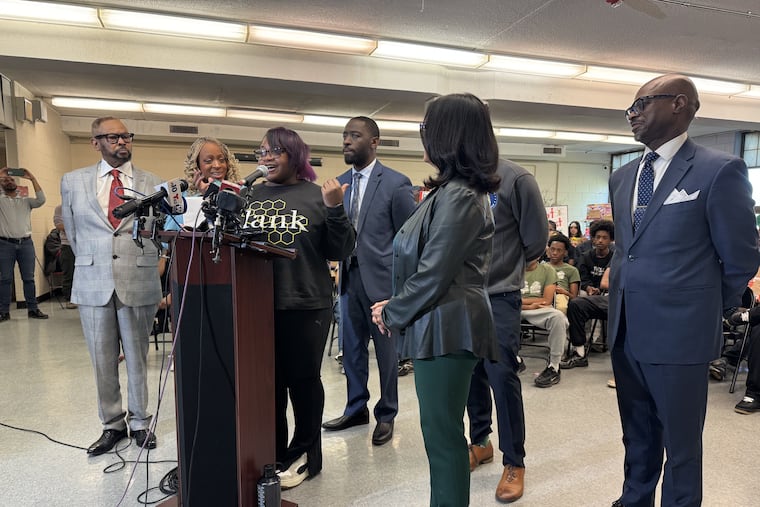
Several politicians who hold the Philadelphia School District’s purse strings threatened Tuesday to oppose school system funding requests if the district closes certain schools, including Lankenau High School.
The escalation came first at a news conference at Lankenau, where city and state lawmakers spoke out against school board president Reginald Streater’s decision to call a vote this week on Superintendent Tony B. Watlington’s sweeping facilities plan, which would close 17 schools and renovate 169.
“You’re not getting my vote unless you fix this situation at Lankenau,” said City Councilmember Curtis Jones Jr., who represents the Roxborough district where the school sits. “I love you, President Streater, but don’t make me show you: mess around and find out.”
Then, the heat ratcheted up at a City Council hearing on taxes. Watlington and Streater, who had not been scheduled to testify before Council until Wednesday, were summoned to City Hall early at Councilmember Katherine Gilmore Richardson’s request.
It was an extraordinary move, one that showed the fractious state of current relations between many City Council members and district leaders.
“The problem is that you’re asking us to engage in this difficult conversation and decision with you while simultaneously telling us that you’re not going to listen to us or our communities. That is the problem with the entire conversation, because that’s not what partnership is,” Councilmember Jamie Gauthier said.
Watlington made amendments to the facilities plan Monday, removing Ludlow Elementary in North Philadelphia from the closing list and making other changes, including adding 10 modernization projects to the facilities list and upping the price tag to $3 billion.
But his announcement — and Streater’s decision to call for a vote on Thursday — caught many lawmakers off guard, they said.
While Council does not have a say in the school closures, the city budget provides funding for the district.

Wholesale changes are coming to the Philadelphia School District, with the school board passing a $3 billion facilties plan that aims to close 17 schools permanently, and renovate 169.
Superintendent Tony B. Watlington Sr. presented the plan to the school board Feb. 26 and it immediately faced strong opposition. After some amendments, the board passed the plan April 30. Here's what we do and don't know about it.
And to see the proposed list school closures and check how your school could be impacted, use our interactive charts.
Each of the schools proposed for closure has its own story. Find them all here.
Councilmember Nicolas O’Rourke, at the Lankenau news conference, said it was “ridiculous” for the school board to vote on a plan that will affect the city for generations three days after it was finalized.
“We’re going to vote on something that was put forward yesterday morning and pretend that has everyone’s voices recognized in it?” O’Rourke said. “It’s a shame — for a process as delicate and impactful as this, there’s no excuse for how they are choosing to speed this along. This pace is frankly undemocratic.”
A three-day window “frankly leaves dedicated parents and students and teachers and advocates with little to no time to respond,” O’Rourke said.
Councilmember Isaiah Thomas, chair of Council’s Education Committee, noted that several of the politicians standing in Lankenau’s auditorium were running for reelection and are listening hard to their constituents who oppose the closures of schools like Lankenau, Overbrook Elementary, and others.
“At some point, [the district] will ask us for more than just your vote for budget,” Thomas said at Lankenau. “You will come and ask us for votes again. And if you can’t vote with our children, how would you expect us to vote with you? Let’s not forget, School District of Philadelphia, we have some very long memories, just like our children do, and we will not forget your votes, because you can’t ask us to vote for what you think is best when we’re begging you to vote for what we think is best.”
Jones, standing on Thomas’ right, called out then: “like the Uber tax!” referring to Mayor Cherelle L. Parker’s controversial $1-per-trip rideshare tax, which she wants to levy to raise $48 million to stave off classroom cuts in the district.
“As we go through budget season in the Commonwealth of Pennsylvania, we will remember that vote on Thursday,” said State Rep. Morgan Cephas, a Democrat and chair of the Philadelphia delegation.
‘Slow it down’
Lankenau’s fight against closure has drawn significant attention and political support. The school, a magnet on 400 wooded acres with a 100% graduation rate, is the city’s only environmental science school and has a large and well-integrated population of students with disabilities.
The school is small — 228 students — but as with a number of citywide admissions schools on the closing list, including Parkway West, Parkway Northwest, and Robeson, its enrollment was directly affected by district-ordered changes to the special-admissions school policy.
Watlington, on Monday, said “the reason is we cannot drive faster improvement and at the same time support really small high schools. It is just inevitable that we’ve got to reallocate some of our resources.”
Gauthier said she was frustrated by the district’s decision to keep Lankenau and Robeson — in her West Philadelphia district — on the closing list. Watlington amended his Robeson recommendation Monday to keep the school building in district hands and to work with the community to eventually repurpose it for some science, technology, engineering, and math-related use, but stopped short of removing it from the closing list.
The last-minute changes and confusion, Gauthier said, are “also emblematic of how this entire school facilities process has gone. It’s confusing. It’s illogical and it’s out of touch.”
Behind the lawmakers standing at a wooden lectern, Lankenau students — some holding signs that said “Closing Schools is Trashy” and others dressed in tree costumes — clapped, cheered, and occasionally broke into chants of “slow it down,” a nod to politicians’ wish to delay the facilities vote.
Wyntir Alford, a Lankenau 10th grader, spoke for her fellow students when she said that closing the school “makes no sense.”
“Lankenau remains open, and it will remain open, because closing us is only going to make us more angry, and make us protest even more,” Alford said.