Why City Council is threatening to block Mayor Cherelle Parker’s ‘Uber tax’ if it doesn’t get its way on school closures
School officials say the district's budget deficit and infrastructure needs are separate issues. Council members aren't treating them that way.
Closing schools is always politically toxic. So is imposing new taxes. Doing both at the same time — one year away from a municipal election — was never going to be easy.
Philadelphia City Council members have been fuming for weeks about being asked by Mayor Cherelle L. Parker to create a new $1-per-ride tax on services like Uber and Lyft to plug a Philadelphia School District budget deficit, while the district simultaneously is moving to close 17 school buildings and renovate 169 more as part of its facilities plan.
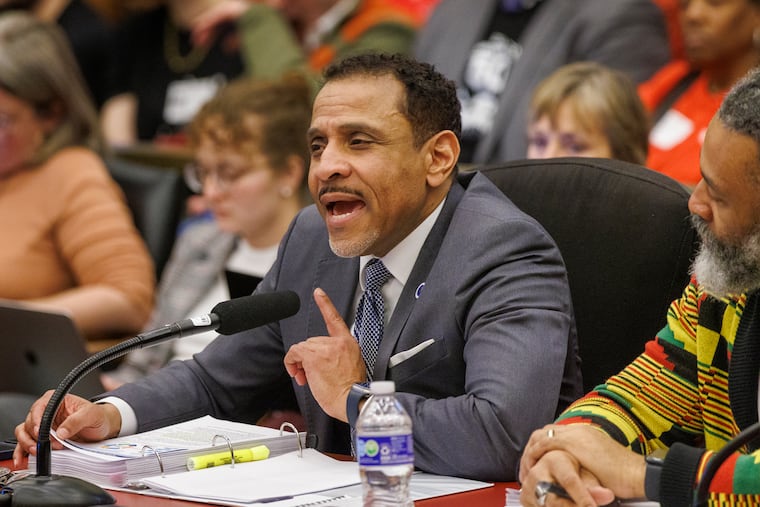
That frustration boiled over Tuesday at a fiery Council budget hearing that was ostensibly about the mayor’s proposed tax policies but quickly became a far-ranging and heated debate over education.
“On the one hand, we are going to tax people — and then take away from people educational opportunities," Councilmember Curtis Jones Jr. said. “I can’t knock on the door and say, ‘I’m taxing you, and I’m closing your school because of some nebulous number that we don’t know.’”
During the hearing, Council President Kenyatta Johnson admonished Parker’s chief education officer for not having the answer to a factual inquiry on hand. Councilmember Isaiah Thomas subjected the city finance director to a “Who knew what when?”-style interrogation on when the district’s budget shortfall became apparent. And Council Majority Leader Katherine Gilmore Richardson took the rare step of summoning school district officials to City Hall even though they were not scheduled to testify.
Shortly after, Superintendent Tony Watlington Sr. and school board president Reginald Streater dutifully appeared in Council chambers. Streater repeatedly apologized for not wearing a suit after being summoned on short notice.
What prompted Tuesday’s eruption?
The school board announced Monday that it planned to vote on the facilities proposal at a meeting on Thursday. That meant Council members needed to act quickly if they wanted to secure changes to the plan by using their primary piece of leverage: Parker’s rideshare tax proposal.
“How do you rush this plan to a Thursday vote when you haven’t even taken the time to fully engage our communities — and then come in here and ask us to do something hard for you?" said Councilmember Jamie Gauthier, who has been fighting to save schools in her West Philadelphia-based 3rd District from closure.
Parker’s proposed $1-per-ride tax would send about $50 million per year to the district, according to the administration. Watlington said last week that would be enough to allow the district to forgo the planned elimination of 340 school-based jobs.
» READ MORE: Philly School District officials say they won’t need to cut 340 classroom jobs if Mayor Parker’s Uber tax passes
On paper, the facilities plan — a long-term infrastructure issue requiring billions in capital investment — is separate from the district’s roughly $300 million structural budget deficit, which is the result of year-to-year costs exceeding revenue and which Parker has proposed addressing with the rideshare tax.
“One issue is 70, 80 years of deferred maintenance [to school facilities], and the other is reoccurring things that we have to do to support student learning,” Streater told lawmakers. “They are different topics. They are different situations.”
But Gauthier and other members made clear they are linking those issues whether the district likes it or not.
“You believe that these are two different conversations — that we are having a conversation about the Uber tax, and that the facilities plan is somewhere over here,” Gauthier said. “The tenor of this room has been what it’s been all morning because neither Council nor our communities view it that way.”
In other words, Council stressed: If you want our help closing your budget deficit, you’d better work with us on amending the list of schools slated for closure.

Wholesale changes are coming to the Philadelphia School District, with the school board passing a $3 billion facilties plan that aims to close 17 schools permanently, and renovate 169.
Superintendent Tony B. Watlington Sr. presented the plan to the school board Feb. 26 and it immediately faced strong opposition. After some amendments, the board passed the plan April 30. Here's what we do and don't know about it.
And to see the proposed list school closures and check how your school could be impacted, use our interactive charts.
Each of the schools proposed for closure has its own story. Find them all here.
Council has no direct power over the district’s facilities plan. But Council President Kenyatta Johnson indicated weeks ago that lawmakers may be willing to use the rideshare tax proposal as a bargaining chip against the school district.
When he was asked about the rideshare tax on the first day of budget hearings, Johnson immediately pivoted to the facilities plan.
“Before we look at supporting additional funding for the school district, I also want to make sure we’re also … addressing the issues that are concerning my members around the school facilities plan,” Johnson told reporters. “That’s really where my focus is right now.”
Uber has launched a full-court press to persuade lawmakers to reject the tax.
“This will raise the cost of rides, making it more expensive for Philadelphians to get to work, medical appointments, school, and other essential services,” Uber spokesperson Jazmin Kay said Tuesday.
» READ MORE: Uber has launched an all-out pressure campaign to oppose Mayor Parker’s $1-per-ride tax
But Parker and her aides have doubled down on the proposal.
“With this revenue and the district’s own efficiencies, approximately 340 school-based positions can be retained, avoiding harmful cuts that would otherwise be necessary,” Debora Carrera, the chief education officer, told Council on Tuesday. “It is also our hope that if the city approves this new revenue, the commonwealth will continue building on the progress we made in Harrisburg, so our schools have the foundation they need to succeed.”
Two problems in one budget cycle
The political pickle facing Council members is the result of Watlington attempting to tackle two complicated issues simultaneously: the facilities plan and a multiyear effort to close the district’s structural budget gap.
Watlington noted Tuesday that lawmakers have been calling for the district to develop a long-term plan to address its aging infrastructure, including schools in need of lead and asbestos remediation, since before he took office in 2022.
“The district was admonished for not moving fast enough,” Watlington said.
As for the operating budget shortfall, Watlington ticked off the factors that have left the district perpetually short on cash: decades of underfunding from Harrisburg, the expiration of federal pandemic relief money, increases in the payments the district must send to charter schools, salary hikes for teachers, and rising healthcare costs.
“This is not a management issue,” Watlington said. “It’s just economics.”
Councilmember Rue Landau, however, questioned why the district had to enact those cuts this year. And she recounted a conversation in which she said Watlington told her that part of his motivation was to curry favor with Harrisburg lawmakers.
“Your reason for getting rid of the deficit all at once in this one year is because you believe that Harrisburg will give us more money,” Landau said. “What evidence do you have that Harrisburg will give us more money if we eliminate the deficit in one year?”
Watlington responded that it would help district and city officials “make the case that we’re doing our part; you do your part.”
“I don’t have any magic wand or crystal ball, but I think it puts the city in a stronger footing,” he said.
Philadelphia is the only school district in Pennsylvania that is not allowed to raise its own revenue and instead relies on city and state lawmakers for funding.
‘DOA’ … for now
The school board’s sudden scheduling of the vote on the facilities plan and closures for Thursday appeared to have caught lawmakers off-guard, prompting the intense response at Tuesday’s meeting of the Committee of the Whole, which is composed of all 17 Council members.
“What I would suggest is the school board, the superintendent, the administration should read the room,” Jones said during the hearing, describing the rideshare tax proposal as “DOA,” or dead on arrival.
Jones later said that a majority of Council members likely supported the proposal at the beginning of the day, but that the measure no longer had the votes to pass due to members’ frustrations with the administration and the district’s responses to their questions Tuesday.
“When this day started, you had nine votes for an Uber tax,” Jones said. “The way my Council math works, you might be at six. Maybe.”
Despite the rhetoric, it is far from certain that Council would follow through on its threat to reject the rideshare tax. One of the few things as politically hazardous as raising taxes is being blamed for school cuts.
At the end of Streater’s impromptu testimony, Gilmore Richardson asked him to commit to delaying the facilities plan vote.
“Today, I’m not prepared or even empowered to answer that question. We are a board,” Streater said.
Johnson then noted that Streater was scheduled to testify again before Council on Wednesday for a hearing on the school district budget.
“As the board president of the Philadelphia Board of Education, I will testify tomorrow and respond and answer that question,” Streater said.
Staff writers Anna Orso and Kristen A. Graham contributed to this article.