Philly principals get raises; some defend educators in the crosshairs of a congressional investigation: school board roundup
The school board on Thursday night reelected its president and vice president, approved a new contract for principals, and more.
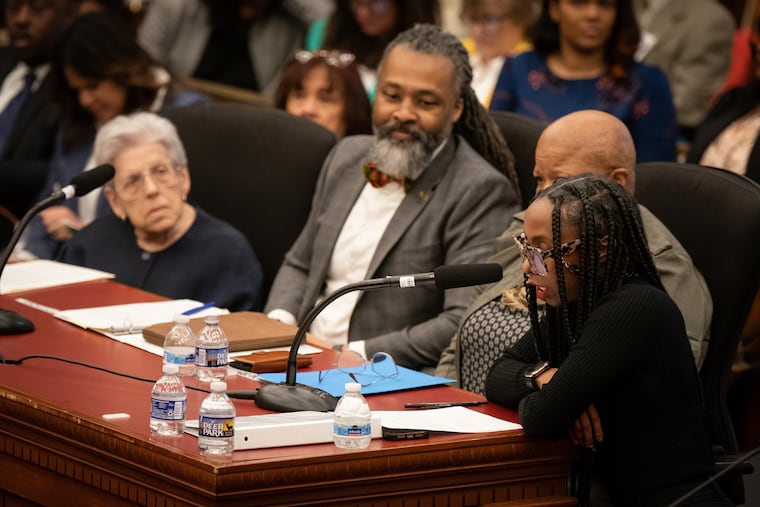
Philadelphia’s principals are getting raises and, for the first time, paid parental leave.
Members of CASA — the Commonwealth Association of School Administrators, Teamsters Local 502 — overwhelmingly approved the new four-year deal on Wednesday night, and the school board sealed the deal at its meeting Thursday night.
» READ MORE: Philly principals union has a tentative contract
Nearly 1,000 district principals, assistant principals, climate managers, and other administrators will get 3% raises every year, plus a $1,500 bonus this year and a $1,500 bonus in 2029.
They’ll also get five weeks’ paid parental leave, a new benefit also achieved by the Philadelphia Federation of Teachers earlier this year, and more: a take-home vehicle stipend and incentives for principals who work at hard-to-staff schools.
CASA’s contract expired in August, and its leadership and members expressed public displeasure with the pace of contract talks as recently as a few weeks ago. Robin Cooper, CASA’s president, said the district stepped up recently.
“We didn’t get everything we wanted, but we are leaving feeling heard, and we are leaving with a what we believe to be a fair contract, and it was never our goal to try to break the bank or not be fiscally responsible,” Cooper said.
Cooper had concerns going into the contract about little differentiation in the salary scale between new administrators and veteran ones. Adjustments to the salary schedule will help, she said.
Principals at the top of the pay scale now make $167,608 annually; at the end of the contract, they will be paid $187,720. The union’s lowest-paid workers, school safety supervisors, now start at $40,256 annually. In 2029, a brand-new school safety supervisor will make $45,087 per year.
School board members and district administrators were full of praise for Cooper and CASA.
“You and your team are always strong advocates for all of your members and deeply committed to improving the lives of students, families, and employees,” chief financial officer Mike Herbstman said. “We appreciate all that you and all of the CASA administrators do.”
Defending Ridgeway and Jimenez
Several supporters also turned out at the board meeting to defend Keziah Ridgeway and Ismael Jimenez, two district educators alluded to in a recent order for a congressional investigation of alleged antisemitism in the district.
In November, U.S. Rep. Tim Walberg (R., Mich.) said that the House Education and Workforce Committee — which he chairs — would probe “disturbing reports of Jewish students being harassed and subjected to open antisemitism in their classrooms and hallways” in three school systems: Berkeley Unified in California, Fairfax County in Virginia, and Philadelphia.
Ridgeway is a high school teacher and Jimenez is director of social studies curriculum and has been targeted by activist groups in the past.
Ridgeway, who testified Thursday night, is suing the school district over alleged civil rights violations. She was suspended and ultimately disciplined after allegations of antisemitism and violations of the district’s social media policy surfaced, but is now back teaching at a district school.
“All I’ve ever wanted was to protect students in the ways that I wasn’t protected from the racism and discrimination that permeates the SDP schools,” she told the board. “While recently the district has addressed antisemitism, it has not addressed racism, Islamophobia, and anti-Palestinian discrimination with the same rigor.”
The district in late 2024 reached a settlement with the U.S. Department of Education’s Office for Civil Rights requiring school officials to hold training on antidiscrimination policies and educate thousands of students about racial and ethnic discrimination.
Ridgeway said the district “is at a crossroads right now, with a national spotlight looming.” She wondered whether it will “capitulate to McCarthyism tactics” or “channel the spirit of Harriet [Tubman] and Martin [Luther King Jr.] ... our Black children deserve better. Our Muslim children deserve better. Our Palestinian children deserve better. Will you give it to them or will you disappoint them?”
Alex Volin Avelin, a district educator and member of Jewish Voice for Peace Philadelphia, called the congressional investigation “political theater. It’s government overreach. It is not about protecting students. It’s about intimidating and silencing teachers.”
Volin Avelin and Thomas Quinn, another district teacher, urged the district to learn from history. In the 1950s, the House Un-American Activities Committee singled out Philadelphia teachers for alleged communist ties. Twenty-six were ultimately fired.
“Looking back, we can all see the injustice and cowardice in the district’s choice to capitulate,” Volin Avelin said. “I urge the board today to learn from this shameful history and stand up for educators teaching critical content.”
Streater and Andrews stay on in leadership positions
The board, in its final action meeting of the year, also formally reorganized, setting meeting dates for 2026 and naming leaders.
Reginald Streater and Sarah-Ashley Andrews held on to their president and vice-president positions. Every board member supported Andrews’ candidacy; Streater won 8-0, with board member Crystal Cubbage abstaining. She gave no reason for the abstention.
Streater complimented his fellow board members for their work in the past year.
“We have demonstrated that steady leadership, not reactionary swings, produces real results,” Streater said.
The board has an enormous job in front of it in the next year: the facilities master planning process, which will bring school closures that will surely be unpopular.
“The responsibility is not lost on me,” Streater said, “and I gratefully accept.”