Philly teachers union and advocates implore school officials to restore 340 classroom positions
Their plea came the day after the dramatic public collapse in City Council of Mayor Parker's rideshare tax that would have provided recurring funding to the school district.
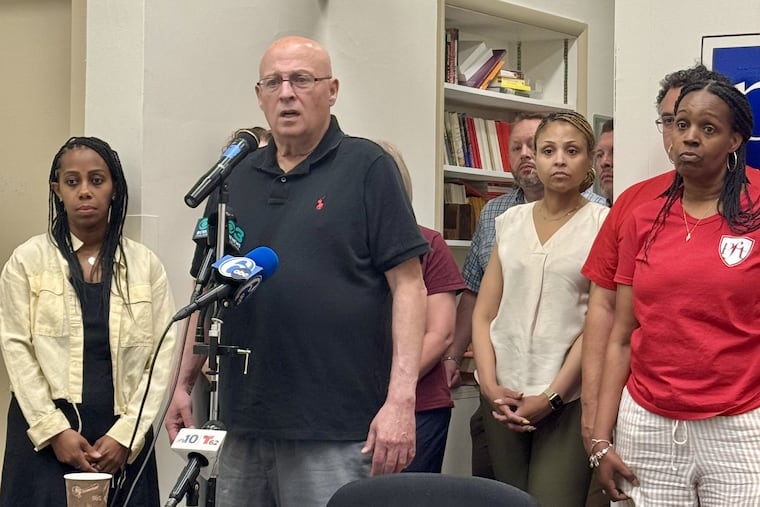
The money is on the table, the teachers’ union and education advocates said Friday. Now, Philadelphia School District officials need to use it to restore 340 classroom-based jobs.
Arthur Steinberg, president of the Philadelphia Federation of Teachers, said it is “ridiculous” that the district is getting $48 million in new money from the city but opting not to save the positions of 149 teachers, 130 climate staff, and 23 counselors.
“I’m standing here today to implore [Superintendent Tony B. Watlington Sr.] and [school board president Reginald] Streater to immediately restore the cuts as they told the district and the entire public would occur if they got this money,” Steinberg said.
» READ MORE: Philly school officials are cutting 340 classroom jobs despite getting more funding from City Council
The PFT president and a phalanx of education advocates who helped fight for Mayor Cherelle L. Parker’s ultimately unsuccessful $1-per-trip rideshare tax proposal gathered at PFT headquarters Friday to rail against Superintendent Tony B. Watlington Sr.’s refusal to restore the jobs.
Their plea came the day after the dramatic public collapse of Parker’s play to come up with $48 million in recurring revenue for the school system, which is unable to raise its own funds. After it became clear that the Uber tax did not even have enough support to come up for a vote, Council pivoted to increase the city’s contribution to the district by $48 million for 2026-27.
Though Council members said they want to work on finding new recurring revenue sources going forward, the present one-time fix approved Thursday appeared to blindside and frustrate Watlington and Streater, who joined with Parker in saying the district cannot pay for 340 positions with a Band-Aid. They highlighted that charter-school costs will also rise based on the one-time increase to district spending, as mandated by state law governing charter payments.
Steinberg said it was “deplorable and really absurd” that the school system would not use the money Council proffered specifically for the purpose of halting classroom cuts to do just that.
“Never once did they say, ‘If we only got it for one year, we’re not going to restore the cuts,’” Steinberg said.
Watlington, on Thursday refuted that notion. He said he has made clear since he began talking about the district’s $300 million shortfall that any fix must be recurring, not temporary. He has committed to retiring the district’s structural budget gap by 2029-30.
“We’ll have to live within our means,” Watlington said alongside Parker on Thursday. “We can’t commit to a staffing ratio that we don’t have the revenue for, and so we are just unable to play Russian roulette with staff positions.”
The district had no immediate comment to Steinberg’s position Friday. The planned cuts will not involve layoffs; staffers will instead be moved into other open positions in the district.
Dan Urevick-Acklesberg, a lawyer who argued the state’s landmark school-funding case, said he found the district’s logic on finances confusing.
“The bottom line is: the kids need these positions, and they will be lost,” said Urevick-Acklesberg, who stood with Steinberg and others at PFT headquarters Friday. “They’re not coming back.”
With a dizzying month of changes — from confirmation that 17 schools will close to a chaotic teacher-hiring season to news that the 340 position cuts will still go forward — the mood inside district schools is poor, Steinberg said.
“Morale is lower than it’s ever been,” he said.
The public battle between Council and the district and school board is not just a family squabble, as some officials have labeled it, officials said.
“There is very little confidence out in the public in the School District of Philadelphia now,” said Steinberg. A facilities plan that closes 17 schools, even if it renovates 169, plus the district’s refusal to restore jobs, “really impairs their credibility and people really are reluctant to work with them and take them at their word.”
Staff writer Anna Orso contributed to this article.
