Philly school officials are cutting 340 classroom jobs despite getting more funding from City Council
More than 340 school-based budget cuts are apparently still on the table, despite $48 million in new funds for the Philadelphia School District.
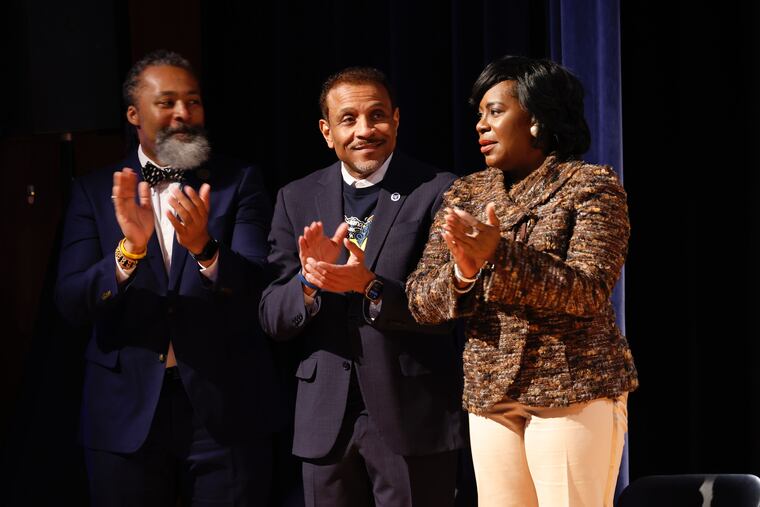
Philadelphia School District officials said they will cut hundreds of classroom jobs — even though they are getting $48 million in new funding from the city that lawmakers hoped would avert the reductions.
That is because City Council gave preliminary approval to a budget Thursday with a one-time increase for the school system and no guarantee of the same level of support going forward.
Mayor Cherelle L. Parker had proposed a $1-per-trip tax on rideshare services, which was expected to produce $48 million for the district annually — a sum that, Superintendent Tony B. Watlington Sr. said, would have made it possible to avert 340 classroom-based job cuts. But on Thursday, that plan died in Council.
“We’ll have to live within our means,” Watlington said during a news conference alongside Parker on Thursday. “We can’t commit to a staffing ratio that we don’t have the revenue for, and so we are just unable to play Russian roulette with staff positions.”
Parker cast Council’s rejection of her rideshare tax proposal as a move that would hurt Philadelphia students.
“Our goal here was to generate … predictable and recurring revenue sources for the School District of Philadelphia so that they could save 340 school-based jobs and preserve the progress that our district and our children have been making,” Parker said. “City Council did not offer an alternative plan for recurring revenue.”
Watlington, in a letter sent Thursday to Parker and Council leaders and obtained by The Inquirer, said the system “cannot restore the 340 school based positions without a commitment to recurring and predictable funding over multiple years.”
The idea that the classroom cuts could move forward despite the city’s increasing its contribution this year to the school system immediately raised Council’s ire, deepening divisions and tensions that were laid bare when the school board moved to close 17 schools in April.
“If staff gets moved and or laid off, that’s not on us,” Councilmember Isaiah Thomas said. “That’s a choice. There is money, and we put more money on the table.”
And Philadelphia Federation of Teachers president Arthur Steinberg, who supported the mayor’s proposed tax, said in an interview Thursday that he believed it would be “absurd” for the district not to restore the planned job cuts.
“For an organization that continues to [say it] cares about kids and wants kids to achieve, to not do that would just fly in the face of that,” Steinberg said. “It would be beyond ridiculous.”
But Parker and Watlington both emphasized that one-time funding could undermine the district’s long-term financial position, in part because the $48 million increase in city revenue will mean additional charter school costs next year under public education funding law.
Charter payments are based on school system funding in the prior year. Without recurring revenue, the district cannot afford to pay for increased charter costs and keep the 340 teacher, climate, and counselor positions that are now on the chopping block, Parker said.
Council says ‘sole purpose’ was to avoid cuts
In unusually animated remarks Thursday, City Council President Kenyatta Johnson said lawmakers were given the impression throughout weeks of budget negotiations that finding nearly $50 million for the district would stave off the planned staff cuts.
He said that was the “sole purpose” of Council working to find money elsewhere in the city budget after telling the Parker administration that there was little appetite in Council to impose new taxes.
“For them to make a decision and say, ‘Oh, no, we’re not going to restore the cuts,’ it’s just short-sighted,” he said. “The question should be to them: ‘What are you going to do with the $50 million? Why not save the positions?’ I think that’s what the parents should be asking the Philadelphia School District.”
Johnson likened the district making the position cuts despite the funding to saying: “I’m taking my ball and going home.”
“Real leadership,” he said, “says, ‘You know what? OK. They worked hard. They gave us $50 million. Let’s keep those positions.’”
Other members of Council’s leadership team forcefully pushed back on the notion that lawmakers did not do enough to save the school district from cuts.
Thomas, who chairs the Education Committee, referenced Watlington’s letter, which was sent to lawmakers before their weekly meeting ended.
“We haven’t even finished the session yet, and they’re disrespecting us,” Thomas said during a speech in Council. “It proves the point that we’ve been saying for a long time, that these folks don’t respect this legislative body. Well, guess what? They learned today.”
Councilmember Katherine Gilmore Richardson, the Democratic majority leader, said Council has advocated for public school students “year after year” by repeatedly increasing the city’s contribution to the district.
“I reject anyone who will purport that this Council has not stood up for our children,” she said, “and I especially take exception to it as a mother with children in the public school system and a graduate of this system.”
But Dan Urevick-Acklesberg, a lawyer who argued the state’s landmark school-funding case, said Council still has the power to ensure the new revenue is recurring.
“If City Council’s intention is to stop those cuts,” Urevick-Acklesberg said, ”the solution is there: Make plain that the district can count on this level of funding going forward.”
How did the district get here?
Philadelphia is the only school district in Pennsylvania that is unable to raise its own revenue.
Instead, it depends on City Council and the state legislature for funding, and a 2023 Commonwealth Court decision underscored Pennsylvania’s historic underfunding of Philadelphia and other low-wealth districts.
Cuts would have come prior to this budget cycle because the district has a longstanding structural deficit. But Watlington said he wanted to use pandemic-era federal stimulus dollars and district surplus funds to delay the pain, in an effort to show what classroom investments would mean for student achievement.
The district has posted modest gains in test scores, student and teacher attendance, and graduation rates over the last several years.
But Watlington has been clear for the last several months: He wants to be the superintendent who eliminates the district’s deficit once and for all.
“We are going to retire that deficit completely by fiscal year ’29-’30,” he said in January, introducing the district’s budget.