Inside Philly schools’ chaotic hiring season, with budget cuts and school closures looming
More than a dozen teachers, administrators, and others described a messy, opaque process that they worry could affect student outcomes next school year.
Spring is typically prime teacher-hiring season.
But the Philadelphia School District’s human resources timeline has been clouded by uncertainty and indecision this year, impacted by 17 school closures on the horizon and budget woes that could mean the loss of more than 300 school-based jobs.
This spring’s hiring season has been especially turbulent, according to more than a dozen interviews with candidates trying to get hired, school staff attempting to fill open jobs, and others with firsthand knowledge of the process.
Those interviewed described a messy, opaque process and said they worry it could ultimately affect student outcomes next school year.
It is a mess for many. External and internal district candidates, in some cases, have applied for dozens of jobs and heard nothing and are now looking at charters or suburban districts for work. In other instances, principals have chosen people they want to hire, but the process is not moving on the central-office side so they worry about losing good-fit candidates.
“Hiring is complete chaos this year,” said one principal, who asked not to be identified for fear of reprisal. “We’re not getting many answers, if any at all. We’re reaching out to assistant superintendents and beyond, and they don’t have much information, either.”
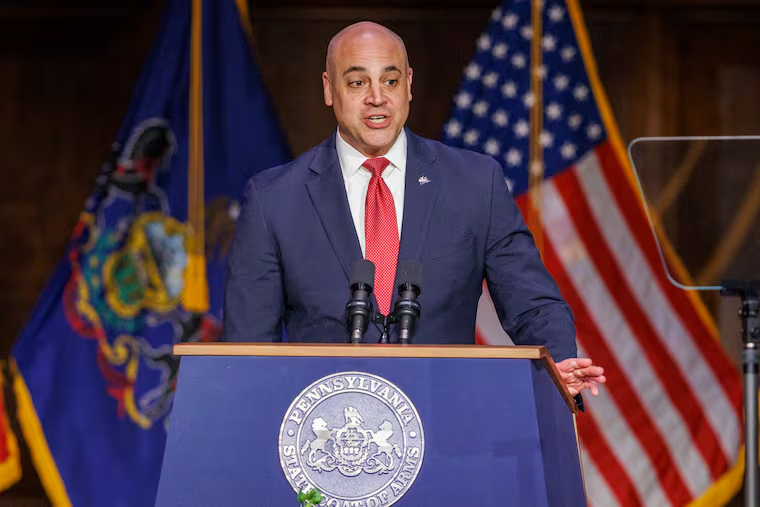
With the district facing a $300 million deficit, Superintendent Tony B. Watlington Sr. has ordered $50 million in school-based cuts, including shedding 340 positions, though because of attrition no workers will be laid off. Mayor Cherelle L. Parker has proposed a $1-per-trip rideshare tax that could generate enough money to stop the position losses, but City Council has balked at the idea. And even if it passes, the timeline is complicated.
Watlington told principals to build budgets that do not assume the rideshare tax money. He has said the cuts will be reversed if the tax is passed, but City Council will not pass a final budget until June — well after many teachers typically will have accepted new jobs.
Monique Braxton, school system spokesperson, said in a statement the process “will involve a lot of moving pieces. We will follow the negotiated agreements and continue to work collaboratively with our union partners.”
‘People are freaking out’
There is always some upheaval during hiring season in a district as large and needy as Philadelphia’s.
“But this year, people are freaking out,” said Alison Andrawos, an ESL (English as a second language) specialist teacher at Potter-Thomas Elementary in North Philadelphia whose position got cut. Even though she is eligible to be moved into another job in the district rather than laid off, she is panicking. She is unsure if she can find another ESL job, even amid a national teacher shortage.
Philadelphia schools first try to fill vacancies through site selection, where principals can hire any candidate they choose for open positions.
After the site selection window closes, those teachers in the system who need new jobs pick from among the open positions, in seniority order. Site selection closes Friday, and force transfers without jobs are scheduled to choose new positions June 24 and 25.
“Principals were not reaching out this year; people are applying and not hearing from anyone,” said Andrawos, who has been a teacher since the early 2000s. “It’s out of control. You have people that are sitting there saying, ‘I don’t know what I’m doing this year.’”
Andrawos is not sure what’s next. She is certified as a K-6 teacher but does not want to go back to a traditional classroom position. There are no district ESL positions posted and she is not optimistic about any opening up. So she has put in applications at a curriculum company and in a suburban district.
Some principals said central office staff told them to hold off hiring external candidates in some positions, including social studies and art teachers and counselors.
Braxton said there is no hiring freeze on school-based positions, but the district is “prioritizing internal transfers first in certification areas where the number of transfer requests currently exceeds the number of available positions, such as counselors, art, social studies, and reading specialists.”
The district, Braxton said, is focused on ensuring all employees who need jobs get them “before expanding external hiring in these specific areas. We hope this is a positive reflection of employee retention and continued interest from current staff in remaining with the district.”
The school system is actively hiring for all other school-based positions, Braxton said, and hopes to be “fully staffed and prepared to support students for the upcoming school year.”
Confusion over external hiring
Nathan Geesing spent time as a student teacher at Sayre High in West Philadelphia this year, and loved it. So when he saw two Sayre social studies teaching jobs open for the fall, he applied right away.
“I’m someone who believes that all kids deserve to be able to go to a great school, no matter where they live or what their grades are,” said Geesing, who recently earned his master’s degree from the University of Pennsylvania’s Graduate School of Education. “I was impressed by the kids who really tried if they felt like you cared about them, if you took time to build a relationship with them.”
Geesing wowed Sayre’s site selection committee, and they offered him a job teaching social studies with no reservations, said Kate Conroy, a Sayre teacher and member of the committee.
But soon after Geesing signed site selection paperwork, he got pulled into a meeting where Sayre administrators told him they could not hire him after all. There was a freeze in hiring external candidates for social studies positions, they said — a fact no one had relayed to school officials until after candidate interviews began.
According to a central-office source with firsthand knowledge of the situation, that is emblematic of current district operations, especially in the district’s talent office, which has had considerable turnover in the last few years.
“Decisions have to flow through a small group of individuals,” said the source, who was not authorized to speak on the record and asked to remain anonymous. “Everyone’s waiting for the top tier, and no one can move forward. We’re competing with timelines of more organized school districts that make their decisions much sooner. The left hand never knows what the right hand is doing.”
Geesing scrambled and did find another job outside his certification area — he will be an emergency-certified special education teacher at John Welsh Elementary in North Philly, where he had previously worked as a substitute. The school board voted to close Welsh in 2027, so it is a one-year position.
The whole process has left Geesing disillusioned, he said.
“We live in a really huge city with a lot of great people and a lot of smart kids, but schools are not the priority,” he said. “We’re seeing 17 schools close, we’re seeing a bunch of schools lose teaching positions. All of that is going to further discourage parents and kids from going to neighborhood schools.”

Wholesale changes are coming to the Philadelphia School District, with the school board passing a $3 billion facilties plan that aims to close 17 schools permanently, and renovate 169.
Superintendent Tony B. Watlington Sr. presented the plan to the school board Feb. 26 and it immediately faced strong opposition. After some amendments, the board passed the plan April 30. Here's what we do and don't know about it.
And to see the proposed list school closures and check how your school could be impacted, use our interactive charts.
Each of the schools proposed for closure has its own story. Find them all here.
Chris Hsieh found himself in a similar spot. Hsieh, a recent graduate with a teaching degree, currently substitutes at Parkway West.
Hsieh is dual certified in English and social studies, and was hopeful he would find a place to plant roots. He ended up accepting a job at Parkway West, another of the schools slated to close next year.
He and his similarly situated friends “really want to teach in the Philly school district, but it’s tough,” Hsieh said. “Some people are looking at suburban districts now, whereas before we were all really committed to Philly.”
Arthur Steinberg, president of the Philadelphia Federation of Teachers, agreed that this year’s hiring process — which started later than usual — has been especially tumultuous.
“It’s the type of dysfunction and inefficiency that exacerbates people leaving the system,” Steinberg said.