What budget cuts will mean for one Philly high school, which could lose 13 teachers and its college-prep program
Olney High teachers say the school has made great progress in recent years, including adding a college-prep program. Now potential budget cuts threaten that success.
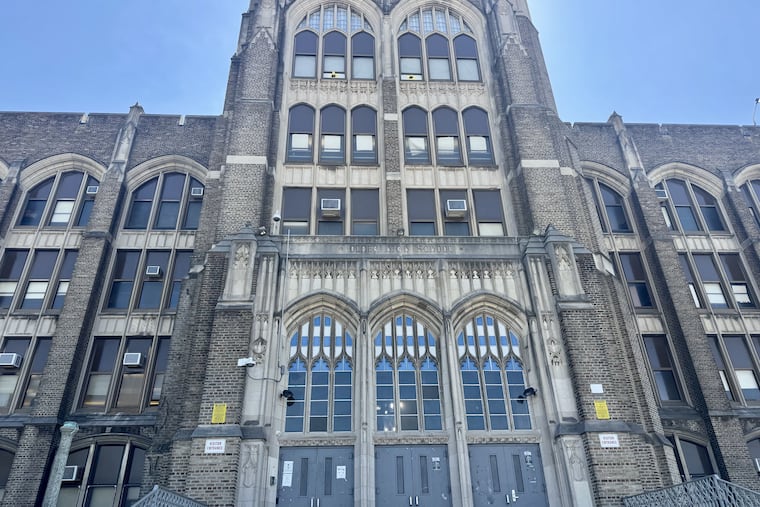
Olney High stands to lose more than a dozen staffers next school year, including educators who teach all but one of its Advanced Placement classes and run a new college-prep program, due to budget cuts as the Philadelphia School District faces a $300 million deficit.
And looming budget cuts represent just the latest upheaval for the school.
Olney has been through significant turmoil in the past: It split into two smaller schools in 2005, became a charter in 2011, then was taken back by the district four years ago after ASPIRA of Pa., the nonprofit that operated the charter, failed to meet the school system’s academic and operational standards.
“The amount of tumult the district has put Olney High School, in particular, through over the last 20 years is crazy,” said Sarah Apt, who has taught there since 2011.
Still, the neighborhood high school’s star has been on the rise lately, with a strong staff, career and technical education and traditional academic programs, a growing roster of extracurricular opportunities, a burgeoning sense of community — and even the promise of upgrades to its long-dilapidated athletic complex.
It’s now one of many schools poised to face major hits as the district addresses its deficit. Mitchell Elementary in Southwest Philly, for example, will go from an average class size of 15 in grades K-4 to nearly 30, its principal said recently. Many schools will lose teachers, counselors, and climate staff.
Superintendent Tony B. Watlington Sr. asked principals to make budgets for next school year based on a need to cut $225 million from schools, including 340 classroom jobs.
There is still some hope that the austerity measures won’t come to fruition; Mayor Cherelle L. Parker has proposed a possible fix via a $1-per-trip rideshare tax, a move she said would give the school system enough revenue to halt the classroom cuts.
But the tax faces an uphill battle with a skeptical City Council and significant pushback from companies like Uber. And even if it does pass, some damage has already been done: District staff who got force-transfer notices because of the budget cuts are now applying for other jobs. The district must pass its budget by the end of May and City Council has to approve a spending plan by July 1.
At Olney, Parker’s proposal feels uncertain — so the community is gearing up for a fight. Doris Thayer, an alum and parent of a recent graduate, is sick at the idea of the school absorbing such steep losses.
“The school has had a great turnaround, but this could be a disaster,” Thayer said. “If you start pulling these teachers out, and the school is doing well — academically, bullying-wise — if you take out what kids already got used to, that’s not good.”
The bare minimum
Olney educates more than 1,000 students, and its enrollment is down by more than 100 from last school year — in part, staff say, because of increased immigration enforcement in the heavily Latino community.
The school system’s budget cuts are partially enrollment-based, but Olney is faring worse than many other schools because of its unique situation.
It received extra staff to help bridge the complicated process of returning to the public school system after it was a charter. (On Olney’s first day as a district school in 2022, for instance, 750 unregistered students showed up, rosters had to be built on the spot, and it took months for credits to be straightened out.)
Olney staff members were concerned about eventual cuts, they said, but district officials predicted the school would naturally lose staff to attrition. Then a remarkable thing happened: Staff and students built a place where people wanted to work, and they stayed.
Then came this year’s budget cuts, spurred by decades of underfunding, an end to federal COVID-19 funds, and rising salary, benefit, and charter-school costs. Olney at first heard it would lose about 20 teachers and counselors. That got negotiated down to 13 teachers and counselors — nearly 15% of the teaching and counseling ranks.
Olney now boasts 17 sports teams, 21 clubs and activities, and Advanced Placement, honors, and dual enrollment classes. But Shawn Donoghue, a four-year veteran counselor, isn’t sure what will be left next year.
“If we are cut down to the wick and we can only have what is the bare minimum, then we won’t be able to have these opportunities for kids,” said Donoghue, who is among the staff losing her position.
College prep ‘cut off at the knees’
Jessica James came to Olney four years ago after Wesley College, where she had been a professor, was acquired by Delaware State University. James wasn’t sold on being a high school teacher, but she was sold on Olney, where it felt as though staff members were building something important with a community that needed it.
In James’ first year at Olney, four students volunteered to show up at school an hour early to take a course she taught with University of Pennsylvania professor and researcher Angela Duckworth.
Over time, dual-enrollment opportunities have grown. Olney added a college-prep magnet program after students came to James last year to ask her to help them build a strong program that would give them opportunities for which they’d otherwise have to leave the neighborhood for magnet schools. James was thrilled by the idea, and school administrators helped make it happen.
But now most of the college-prep teachers, like James, are losing their positions. All but one of the AP teachers will be gone, and it’s not possible for just anyone to teach an AP course, because it requires additional training.
“We had started to build a little bit of momentum, and I feel like we’re being cut off at the knees,” James said.
Iamdra Peguero, one of the students who inspired the college prep major, is an Olney senior; she won’t have to absorb the cuts. But she worries about what her classmates will lose.
Students “were just really crushed when they found out what’s happening next year,“ Peguero said. ”We grew up with these teachers. They were our motivators, our inspiration. They pushed us to take the rigorous classes that we’re now taking.”
Staff, students, and parents have planned a rally Tuesday after school to highlight their plight.
In presenting the district’s facilities plan that the school board plans to vote on this week, Watlington has stressed the importance of neighborhood schools. He has pointed to places like Northeast High, with its in-house magnet program and thriving extracurricular options, as a gold standard.
That’s what Olney was on its way to building, said Hanako Franz, who taught at the school from 2011 through 2015 before moving out of Philadelphia. She came back to Olney this school year and believes what the school is building is promising.
“We’re working with students and families, and word is really spreading,” Franz said. “It’s an example of the district being incredibly short-sighted, punishing schools that are doing exactly what they say to do.”