University of the Arts’ $77 million endowment remains mired in court proceedings two years after the school closed
Colleges that accepted UArts students are vying for portions of the endowment. So is the Hamilton Family Charitable Trust, which donated more than half the funds. A judge will ultimately decide.
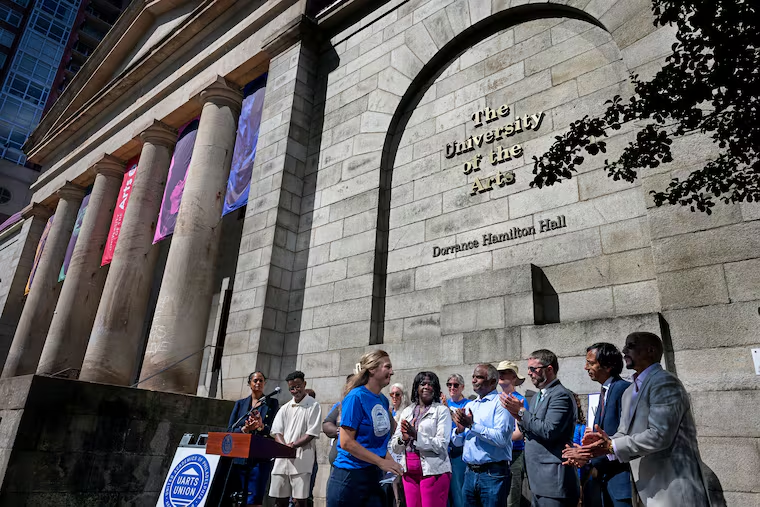
Since the University of the Arts suddenly shuttered two years ago, its buildings have been sold, many of its staff members have found other jobs, and its students have enrolled elsewhere.
But the school’s more than $77 million endowment remains in limbo.
Many parties, including colleges that accepted UArts students and a charitable trust that had funded more than half of the endowment, have been vying for the money in court.
» READ MORE: The University of the Arts is closing June 7, its president says
While the battle continues, about $3 million in endowment earnings every year are not funding student scholarships and other intended educational purposes, said a source with knowledge of the discussions related to the UArts proceedings.
“Right now the money is locked up,” said the source, who asked not to be named because of the ongoing sensitivity of the matter. “We’re just trying to find a reasonable solution that’s fair.”
University endowments are money or investment assets that largely come from donors. Much of the money is often restricted in legal agreements with donors for specific purposes, such as scholarships, awards, or programs. UArts’ abrupt closure left little time to sort out what to do with the endowment.
The Hamilton Family Charitable Trust, founded by the late Dorrance “Dodo” Hill Hamilton, had donated more than half of the endowment and wants it back. Meanwhile Temple University, Moore College of Art and Design, Rowan, Drexel, and other colleges that admitted UArts’ students following the school’s closure say they should get the money.
» READ MORE: University of the Arts asks judge to distribute endowment with partner schools
UArts’ bankruptcy trustee initially advocated that the colleges should get the money based on the percentage of UArts students they enrolled. Temple stood to get the largest amount, 44.3%, after enrolling more than 350 UArts students.
But the trustee in court filings has since said that each of the more than 200 funds that make up the endowment should be individually awarded to an entity that most closely matches the donors’ original intent.
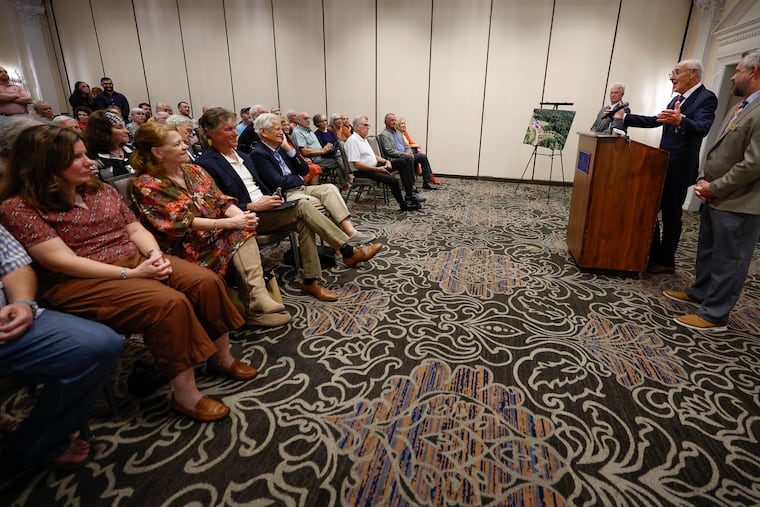
The parties last week participated in an informal conference called by Philadelphia Orphans’ Court Judge Sheila Woods-Skipper, but the matter remains unresolved. Orphans’ Court monitors to make sure gifts are used with the donors’ original intent and intervenes if disputes arise.
The case could either go to trial — which would put the decision in the hands of the judge — or a settlement among the parties. Another status conference will be scheduled, probably in July.
The Hamiltons want their money back
Dorrance Hill Hamilton, the American heiress of Campbell Soup fortune fame, had been a UArts board member and was the “leading and primary supporter” of the school, a lawyer for the Hamiltons said in court filings. Hamilton, who died in 2017, had donated funds for UArts’ Hamilton Hall, and her money makes up more than half of the endowment.
In 2006, four annuity payments of $6.25 million each were earmarked for the school to establish the Hamilton Endowment Fund, according to the court filing. Another eight payments were made totaling $10 million.
Lawyers for the Hamiltons have argued that the money should be returned to the trust’s education fund, designated for supporting educational activities in the Philadelphia region.
They were adamant that it not go to Temple University or other publicly funded colleges. That stance led a potential merger between Temple and UArts to fall apart a couple months after UArts closed.
» READ MORE: UArts is unlikely to merge with Temple after negotiations soured with a major donor
“It was never Mrs. Hamilton’s intention to support publicly funded colleges or universities with a vast student body offering a wide range of degrees and programs,” the lawyer said in court documents.
But the family may be fighting an uphill battle, according to one expert.
» READ MORE: UArts is unlikely to merge with Temple after negotiations soured with a major donor
“It’s very difficult to get the money back unless there is something in the gift agreement that calls for it,” said Reid Weisbord, a law professor at Rutgers University’s Newark campus.
The colleges’ argument that they should get it because they enrolled UArts students’ isn’t the most important factor, either, he said.
» READ MORE: UArts’ closure put almost 700 faculty and staff out of work. We caught up with some of them.
“I don’t think it’s irrelevant but what is the most relevant is what did the donor intend and how can we accomplish something as close as possible to what the donor intended at the time of the original gift,” he said.
Moore College wants all of it
Moore College, a 490-student women’s arts school in Philadelphia, has argued that it most resembles UArts and therefore should get the entire endowment. Moore’s current endowment stands at $52.7 million; if it were awarded the whole UArts’ amount, its endowment would more than double.
“Moore is most similar to the now defunct University of the Arts because it is a small private institution, solely devoted to arts education, which serves the same locality as the University of the Arts and which grants degrees only in the arts,” the school said in a court filing.
The school acknowledged it doesn’t have performing arts majors like UArts did, but said it has a film and digital media major.
Other colleges countered in court documents that Moore’s attempt to distinguish itself as most like UArts was “premature, incomplete and incorrect.” Unlike UArts, Moore is a women’s college for one thing, they asserted. The school is considering admitting men, with a decision expected by June.
Tim Holman, the lawyer for Moore in the endowment matter, said in a statement that the college remains hopeful a settlement can be reached.
“However, if the matter is not resolved via a settlement,” he said, “as Philadelphia’s only independent, private college dedicated solely to art and design education, we look forward to presenting our case in court.”
» READ MORE: Temple plans to fill the gap left by UArts with their new Center City campus
Temple in a statement pointed out its investment in the arts, including its purchase of former UArts building Terra Hall, which will become Temple’s Center City campus. The school also has entered into partnerships with the Pennsylvania Academy of Fine Arts, the Philadelphia Orchestra and Ensemble Arts Philly; and Opera Philadelphia.
“Certainly, any endowed funds Temple receives in this matter would be applied as directed by the Court, which we anticipate will enable Temple to expand arts programming and access for students pursuing arts-related degrees,” the university said.
Earmarked funds
Many funds that make up UArts’ endowment are earmarked for scholarships, often for students who meet certain academic or financial criteria or study in a certain field.
Some were very specific. The Donna J. Globus Scholarship, for instance, was specified for a female master’s of fine arts candidate in the Book Arts or Printmaking program, who is age 35 or older and who was enrolled for “a broader personal attempt to make a late change.” Another said it could be awarded to a student from the Lancaster-Reading area or students of Pennsylvania German descent and was designed to “carry on and develop the pottery of the Pennsylvania Germans.”
Another was directed to a member of the Mummers or one of their children.
There were also funds for prizes, such as the Prize in Glass Arts, and programs, including one aimed at bringing guest photographers and filmmakers to campus.
A number of the funds had no restrictions or the purpose was listed as unknown, court documents show.
Philadelphia-area couple Norma and Lawrence Reichlin donated scholarship funds to UArts in 2020 for students studying photography who had financial need or “great artistic promise” or both.
Their lawyer asked in court documents that their donation be returned so they can give it to Moore College.
A different approach at Cabrini University
When Cabrini University in Radnor closed in 2024, it gave staff and students a year’s warning and provided donors time to make requests like the Reichlins are now seeking.
The school contacted donors who contributed restricted funds or scholarships within the $42 million endowment, said Helen Drinan, former Cabrini president. Cabrini officials asked if the donors wanted the money to go to Villanova University, which was purchasing the Cabrini campus, or to another charity or college, Drinan said.
» READ MORE: At Cabrini University, there will be no next year: A chronicling of its final semester
Because of tax deductions granted on donations, donors were not allowed to get their money back. Many chose to send the money to Villanova, while some chose other Catholic colleges or charities, Drinan said.
The matter was overseen by Delaware County Orphans’ Court.
“Every effort was made to honor the intention of the donor,” she said. “You couldn’t have done a fairer job.”