Critics say Penn’s proposed guidelines on ‘open expression’ will chill speech and unduly restrict protest
The university has said it will consider feedback and release final rules in the fall
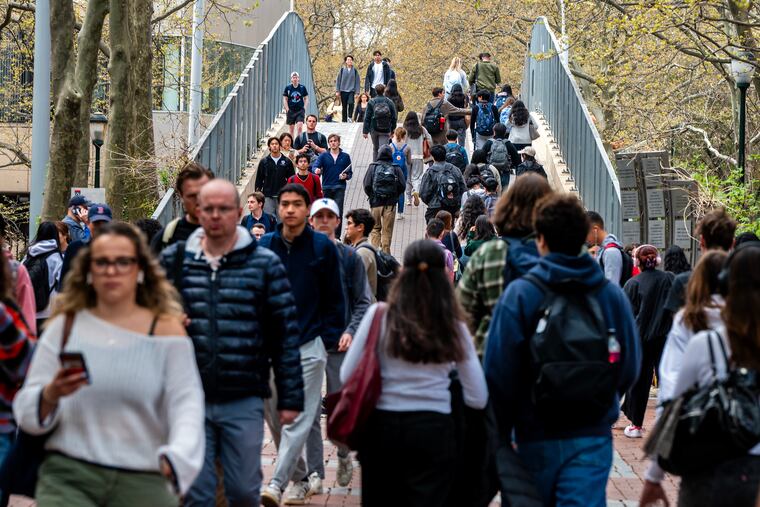
New proposed rules that would govern “open expression” on the University of Pennsylvania’s campus have drawn harsh criticism from some students, faculty, and groups who fear they will “chill” free speech, restrict spontaneous protest, and unfairly give too much authority to the provost.
Penn in 2024 released temporary new guidelines following a tumultuous semester capped by the establishment of a pro-Palestinian encampment on the College Green. The encampment was up for more than two weeks and eventually removed by Penn and city police. The school at that time announced the formation of a task force and said new permanent rules would be forthcoming.
The new proposed rules — which would be the first substantive changes in the permanent guidelines since 1989 — would require prior approval for light projection messages on buildings, livestreaming of events, and the erection of encampments or other structures. They would also restrict the use of bullhorns or amplified sound to certain areas and times and require seven days advance notice to hold an event or protest, though the school would consider shorter notice in special circumstances.
» READ MORE: Penn issues new temporary guidelines on campus protests: Encampments are banned
And the guidelines also cite as a violation “speech or conduct that is threatening, harassing, severe, or pervasive such that it limits or denies a Penn community member’s ability to participate in or benefit from their education or work,” leading critics to question who decides what types of speech and conduct fit that description.
“The Revised Guidelines have revealed an administration that is afraid of the speech of its students, faculty and staff...,” wrote Penn professors Carolyn Marvin, Diana Mutz, and Robin Pemantle, who along with the Penn Chapter of the American Association of University Professors, have opposed the draft guidelines. “Its long list of what can’t be expressed, and its burdensome impositions on what can, will discourage speech worth hearing and tame the rest.”
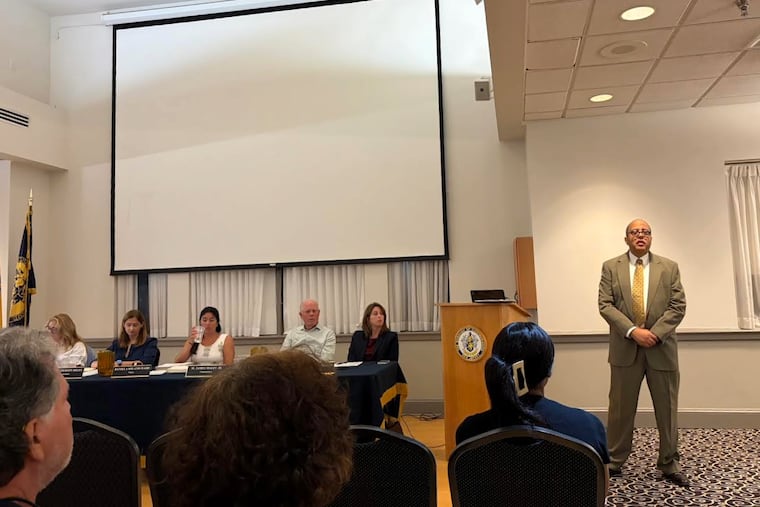
University officials, who held online and in-person meetings this week to hear feedback, plan to consider the guidelines before releasing a final version this fall. A revised version of the guidelines will be presented at the University Council meeting in September and then will go to the university president for review.
Penn’s draft guidelines come as colleges across the country are grappling with what limits should be put on free speech, and as President Donald Trump’s administration pushes schools to crack down on protests — especially encampments and demonstrations by pro-Palestinian groups, which have raised concerns about antisemitism. At the same time, the White House has called for universities to become more welcoming of conservative voices on their campuses.
» READ MORE: Philly Police have cleared Penn’s Pro-Palestinian encampment and arrested 33 protesters
“Open expression is a bedrock of Penn’s mission,” a university spokesperson said in a statement. “The current draft of the Open Expression Guidelines reflects a deliberate, collaborative process guided by a faculty-led task force and shaped by extensive and ongoing engagement with students, staff, and faculty.
“We continue to invite candid feedback and recommendations from across the Penn community to further refine and finalize the guidelines.”
The university, the guidelines note, must be able to carry out its core missions, including teaching, research, and the safety and security of the Penn community.
“It just feels like there is a very unnecessary crackdown on speech,” said Sophie Rivell, 19, a Penn freshman political science and communication major. “I’m worried ... people won’t feel comfortable expressing their opinion, that it will sort of create a chilling effect on campus.”
Student body president Musab Chummun said the language is too vague and could be interpreted in a biased way. It does not recognize, he said, that protests inherently are supposed to be disruptive — it’s how they drive change.
In 1973, 200 students held a multiday sit-in following a series of rapes on campus, and out of that, the Penn Women’s Center was created, said Chummun, 21, a junior philosophy, politics, and economics major.
“This university and also universities across the nation have become better because of bold open expression policies,” Chummun said.
Controversy over encampments and pro-Palestinian protests at Penn
The 2024 encampment stemmed from controversy that began at Penn the prior September when the Palestine Writes literary festival, which critics said included speakers with a history of making antisemitic remarks, was held on campus. Tension escalated after Hamas’ Oct. 7 attack on Israel and Israel’s subsequent military response. Donors criticized the university for not doing enough to protect Jewish students, and then-Penn president Liz Magill resigned in December 2023 following a backlash over her congressional testimony about the university’s handling of antisemitic incidents.
Pro-Palestinian students and faculty said the university didn’t do enough to protect their rights, and the encampment was erected in April 2024 and disbanded by police 16 days later.
The temporary guidelines that Penn issued in June 2024 banned encampments.
Some other restrictions in the new guidelines also can be traced to issues the university dealt with during that tumultuous 2023-24 year. The rules, for instance, state: “University statues and sculptures may not be climbed on or covered with any material.” During the encampment, the statue of Benjamin Franklin was climbed on and vandalized.
In fall 2023, messages including “from river to the sea, Palestine shall be free,” were projected on several Penn buildings, including Penn Commons, Huntsman Hall, and Irvine Auditorium. It is a sentiment that some have used as a rallying cry for the destruction of Israel, and the university said at the time that an investigation was underway.
Concern about new guidelines
Critics of the proposed guidelines fear that the long-standing Committee on Open Expression, made up of faculty, staff, and students, will no longer be the interpreter of what constitutes violations and that too much authority will now be placed in a newly created executive director position who will report to the provost.
“This puts the provost in charge of the expression of the community and we don’t think that’s good,” said Marvin, professor emeritus of communication. “All of that is a way of quashing speech at Penn, making it more difficult for students to speak out about things that matter to them and matters of public concern.”
They also raised concerns about the need for permission to livestream events. Earlier this month, a debate between education professor Jonathan Zimmerman and conservative political commentator Steven Crowder was canceled after Penn prohibited livestreaming and Crowder’s team backed out, according to the Daily Pennsylvanian, Penn’s student newspaper.
Mutz, a professor of political science and education, said she pressed Provost John L. Jackson Jr. for the reason livestreaming required permission and he told her, she said, that there was a concern they could draw “flash mobs.”
Critics also said the university hasn’t provided enough opportunity for input and questioned the guidelines on social media use. The guidelines prohibit the ”online harassment or the doxing of students, faculty or staff" and say the school could take action.
“There are going to be lawsuits galore when you try to control people’s social media accounts,” Mutz said.
Pemantle, a math professor who attended an in-person listening session about the guidelines, said attendees were upset that the university president and provost were not in attendance. Eric Feldman, a tri-chair of the faculty senate, moderated and notes were taken to provide to the administration.
“Nobody was confident they were being listened to,” Pemantle said.
He said 27 people spoke, all of whom expressed criticism of the guidelines.
“They didn’t think it was salvageable,” he said.