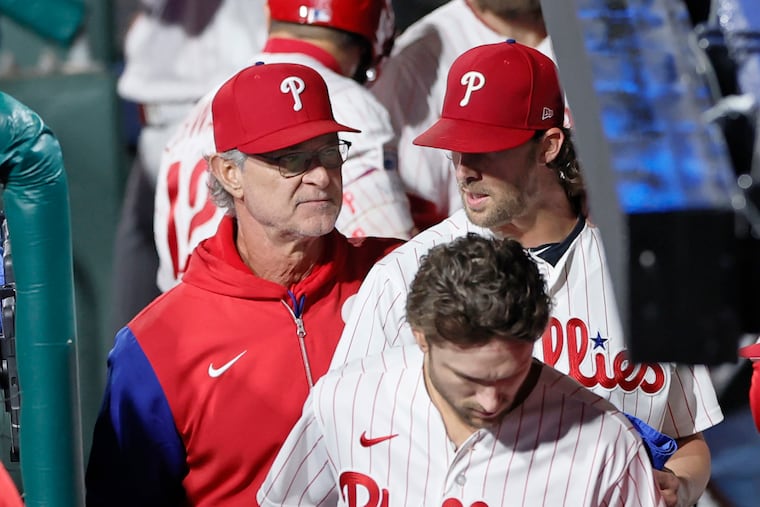
Danny Brière was at his best in the playoffs. He’s not holding the Flyers to the same standard. Yet.
The Flyers' top scoring threats have been mostly silent, even against the Penguins. Brière sees it all as a chance for his young team to learn what it takes to win in the postseason.
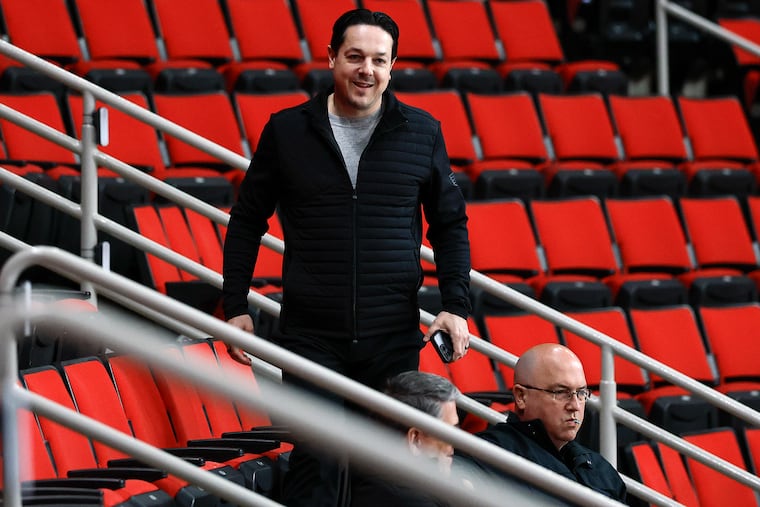
Sometimes Danny Brière will tell a Flyers player about the lengths to which he went to prepare himself for a playoff game, for every playoff game. What he tells the player, at its core, is simple enough: that he had a plan. Then Brière catalogs the elements of that plan, the questions he’d ask himself and the hours he’d spend seeking the answers. Who would go against him on faceoffs? What opposing defensemen would be on the ice when he was on the ice? What were their tendencies? How might he take advantage of them? Where did he have to be to score? If he got a shot off from one of those spots, where might the goaltender be when he did?
The questions and the explanation and the advice go on and on, and eventually the kid tilts his head and widens his eyes.
“They look at me like, ‘Were you crazy?’” Brière, the Flyers’ general manager, said. “But that was my approach. It was mental. It was watching. It was taking notes. And you learn along the way.”
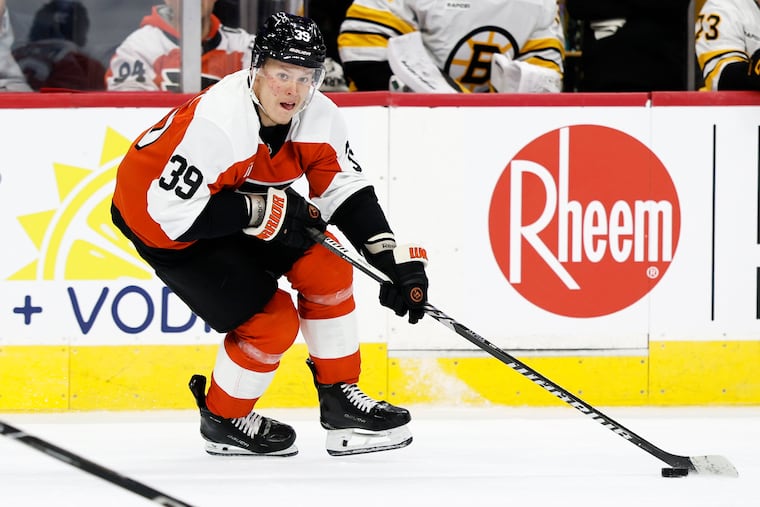
For his 17 years in the NHL, Brière was the rarest of players: one who was genuinely and undeniably better when it mattered most. He scored 26 goals per 82 games in the regular season but 35 per 82 in the postseason, and in some place deep within his heart and head, it has to be killing him night after night to watch his team’s most talented forwards fail to produce. The Flyers have seven total goals in their last five games — four of them losses — and haven’t scored more than two in any of them. Travis Konecny, Trevor Zegras, and Owen Tippett have one goal each in this postseason, and Tippett’s came on an empty net. Porter Martone hasn’t scored in six games. Tyson Foerster and Matvei Michkov haven’t scored at all.
» READ MORE: Three key numbers for the Flyers entering a must-win Game 3
That collective drought, of course, is one of the reasons the Flyers are down two games to none in their second-round series against the Carolina Hurricanes. Even when they peppered Hurricanes goaltender Frederik Andersen with 15 shots during 19 minutes of overtime in their 3-2 loss Monday in Game 2, they still couldn’t break through.
Yet Brière, at the moment, is content to view the slump less as an indictment of a team that’s not quite ready to make a deep run and more as a rite of passage for players with little or no previous postseason experience.
“You have to learn how to play in the playoffs,” he said Sunday while the team practiced at Lenovo Center in Raleigh, N.C. “What happened in the first round [against the Pittsburgh Penguins] was really impressive for our guys. We were able to figure out a way to win even though the game was different and it was a first for a lot of guys. …
“Now the big test for them is learning along the way: what works, what doesn’t work. Young players, usually why they get better in year three, four, five, is that they learn and adapt. Now this is at a higher volume and you speed through everything quicker. You don’t have two or three years to learn to play in the playoffs. But the more games we can play, the more experience they can gather, and hopefully it will help them in the future.”
Brière uses himself as an example of that necessary, and sometimes gradual, development. He was 24 when he played a full playoff series for the first time, scoring two goals for the Phoenix Coyotes in their five-game, first-round loss to the San Jose Sharks in 2002.
“I remember that round,” he said. “I wasn’t very good.”
» READ MORE: Marcus Hayes: Are the Sixers and Flyers outclassed or out of gas? Or, gulp, both?
Four years passed before he was back in the playoffs again, this time as a 28-year-old, this time with the Buffalo Sabres, this time scoring three goals and nine points in a six-game victory in 2006 … over the Flyers, his scouting and studying the byproduct of his natural aging and maturation.
“The other big thing is managing your emotion,” he said. “Early in my career, it was the highs and lows. Trying to stay even-keeled — personally, that was something I struggled with. I had to learn that. I was so nervous the whole day of a game. I was so anxious to get going and fired up. I’d warm up extra hard, flying around, and I’d come back after warmups totally depleted. The game’s about to start, and I have no energy whatsoever. Learning how to manage that, those are different experiences you’ve got to learn along the way. It’s different for everybody, and that’s what makes it hard, but that’s what experience is.”
The process is different for an individual player, though, than it is for a team, and Brière not only isn’t the former anymore, but he oversees the latter.
He and his fellow power people in the Flyers’ player-personnel department — president Keith Jones, vice president Barry Hanrahan, and assistant GM Brent Flahr — can’t necessarily wait for every promising forward on the roster or in the system to reach his full potential. They have to balance giving those players time to grow and perhaps concluding that some of them don’t have the stuff to be key contributors to a Stanley Cup-caliber club.
» READ MORE: Mike Sielski: There’s no shame in the Flyers’ Game 2 loss. The Hurricanes are just better.
“It’s still early,” Brière said. “It’s been impressive, what they’ve been able to do. We didn’t expect them to take this step the way they did this year. At the trade deadline, it was really small, the chances [of making the playoffs]. That’s another accomplishment in the memory bank. But at the same time, we’re always watching who can elevate and who cannot. It’s not everybody who has that. Yeah, we’re constantly evaluating.”
This matchup against Carolina, against a superior opponent with championship expectations, is part of that process. The two teams have played 138 minutes, 54 seconds of hockey so far, and aside from a 39-second span early in Game 2, the Flyers have generated nothing of consequence against the Hurricanes, and maybe the obsessive preparation that made Brière so clutch and dangerous back in the day doesn’t seem so crazy anymore.
» READ MORE: Eric Tulsky grew up in Philly and wrote for Broad Street Hockey. Now, the Carolina GM is facing his hometown team.
“He’s always willing to give tips, and if you ask him something, he’s willing to give you a good answer,” Martone said. “He’s a really smart hockey mind. Everything he says, you store in the back of your mind, and you can always use it.”
Game 3 is Thursday night. Now would be a good time for them to start.