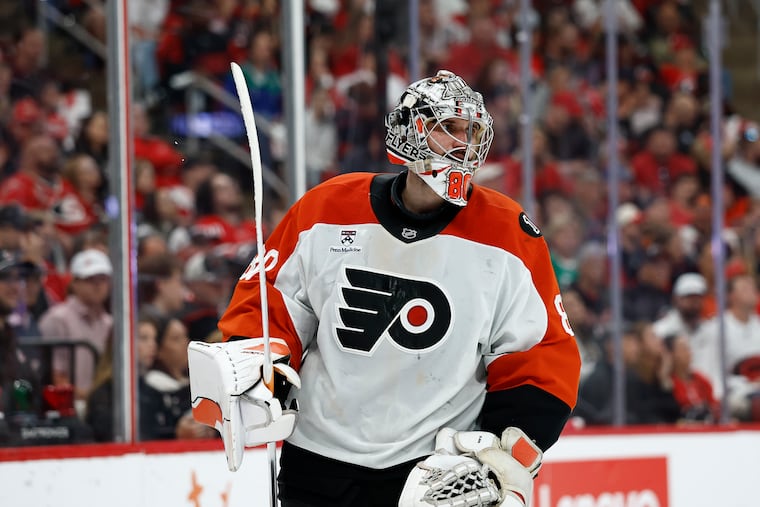
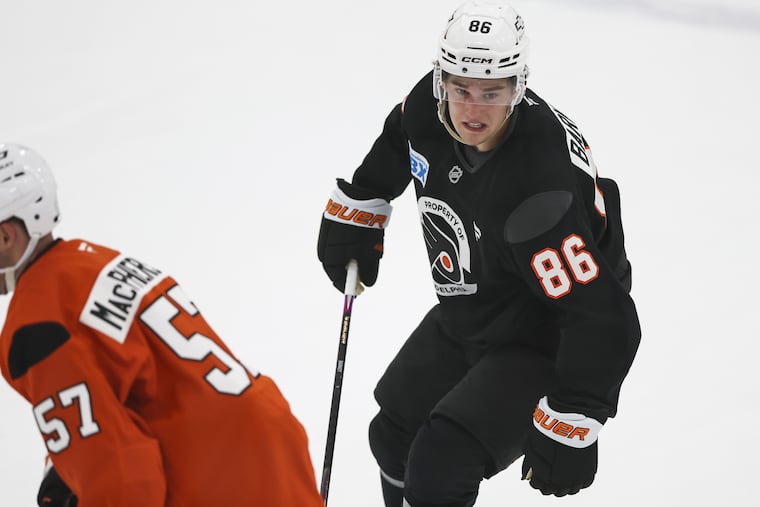
The Flyers still believe in goalie Sam Ersson. But can he take the next step and become a bona fide No. 1?
After a historically bad season between the pipes, the Flyers are counting on Ersson to be more consistent with the benefit of a steadier partner and a system that should decrease odd-man rushes.

Sam Ersson knows.
He knows there are questions about how good a goalie he is. He knows everyone outside the Flyers organization sees the save percentage — .883 last season and .888 across his 110-game NHL career — and wonders if he can carry the load, let alone the 65 games he wants to play.
He knows he needs to be better.
But for those questioning whether he can be a No. 1 goalie, or even an NHL goalie, he thinks they’re focusing on the wrong thing.
“Sometimes, it’s easy to kind of get stuck in looking at the numbers, like save percentage; I think it’s bigger than that, in some sense,” Ersson said. “I think I had a better winning percentage last year than I did the year before.
» READ MORE: The Flyers’ gifted Matvei Michkov overcame pressure as a rookie. Now he’s out to avoid the sophomore slump.
“And, I think the game is all about winning games. So that’s the only stat, for me, that I [care] about. You want to win so many games, and you want to get to the playoffs, that is the goal. So if I would do that, and I would have a 70% save percentage, I would gladly take it.”
Ersson is correct: His win percentage was better year-over-year. In the 2023-24 season, he played in 51 games, getting the decision in 49, and won 46.9% while earning at least a point in 61.2%. Last season, he dealt with injuries and missed time but still played in 47 games, earning a decision in 44, winning 50% and earning at least a point in 61.4%.
Still, as general manager Danny Brière said at the end of the season, Ersson and all of the team’s goalies, who combined for a league-worst .879 save percentage, need to be much better.
Young in goalie years
Ersson walked into the locker room at the Flyers Training Center in Voorhees last week. At 6-foot-3, he towers over most in the room while taking up a lot of space because of the goalie equipment that adds an extra 50 pounds — when dry — to his 194-pound frame.
He stood in front of his stall and took off the goalie mask that was propped up on his head — he’s still waiting on his new mask for the season — showing off flowing blond locks and a big bushy beard that makes you forget the Swede is a few days away from turning 26 years old.
Yep, that’s it. He’s still a relative pup in the goaltending world, as most NHL goalies do not hit their stride until their late 20s.
The Patrick Roys of the hockey world are a rarity. The late Ken Dryden, New York Rangers goalie Igor Shesterkin, and three-time winner Connor Hellebuyck of the Winnipeg Jets were all between 26 and 27 when they snagged their first Vezina Trophy. The beloved Bernie Parent didn’t win one until his age-28 season, while Hockey Hall of Famer Martin Brodeur was 30.
Of course, Ersson has a long way to go as he enters his third full season with the Flyers, but the expectation and hope is that he will age like a fine wine. After all, former Flyers goalie Sergei Bobrovsky, who just backstopped the Florida Panthers to two straight Stanley Cups, is playing some of his best hockey in his late 30s.
“Sam’s still a young goaltender, so he’s still rounding out his game and figuring out what solutions fit the problems that you see as a goaltender throughout a game,” Flyers goaltending coach Kim Dillabaugh said.
“So he’s working through that process, but, obviously, when you’re a guy that processes the game at a high level like Sam, that makes that development and overall process a lot easier.”

- Flyers Q&A: Danny Brière on the NHL draft
- 15 options for Flyers at No. 21
- Brent Flahr on the Flyers’ draft strategy with the 21st pick and more
- Jaxon Cover and Ryder Cali: From the Cayman Islands to the NHL
- Is 17-year-old Ilia Morozov the next center to join the organization?
- Alexander Command feels in sync with Philly. Will he be there at 21?
- Mock draft 3.0: Could another Hextall be in Philly soon?
Environmental problems
Dillabaugh was hired in 2015 after working with stalwart Jonathan Quick in Los Angeles, where they won a pair of Stanley Cups. He has been with Ersson since the day he was drafted in the fifth round in 2018.
He feels like a “proud papa” watching the Falun, Sweden, native grow and develop his game. And the two are tight — a necessity as they, along with newcomer Dan Vladař, are on a proverbial island together.
“We focus on the things that we can control,” Dillabaugh said.
“Everyone compares a goaltender to a quarterback or to a pitcher, in terms of the importance and the role they play on their team for success. But unlike a pitcher or quarterback, you don’t have the puck on your stick. You’re waiting for things to unfold and come to you. So there’s a lot of uncontrollable variables that you have to try and manage as best as you can.”
Last season, playing under former coach John Tortorella’s systems and concepts, the Flyers’ variables were off the charts. Watching 82 games, one could try to track all the odd-man rushes but eventually would throw their hands up in disgust as the number skyrocketed.
“Expected save percentage is based on the quality of chances that they faced,” InGoal Magazine senior editor Kevin Woodley said over the summer, noting Clear Sight Analytics, which uses 34 points of data and was created by former NHL goalie Steve Valiquette.
“Expected save percentage is basically how we measure environment for a goalie, right? Like higher is an easier and lower is a harder environment,” he continued. “The Flyers had three of the eight hardest environments for their goaltenders last season,” he said, among goalies who faced at least 250 chances.
“... Sam Ersson’s was .880, which is sixth lowest.”
Ersson actually did a little better than his expected at .883, and for comparison, the top of the league — Calvin Pickard, Hellebuyck, and Andrei Vasilevskiy — had expected save percentages of around .903.
But while Ersson played under tough conditions, he was not absent from blame either. The Swede was plagued by several soft goals, ranked 103rd of 103 goalies in goals saved above expected (minus-19.9), according to MoneyPuck, and tied for third in the league with 14 really bad starts (starts with a save percentage under .850).
» READ MORE: Matvei Michkov and Trevor Zegras headline the Flyers’ opening roster; Cam York to start season on IR
Predictability makes perfect
Under Rick Tocchet, the hope is that the odd-man rushes that plagued the team will be reduced. It’ll take time, as he bemoaned several two-on-one and two-on-none chances in the preseason. But the new bench boss does not “believe in river hockey, a chance-for-chance type of game.”
“You hope that the new system doesn’t allow for those odd-mans like that, because they can be difficult,” former Flyers goalie and current NBC Sports analyst Brian Boucher said.
“As a goaltender, you have no idea when they’re coming, right? That’s the hardest part, when playing goal, is that you don’t know when that situation is going to pop up. So, yeah, if they can make it more predictable, not have those odd-mans pop up at key times, it can kind of allow the goaltenders to settle in.”
Predictable is a good word to describe how Tocchet likes his defensive zone structure. Like Tortorella, he prefers a zone defense, in which players cover a specific area, releasing and re-engaging with opponents who come into their zone. But Tocchet, a former Flyers forward, has a twist: He isn’t afraid to use the overload, aka the box-and-one, shifting to the strong side of the ice — where the puck is — to out-man the other team.
“There’s going to be some nights where if you box out well, [Ersson’s] going to get shots, but you and me can stop them; they’re from the blue line, and they’re going into the stomach, and you freeze it,” Tocchet said. “You’re still getting your warmup shots. I don’t care, go ahead [take those]. We don’t want to give up Grade A shots.”
The coach doesn’t care if the other team puts 50 shots on goal, either. All he wants is for them to be from low-danger spots, like those that come from the point or along the boards. He wants his goalies to see the puck — so don’t expect a ton of blocked shots this year — because he doesn’t want a guessing game for his netminders. He wants predictability.
And ask any goalie: They like to get shots. It helps them get into a rhythm, and Ersson is no different.
“In the regular season, sometimes from the outside, trust your goaltender, trust that he can make a save,” Boucher said. “And, if you give up maybe eight more shots in the game, but they’re not from dangerous areas, the goaltender will feel better about himself.”
Mental maturity
At the end of the day, “Our job is always to stop the puck. We have to. That’s always our responsibility,” Ersson said. But what sets Ersson apart is how cool and calm he is in the blue paint. It’s not easy when a single bounce or a lucky goal can decide a game.
Part of his approach, as preached by Dillabaugh, is to focus on what he can control with so much out of his hands.
» READ MORE: NHL predictions: Will Rick Tocchet’s Flyers snap their five-year playoff drought? And who will win the Stanley Cup?
“Our focus kind of stays on what we need to do, what we can control in situations, how we respond in certain situations, and that’s kind of always been our approach,” Dillabaugh said. “We’re always looking at what can we do better? … What can we do a little bit better to give ourselves the best opportunity to keep that puck out of the net?”
An intelligent goaltender and a student of the game, Ersson is always evolving and working on his craft. The new Flyers mantra, “brick-by-brick,” suits him perfectly.
Through repetition, he is preparing himself for all the situations, the ebbs and flows, peaks and valleys, that arise in a hockey game by creating good habits.
“You’re trying to push your game in all different types of aspects,” he said when asked about his focus in this past offseason, before adding with a grin: “Try not to give away any secrets, too much, of what I do.
“But no, I think you’re trying to push everything, obviously, a little bit better, and then a lot of, for me, I think it’s just like the mental side of it. I think that’s probably the biggest aspect that I can work on.
“With maturity, with everything, I think that is where I’m kind of putting the pieces together to try to get me to put through a consistent, good level throughout a whole season.”
Ersson’s mental approach has always been on point. He is confident and regularly assesses his game, win or lose, whether to himself or the media. He does it in-game, too.
“I’ve seen some goalies where they’re having a tough night, and it’s like, ‘I’m having a bad night,’ and they let the next [one in] and you have no chance of winning,” Tocchet said. “I’ve seen some goalies who are like, ‘I’m not letting the next goal in,’ and they allow [their] team to come back. That’s mental toughness to me.
“You’re not going to have it some nights. But can you give us, like, 20 minutes of stellar mental, good goaltending time to help us get back in the game? Yeah, I think you can. And I think, from what I’ve been told, both goalies have that mentality in them.”
Ersson knows, and the team knows, he’s capable of playing at a high level, as evidenced by multiple extended stretches during his first two full seasons and his standout performances internationally for Sweden.
“At the end of the day, a lot of the guys are all pretty much the same,” Boucher said. “It’s what’s in between the ears, [that] is what separates from being good to great, average to good. And I think for Sam, it’s still a work in progress.”
The focus for the soon-to-be restricted free agent is on consistency this season. He can lean on Dillabaugh and his goalie coach in Sweden, Pecka Alcén.
» READ MORE: Goalie Samuel Ersson's rise started in a small town in Sweden
He also will lean on his new partner, Vladař, who will push him for starts. And a text or call away are members of the goalie union, like the New Jersey Devils’ Jacob Markström and Tampa Bay Lightning’s Jonas Johansson, with whom he trains in Sweden. They talk strategies for handling everything that can get thrown at them across a game and a season.
But it all comes down to him as he gains experience — a vital element for NHL goalies.
“I think that position, especially, probably more than any other, that comes into play,” Brière said. “How many goalies have consistency early in their career? They’re very rare, like the elite of the elite, maybe. But overall, he’s on track to where we plan to have him.
“I hope that the system this year helps him out; different systems might help him be more consistent as well. But I’m excited about him. I’m excited to see where he’s going to take his game.”
The Flyers are hoping it takes them, and him, to more wins.