World Juniors: Grading Jack Berglund, Porter Martone, and the rest of the Flyers prospects
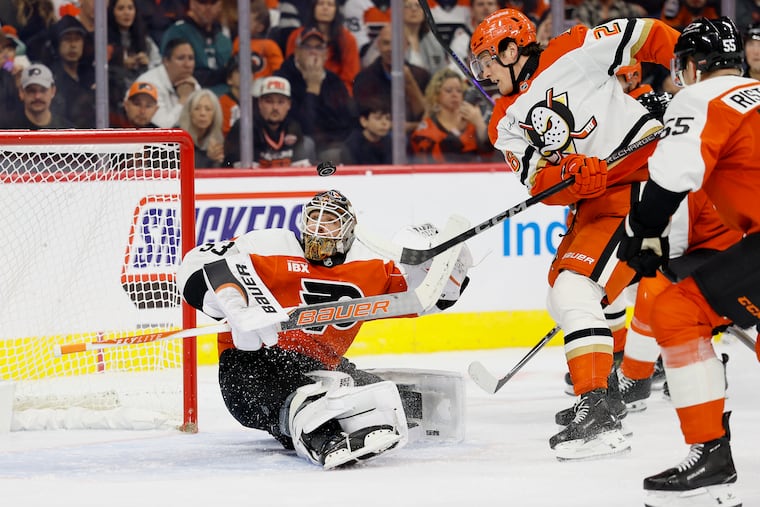
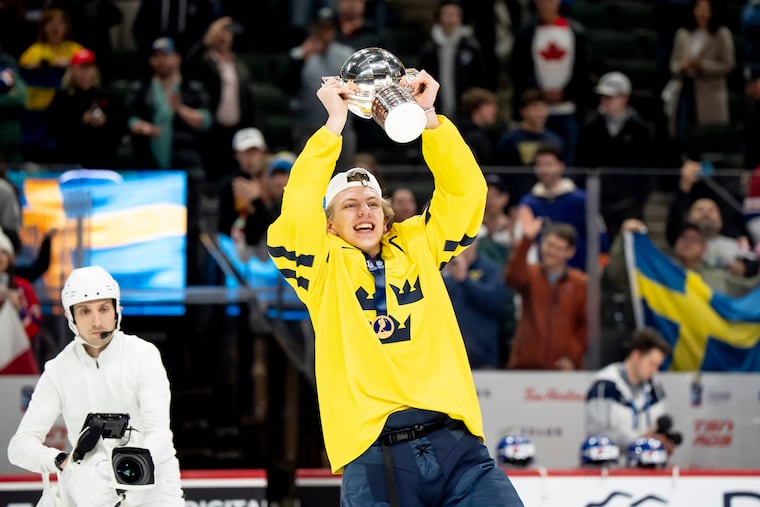
Berglund captained Sweden to gold while Martone and Jett Luchanko underwhelmed at times for Canada. Here's how all six Flyers fared in Minnesota.
Every December and January, the World Junior Championship delivers exhilarating hockey, unrivaled drama, and a lot of debate surrounding the sport’s top under-20 prospects, some of whom have been drafted and others who are about to be.
While the 10-day tournament in isolation is far from a perfect way to evaluate prospects, it does provide a snapshot to gauge players’ development and a chance to see how they perform in a best-on-best environment.
» READ MORE: Flyers top 20 prospects: Porter Martone is No. 1, but where do Alex Bump and Jett Luchanko rank?
“It’s not a be-all, end-all. Especially in Canada, it gets so blown up on the stage, people get crazed if guys don’t make it or make it,” Flyers assistant general manager Brent Flahr recently told The Inquirer of the tournament.
“But the thing that fans don’t understand is that the coaches of those teams and management have different goals than what we have. ... There’s been lots of great players who have been cut [or have lesser roles] that go on to have great careers,” Flahr said.
That brings us to the Flyers, who were well represented in Minnesota’s Twin Cities. Amid the team’s ongoing rebuild and the high-end nature and sheer volume of the team’s draft picks in recent years, the Flyers sent six prospects — tied for third-most among NHL teams — to this year’s edition of the tournament.
Here’s a look at how each of the six performed relative to expectations. (These grades are purely based on performance at the World Juniors and are not reflective of prospect rankings or the players’ seasons overall.)
Jack Berglund, C, Sweden
Captain Jack led Sweden to its first World Junior gold in 14 years and only its second in the past 45, and was dominant along the way. Berglund plays well-rounded and winning hockey and is almost impossible to get the puck off of.
While Anton Frondell scored more goals, and 2026 draft eligibles Ivar Stenberg and Viggo Björck earned most of the headlines, Berglund was the unquestioned heartbeat of Team Sweden and led by example like a captain should from the opening puck drop.
The 2024 second-round pick tallied three goals and a joint team-high 10 points in the tournament and delivered several clutch moments in the knockout rounds, including scoring a do-or-die penalty shot to keep Sweden in the tournament in the semis and delivering assists on Sweden’s first two goals in the gold medal game.
Berglund’s skating and lack of speed will always come under scrutiny, but he plays at his own pace, and his strength and reach at 6-foot-4 and 210 pounds allowed him to get where he needed to go at this level.
Berglund’s a horse when it comes to puck protection and wall work, and after some early skepticism, he has now aced his last three major test: Flyers development camp, the World Junior Summer Showcase, and the World Juniors.
Grade: A
Heikki Ruohonen, C, Finland
Ruohonen, a player the Flyers’ brass has gone out of its way to namecheck the past few years when asked for under-the-radar prospects, backed up that praise in Minnesota with a strong tournament.
For my money Finland’s top player at the event, the 2024 fourth-rounder led Suomi with nine points (three goals, six assists) across seven games and was a plus-six.
Not the flashiest guy, Ruohonen has great hockey sense and always seems to make the right play. He’s also very calm with the puck under pressure and empties the tank shift to shift from a competitiveness perspective.
The Harvard freshman impressed me here with his ability to transport the puck, and I think he has a little more skill and cleverness with the puck than he gets credit for. Though still a few years away, he’s definitely one to monitor.
Grade: B+
Porter Martone, RW, Canada
Martone was good: He led the tournament with six goals and had nine points in seven games. But he wasn’t nearly as impressive or impactful as those numbers might suggest while captaining a Canada team that fell short of the expectation of winning gold.
Three of Martone’s goals and five of his points came in 7-1 and 9-1 blowouts of overmatched Slovakia and Denmark, and another one of his goals was an empty-netter against Czechia.
» READ MORE: Top prospect Porter Martone ‘can’t wait’ to play for the Flyers. But first, he has a couple of championships to win
Speaking of that empty-netter, his controversial butt tap of a Czech player afterward earned him a silly unsportsmanlike conduct penalty and ultimately came back to bite him and Canada when Czechia got the last laugh and knocked them out in the semifinals.
Martone did score a clutch tying goal late in that semifinal, which was a huge moment and should not be discounted, but big-time plays in the biggest games were few and far between across the tournament for a player whom many expected to dominate.
This grade might seem a tad harsh, but I thought Martone, who has the potential to be a truly special player given his combination of size, skill, and snarl, disappeared at times and wasn’t the consistent driver Canada needed atop its lineup.
Grade: B
Max Westergård, LW, Finland
It’s early, but the Flyers might have found something in Westergård, a 2025 fifth-round pick. One of the youngest players in his draft class, Westergård was noticeable on almost every shift and consistently made things happen offensively with his speed, vision, and skill.
Westergård looked threatening in transition throughout and also worked hard below the goal line to retrieve and keep the puck. He had a goal and four points in six-plus games — he probably deserved a few more — before being knocked out of the bronze medal game early after taking a big hit from Canada’s Kashawn Aitcheson.
Relative to expectations, Westergård improved his stock the most in my eyes and should be a leading contributor for Finland at next year’s tournament.
Grade: B
Jett Luchanko, RW, Canada
Flyers general manager Danny Brière was vocal about his disappointment in Luchanko’s use at last year’s tournament, but this year more of the blame has to fall on the 19-year-old’s shoulders. Playing out of position on the wing, Luchanko had an unspectacular tournament while filling a depth role.
» READ MORE: Flyers Q&A: Brent Flahr dishes on prospects Porter Martone, Jett Luchanko, and more
In seven games, Luchanko had just one assist — battling in front to dig out a puck in the lead up to Tij Iginla’s opener in the semis — and was a minus-four, including being tagged with a minus-three in that semifinal loss to the Czechs.
Luchanko’s details and speed are real positives, but his play with the puck left a lot to be desired here, as he was largely a non-factor offensively despite being on one of star-studded Canada’s power-play units.
It’s far too early to give up on Luchanko as a prospect, but more was expected in Minnesota. His second half with new OHL team, Brantford, will be intriguing to follow.
Grade: C-
Shane Vansaghi, RW, United States
It would be hard to say anything other than Vansaghi had a disappointing tournament. Deployed in a bottom-six role, the Michigan State sophomore averaged a team-low 5 minutes and 11 seconds of ice time and was a healthy scratch in two of Team USA’s five games.
Vansaghi’s hallmarks of grit, physicality, and net-front activity were curiously absent in this tournament, as he was a minus-four despite his limited ice time. He was particularly exposed in a 6-3 loss to Sweden.
Grade: D
» READ MORE: Flyers Q&A: Brent Flahr talks Denver Barkey, Alex Bump, Jack Berglund, and the 2026 NHL draft