No matter what you call it — chao (Vietnamese), jook (Korean), shi fan (Mandarin), arroz caldo (Filipino), rice porridge — congee is a dish that will start your day off right. As someone who grew up eating it at cafes in Hong Kong, where it doesn’t get cold, I can attest that despite being associated with winter, congee is satisfying no matter the time of year. Philly, with its many different immigrant groups that consume rice, has just as many variants of congee, which consists of (often day-old) rice cooked in water or broth until the grains melt into a soft, fluffy texture. Despite how filling it can be, congee remains shockingly affordable, with prices ranging from just $6 to $16 at the high end. Here are some of my favorites throughout the city.
Beijing Duck Seafood Restaurant
If you scan the dining room at lunch, Beijing Duck Seafood Restaurant’s swarms of dim sum are frequently anchored by filling bowls of congee. It offers two: pork with a thousand-year egg or fish congee, both priced under $10. The pork congee is thicker, with small bits of pork and chopped egg incorporated into the porridge. The thousand-year egg — preserved in a mixture of clay, ash, salt, quicklime, and rice hulls to achieve a brown-black gelatinous “white” and a funky, dark green yolk — is relatively mild, so it’s enjoyable even for people who haven’t developed a taste for the delicacy’s ammonia-laced funk. The thinner fish congee contains larger slivers of exceptionally tender cod, but it’s the least fishy fish congee I’ve ever eaten. Don’t forget to order zha liang — rice sheet-wrapped you tiao or savory crullers — on the side for dipping.
Cafe Thanh Truc
Cafe Thanh Truc’s chao ga is like if Hainanese chicken rice and pho ga (chicken pho) got married. The same cold, beautifully gelatinous poached chicken is found on both the chao ga and Hainan chicken rice plate ($14). The chao ga ($14) is sparingly decorated with shallots and scallions, but it comes with a side of gingery dipping sauce, a fistful of fresh bean sprouts, and a wedge of lime. The bracingly sharp ginger sauce also works for an obligatory side order of spring rolls ($5 for two). It’s up to you to toss in the chilled Hainanese chicken — I’d do it slowly, marrying it only at the last moment with hot porridge.
Càphê Roasters
During colder months, Càphê Roasters’ chao comes with a wedge of lime to squeeze a bit of citrus sparkle over its bà ngoại’s, or grandma’s porridge, which is fabulously rich despite being vegan. A playful riff on canh bí đỏ, a Vietnamese pumpkin soup, it blends roasted kabocha squash with veggie broth, and is topped with scallions and crispy shallots. When the weather turns steamy, it’s swapped for a lighter porridge that’s tinged fuchsia with beets. Available in two sizes — $6 for a cup and $10 for a bowl — the smaller portion is perfect to use as a dip for the crust of a banh mi. Both work as an accompaniment to the inventive Vietnamese coffee drinks that nabbed it a James Beard semifinalist nod earlier this year, all made with beans roasted in view of the sunny, cheerful dining room.
China Gourmet
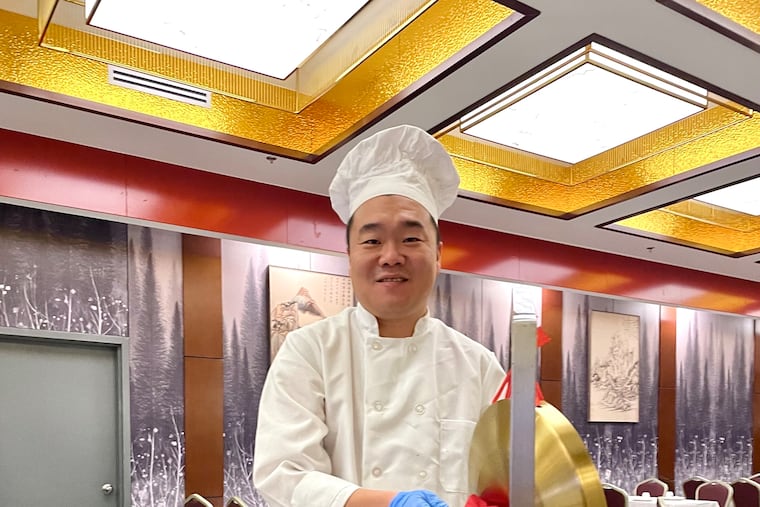
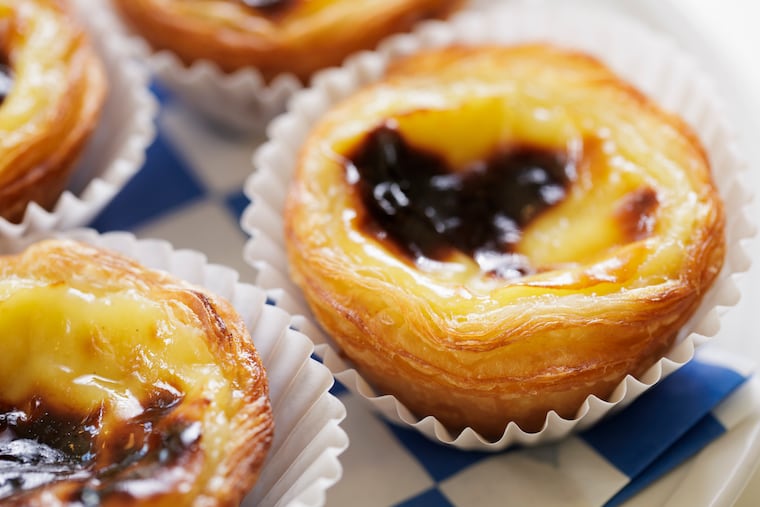
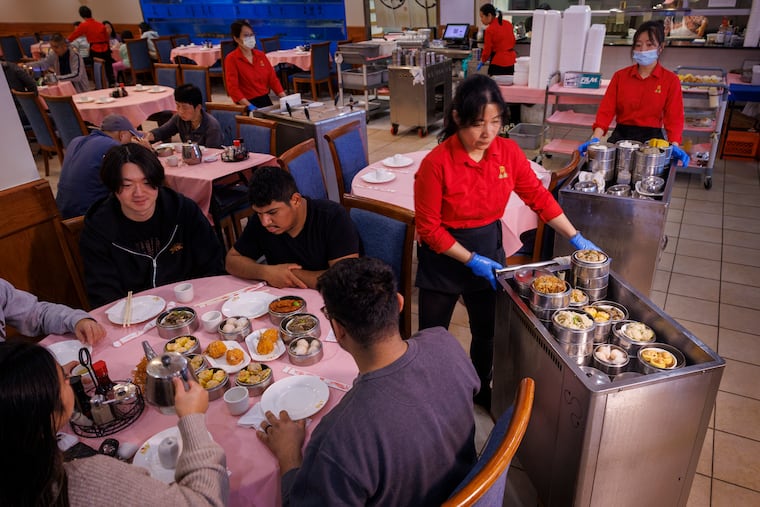
If you’re looking for the most atmospheric congee experience, head to China Gourmet. Congee is a perfect sidecar for the multitude of bites that will roll your way on steam table-outfitted carts, including flaky egg tarts, crisp spring rolls, and airy char siu bao stuffed with electric red roast pork. Of medium consistency, with the rice grains just barely dissolved in broth, the congee is mixed with generous handfuls of sliced scallions and chunks of pi dan, or preserved egg, then topped with crunchy fried dough slivers — sort of like flat noodles — before it hits your table.
D’jakarta Cafe
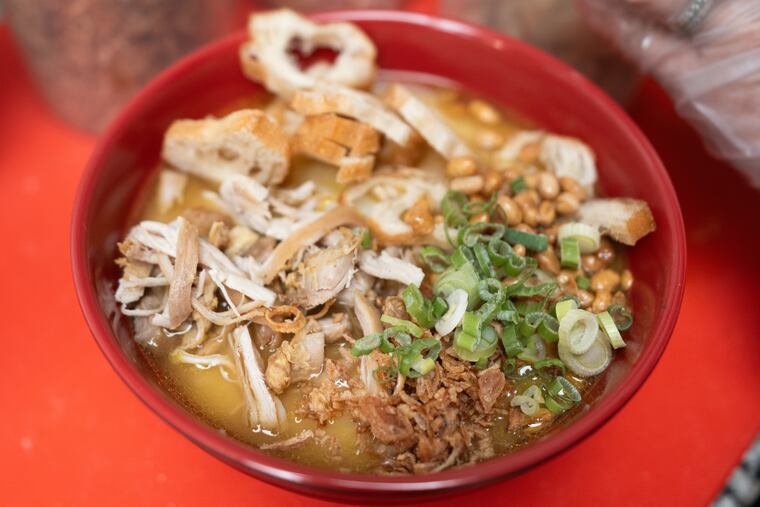
While the South Philly Indonesian restaurant is better known for slow-braised beef rendang, lamb and chicken satay, or noodle platters dotted with tiny, pearlescent fish balls, don’t sleep on its heavenly chicken porridge (sleep after, it is nap-inducing). Shredded chicken, browned shallots, and roasted peanuts on top of thick, cloud-like porridge make D’jakarta’s chicken porridge one of my favorite bowls of anything in the city. With so many toppings, it’s also one of Philly’s most fully-loaded congees: It comes with sides of sweet soy sauce, tear-inducing sambal, and crunchy kerupuk (fried Indonesian crackers). For even more satisfaction, get a side order of perkedel — potato fritters stuffed with ground beef — to drag through the remnants of your bowl.
Gabriella’s Vietnam
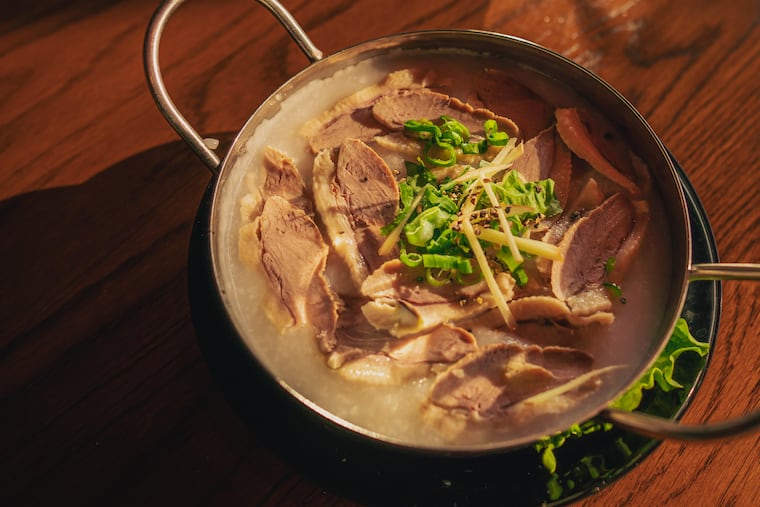
Gabriella’s chef-owner Thanh Nguyen is an absolute master of porridge, and if you catch her duck chao on the menu, it’s a must-order. It’s also distinct: While the Cantonese-style duck found in most Chinatown congee is barbecued, Gabriella’s is gently roasted and sliced into large, thin discs. Finished with fresh scallions and chunky matchsticks of fresh ginger, the result is restorative and restrained. Served in a stainless-steel cauldron so large it needs handles, it can easily serve a table of four as a backdrop to a set of small plates like the fish sauce chicken wings, lemongrass tofu, and water fern dumplings. And at $16, it’s a bargain.
Griddle & Rice
If you took the cheery design of Middle Child Clubhouse but made it Indonesian breakfast favorites, you’d arrive at something like Griddle & Rice. On a Wednesday morning, it was packed equally with Indonesian families and South Philly locals in dad hats. Here, rice porridge takes the form of bubur ayam abang abang. Served in a deep bowl, this thick, fluffy congee is drizzled with curry chicken broth and dressed with fried shallots, fresh scallions, shredded chicken breast, slices of bready cakwe (the Indonesian equivalent of Chinese you tiao), crispy soy beans (though the menu lists peanuts), and shrimp crackers that are fried in house.
Heung Fa Chun Sweet House
The earlier you get to Heng Fa Chun, the looser the jook will be. At 10 a.m., the consistency is quite thin, but as the morning wears on, it will cook down into a thicker paste. The no-nonsense pork and pi dan jook ($6), with small slivers of pork mixed in with finely chopped pi dan, tends to sell out by noon, however. The jook is set up in stainless steel vats behind a sneeze guard; you fill the provided plastic pints yourself. You’ll be asked if you’d like scallions or hot sauce added to it, and be sure to grab a couple of zhong zhi, located to the right of the counter, for about $3.25 (prices vary depending on fillings). These stuffed sticky rice bundles come in a multitude of varieties, including mung bean and pork, peanut and pork, and mushroom, and are some of the most fragrant I’ve had in the U.S. Expect to pay cash, and while most orders are sold to go, there is a tiny counter to (quickly) dine there.
M Kee
The congee at M Kee is a perfect introductory congee: There’s nothing overpowering about it, and it’s neither too thick nor too thin. The base is well-balanced, savory without being too salty, and the rice grains melted into an Elmer’s glue consistency (a good thing). The best option is the roast duck, which is chopped into small pieces and mixed throughout. The beef congee is similarly straightforward, with large slices of beef integrated into the porridge. The youtiao, meanwhile, is some of the best in the city — light, airy, and crispy.
New Phnom Penh
New Phnom Penh has few frills but a dizzyingly large menu, made all the more head-spinning by its presentation in four languages — Khmer, traditional Chinese, English, and Vietnamese — and an array of puzzling options like General Tso’s chicken. Focus on the house specialties, where you’ll find the congee, which include fish, chicken, and Cambodian-style varieties. This is the brothiest congee I’ve had in Philly — so loose it’s practically soup. The chicken stands out for the floating globules of schmaltz, while the Cambodian-style congee features pork, thinly sliced beef, and cubed beef blood. Little has changed here since it opened in Cambodia Town in 1993 (paying by Venmo is its one nod to the present), but underneath a poster of Angkor Wat, you’ll tuck into some of the city’s best congee.
Sang Kee Peking Duck House
Of all the congee in Philadelphia, Sang Kee’s is the most transportative to my childhood in Hong Kong. While the Chinatown institution and Inquirer 76 restaurant is known for its Peking duck, it in fact serves the best Cantonese BBQ roast duck in the city, and the shredded duck congee ($15) is my favorite way to eat it. Despite the name, the duck is chopped into generous chunks and thrown into a congee that’s on the thinner side — a good thing, because the skin infuses it with a depth of duck flavor and a pleasantly oily slickness. An order comes with a side of savory crullers — youtiao (Mandarin) or you zha gui (Cantonese) — essential to the Cantonese congee experience. Skipping them would be like eating a salad without croutons. You can also add a soy-marinated egg for an extra $2.
Tai Lake
Seafood specialist Tai Lake’s congee all share the same base, woven with long strands of fresh ginger, but there are multiple options: pork and preserved egg, sliced beef, sliced fish, chicken and abalone, and even a whole pot of congee with a live lobster. In terms of the actual porridge, this is the Goldilocks of congee: not too thick, not too thin, nor too creamy or fluffy. The chicken and abalone comes with a generous portion of large, thinly sliced pieces of slippery abalone, along with stewed chicken and straw mushrooms. The lobster congee ($37) may very well be the most indulgent in Philadelphia. It consists of a whole lobster, more or less quartered, and sunk into the depths of the porridge. The shell isn’t removed beforehand, so be prepared to suck it clean of meat.
The Breakfast Den
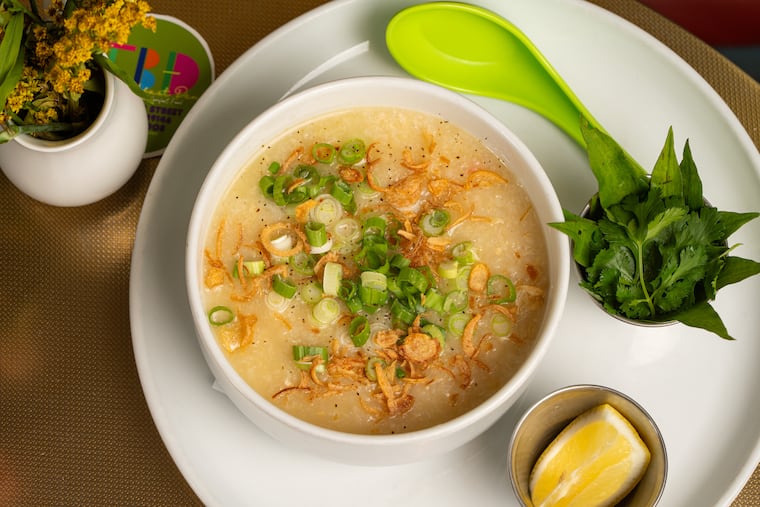
TBD has been a sleeper hit of Southwest Center City since Huyen Thai Dinh opened the Vietnamese breakfast specialist in July 2020. Its chao comes in two varieties — chicken (chao ga) and vegetable (chao chay). For $12, you get a generous bowl of congee simmered in chicken broth to the point that the rice grains have fully melted, with a split soft-boiled egg nestled in the center. But the best part is on the side: crispy bits of chicken skin served in a ramekin. Also in the ramekin is a neat handful of TBD herbs (a blend of cilantro, basil, and rauram). An extra dollar gets you another ramekin of bacon bits or fried shallots (get both). The same chaos are also available at Dinh’s recently opened cafe in Point Breeze, Hannah K, with a few tweaks.
Yin Ji Rice Roll
This newly opened franchise of an operation that originated in Guangzhou in the 1950s specializes in chang fen — long, rice sheet-wrapped rolls that you often see at dim sum or traditional Cantonese breakfasts. (Get the beef roll.) There are a dozen varieties of congee on the menu, topped with everything from shrimp to pork liver. The base is on the thinner side, but it’s exceptionally savory. What makes Yin Ji’s congee operation stand out from the others on this list are its long list of add-ons that range from 50 cents to $2, such as corn, shredded egg, shrimp, preserved egg, and lettuce (which is free). I opted for lettuce on my chicken and mushroom congee ($9), which had generous portions of both chicken and sliced shiitake mushrooms; sunk into the porridge were four large leaves of lettuce. The Lai Wan congee ($11) is fully loaded, with squid, pork skin, white fish fillets, roasted peanuts, shredded scrambled egg, and cilantro. (You can skip the youtiao, which are middling.)
Beijing Duck Seafood Restaurant
If you scan the dining room at lunch, Beijing Duck Seafood Restaurant’s swarms of dim sum are frequently anchored by filling bowls of congee. It offers two: pork with a thousand-year egg or fish congee, both priced under $10. The pork congee is thicker, with small bits of pork and chopped egg incorporated into the porridge. The thousand-year egg — preserved in a mixture of clay, ash, salt, quicklime, and rice hulls to achieve a brown-black gelatinous “white” and a funky, dark green yolk — is relatively mild, so it’s enjoyable even for people who haven’t developed a taste for the delicacy’s ammonia-laced funk. The thinner fish congee contains larger slivers of exceptionally tender cod, but it’s the least fishy fish congee I’ve ever eaten. Don’t forget to order zha liang — rice sheet-wrapped you tiao or savory crullers — on the side for dipping.
Cafe Thanh Truc
Cafe Thanh Truc’s chao ga is like if Hainanese chicken rice and pho ga (chicken pho) got married. The same cold, beautifully gelatinous poached chicken is found on both the chao ga and Hainan chicken rice plate ($14). The chao ga ($14) is sparingly decorated with shallots and scallions, but it comes with a side of gingery dipping sauce, a fistful of fresh bean sprouts, and a wedge of lime. The bracingly sharp ginger sauce also works for an obligatory side order of spring rolls ($5 for two). It’s up to you to toss in the chilled Hainanese chicken — I’d do it slowly, marrying it only at the last moment with hot porridge.

Càphê Roasters
During colder months, Càphê Roasters’ chao comes with a wedge of lime to squeeze a bit of citrus sparkle over its bà ngoại’s, or grandma’s porridge, which is fabulously rich despite being vegan. A playful riff on canh bí đỏ, a Vietnamese pumpkin soup, it blends roasted kabocha squash with veggie broth, and is topped with scallions and crispy shallots. When the weather turns steamy, it’s swapped for a lighter porridge that’s tinged fuchsia with beets. Available in two sizes — $6 for a cup and $10 for a bowl — the smaller portion is perfect to use as a dip for the crust of a banh mi. Both work as an accompaniment to the inventive Vietnamese coffee drinks that nabbed it a James Beard semifinalist nod earlier this year, all made with beans roasted in view of the sunny, cheerful dining room.
China Gourmet
If you’re looking for the most atmospheric congee experience, head to China Gourmet. Congee is a perfect sidecar for the multitude of bites that will roll your way on steam table-outfitted carts, including flaky egg tarts, crisp spring rolls, and airy char siu bao stuffed with electric red roast pork. Of medium consistency, with the rice grains just barely dissolved in broth, the congee is mixed with generous handfuls of sliced scallions and chunks of pi dan, or preserved egg, then topped with crunchy fried dough slivers — sort of like flat noodles — before it hits your table.


D’jakarta Cafe
While the South Philly Indonesian restaurant is better known for slow-braised beef rendang, lamb and chicken satay, or noodle platters dotted with tiny, pearlescent fish balls, don’t sleep on its heavenly chicken porridge (sleep after, it is nap-inducing). Shredded chicken, browned shallots, and roasted peanuts on top of thick, cloud-like porridge make D’jakarta’s chicken porridge one of my favorite bowls of anything in the city. With so many toppings, it’s also one of Philly’s most fully-loaded congees: It comes with sides of sweet soy sauce, tear-inducing sambal, and crunchy kerupuk (fried Indonesian crackers). For even more satisfaction, get a side order of perkedel — potato fritters stuffed with ground beef — to drag through the remnants of your bowl.

Gabriella’s Vietnam
Gabriella’s chef-owner Thanh Nguyen is an absolute master of porridge, and if you catch her duck chao on the menu, it’s a must-order. It’s also distinct: While the Cantonese-style duck found in most Chinatown congee is barbecued, Gabriella’s is gently roasted and sliced into large, thin discs. Finished with fresh scallions and chunky matchsticks of fresh ginger, the result is restorative and restrained. Served in a stainless-steel cauldron so large it needs handles, it can easily serve a table of four as a backdrop to a set of small plates like the fish sauce chicken wings, lemongrass tofu, and water fern dumplings. And at $16, it’s a bargain.


Griddle & Rice
If you took the cheery design of Middle Child Clubhouse but made it Indonesian breakfast favorites, you’d arrive at something like Griddle & Rice. On a Wednesday morning, it was packed equally with Indonesian families and South Philly locals in dad hats. Here, rice porridge takes the form of bubur ayam abang abang. Served in a deep bowl, this thick, fluffy congee is drizzled with curry chicken broth and dressed with fried shallots, fresh scallions, shredded chicken breast, slices of bready cakwe (the Indonesian equivalent of Chinese you tiao), crispy soy beans (though the menu lists peanuts), and shrimp crackers that are fried in house.
Also appears in
Heung Fa Chun Sweet House
The earlier you get to Heng Fa Chun, the looser the jook will be. At 10 a.m., the consistency is quite thin, but as the morning wears on, it will cook down into a thicker paste. The no-nonsense pork and pi dan jook ($6), with small slivers of pork mixed in with finely chopped pi dan, tends to sell out by noon, however. The jook is set up in stainless steel vats behind a sneeze guard; you fill the provided plastic pints yourself. You’ll be asked if you’d like scallions or hot sauce added to it, and be sure to grab a couple of zhong zhi, located to the right of the counter, for about $3.25 (prices vary depending on fillings). These stuffed sticky rice bundles come in a multitude of varieties, including mung bean and pork, peanut and pork, and mushroom, and are some of the most fragrant I’ve had in the U.S. Expect to pay cash, and while most orders are sold to go, there is a tiny counter to (quickly) dine there.
M Kee
The congee at M Kee is a perfect introductory congee: There’s nothing overpowering about it, and it’s neither too thick nor too thin. The base is well-balanced, savory without being too salty, and the rice grains melted into an Elmer’s glue consistency (a good thing). The best option is the roast duck, which is chopped into small pieces and mixed throughout. The beef congee is similarly straightforward, with large slices of beef integrated into the porridge. The youtiao, meanwhile, is some of the best in the city — light, airy, and crispy.
New Phnom Penh
New Phnom Penh has few frills but a dizzyingly large menu, made all the more head-spinning by its presentation in four languages — Khmer, traditional Chinese, English, and Vietnamese — and an array of puzzling options like General Tso’s chicken. Focus on the house specialties, where you’ll find the congee, which include fish, chicken, and Cambodian-style varieties. This is the brothiest congee I’ve had in Philly — so loose it’s practically soup. The chicken stands out for the floating globules of schmaltz, while the Cambodian-style congee features pork, thinly sliced beef, and cubed beef blood. Little has changed here since it opened in Cambodia Town in 1993 (paying by Venmo is its one nod to the present), but underneath a poster of Angkor Wat, you’ll tuck into some of the city’s best congee.

Sang Kee Peking Duck House
Of all the congee in Philadelphia, Sang Kee’s is the most transportative to my childhood in Hong Kong. While the Chinatown institution and Inquirer 76 restaurant is known for its Peking duck, it in fact serves the best Cantonese BBQ roast duck in the city, and the shredded duck congee ($15) is my favorite way to eat it. Despite the name, the duck is chopped into generous chunks and thrown into a congee that’s on the thinner side — a good thing, because the skin infuses it with a depth of duck flavor and a pleasantly oily slickness. An order comes with a side of savory crullers — youtiao (Mandarin) or you zha gui (Cantonese) — essential to the Cantonese congee experience. Skipping them would be like eating a salad without croutons. You can also add a soy-marinated egg for an extra $2.
Tai Lake
Seafood specialist Tai Lake’s congee all share the same base, woven with long strands of fresh ginger, but there are multiple options: pork and preserved egg, sliced beef, sliced fish, chicken and abalone, and even a whole pot of congee with a live lobster. In terms of the actual porridge, this is the Goldilocks of congee: not too thick, not too thin, nor too creamy or fluffy. The chicken and abalone comes with a generous portion of large, thinly sliced pieces of slippery abalone, along with stewed chicken and straw mushrooms. The lobster congee ($37) may very well be the most indulgent in Philadelphia. It consists of a whole lobster, more or less quartered, and sunk into the depths of the porridge. The shell isn’t removed beforehand, so be prepared to suck it clean of meat.
The Breakfast Den
TBD has been a sleeper hit of Southwest Center City since Huyen Thai Dinh opened the Vietnamese breakfast specialist in July 2020. Its chao comes in two varieties — chicken (chao ga) and vegetable (chao chay). For $12, you get a generous bowl of congee simmered in chicken broth to the point that the rice grains have fully melted, with a split soft-boiled egg nestled in the center. But the best part is on the side: crispy bits of chicken skin served in a ramekin. Also in the ramekin is a neat handful of TBD herbs (a blend of cilantro, basil, and rauram). An extra dollar gets you another ramekin of bacon bits or fried shallots (get both). The same chaos are also available at Dinh’s recently opened cafe in Point Breeze, Hannah K, with a few tweaks.
Also appears in
Yin Ji Rice Roll
This newly opened franchise of an operation that originated in Guangzhou in the 1950s specializes in chang fen — long, rice sheet-wrapped rolls that you often see at dim sum or traditional Cantonese breakfasts. (Get the beef roll.) There are a dozen varieties of congee on the menu, topped with everything from shrimp to pork liver. The base is on the thinner side, but it’s exceptionally savory. What makes Yin Ji’s congee operation stand out from the others on this list are its long list of add-ons that range from 50 cents to $2, such as corn, shredded egg, shrimp, preserved egg, and lettuce (which is free). I opted for lettuce on my chicken and mushroom congee ($9), which had generous portions of both chicken and sliced shiitake mushrooms; sunk into the porridge were four large leaves of lettuce. The Lai Wan congee ($11) is fully loaded, with squid, pork skin, white fish fillets, roasted peanuts, shredded scrambled egg, and cilantro. (You can skip the youtiao, which are middling.)