When the buzziest restaurants in Philly need a menu, this is the designer they call
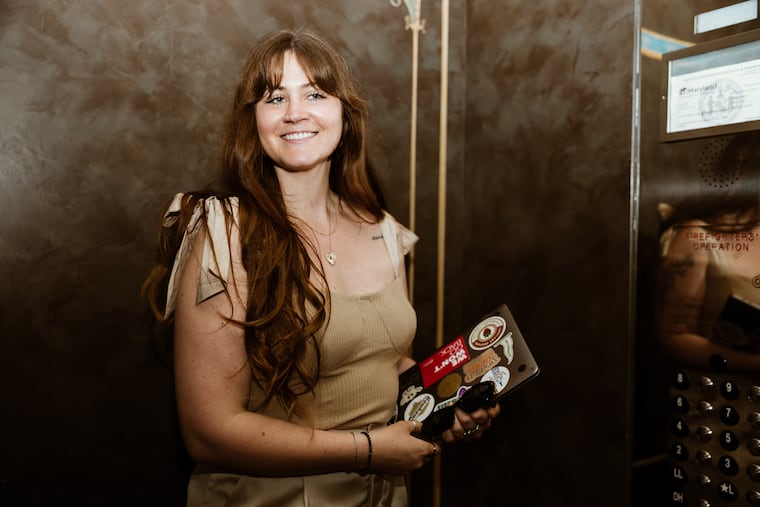
Kylie Silvestri is the artist and designer behind Haridelle.
Unless you’re paying close attention while flipping through the extensive menu at Almanac, Old City’s Japanese American cocktail bar, you might overlook some of the painstaking work that went into it. The leather-bound book’s deep green color is meant to evoke the interior of the bar. The borders of the pages hint at the seasonal ingredients that go into each cocktail, and the thin newsprint pages depicting glassware illustrations of Almanac’s complex cocktails are meant to both be a guide and evoke opening an old book.
Kylie Silvestri is obsessed with these details.
That’s because she is the artist and designer behind menus for some of the city’s trendiest restaurants and bars. Her roster includes Sao, Almanac, Ogawa Sushi & Kappo, Javelin, Little Coco’s, River Twice, Little Water, Habibi Supper Club and its forthcoming cafe, Slow Drinks, and the forthcoming Northern Liberties cocktail bar, Field Day. Her company, Haridelle, focuses on this meticulous hospitality branding.
“Design is part of the holy trinity in the food service industry,” Silvestri said. “There’s the food. There’s the hospitality, and then there’s the design.”
Menus help set the stage for each customer’s meal, and play a big role in bringing the restaurant’s story to life.
“The second a customer sits down — before they even taste the food/beverage — they are holding a menu in hand,” she explained. “How does the menu feel, tactilely? How does it look? It all adds to the experience and helps to tell that story. So, for me, designing them is about building the puzzle pieces together in a way that connects and relays the message eloquently, from chef-owner to customer.”
Silvestri didn’t begin her career with a roster of small hospitality clients. She previously worked for startup groups and larger hospitality companies. In 2021, she started freelancing to build her own company, called Kylie Creative, where she developed branding for predominantly women-owned entrepreneurial businesses in the wellness industry.
As her clientele grew, she would pick up serving shifts at restaurants in the city, including Osteria, and build connections with industry folks. Soon, a friend at the restaurant introduced Silvestri to Amanda Rucker (River Twice, Little Water), who commissioned her to design flyers for a 2022 fundraising event to support abortion access. The following year, Rucker reached out to Silvestri for branding and menu development for Little Water.
“I naturally pivoted my design work to focus on the hospitality industry — because once you start, you never leave,” she said.
While designing menus is just a part of her restaurant branding business, the process can take up to a month for each restaurant. There are five key steps to ensure a final product that owners are happy with.
First, Silvestri takes time to understand the owners/chefs’ vision for the menu. Then, she determines a menu system and layout with brand fonts and drawings. Walk-throughs of the restaurant/bar (in person or via renderings if it’s not built yet) help her connect the menu design to the physical space. Once the vision is mapped out, Silvestri likes to settle down at a local coffee shop to create the menus on Adobe Illustrator and InDesign. The final step is sharing paper stock samples with owners/chefs for feedback on design and tactility.
At Little Water, the linen-textured menu was the answer to conversations surrounding technique and locale, reinforcing the feeling of the coast with dishes offering the breadth of the Gulf to Cape Cod. An illustration of a little sandpiper sipping out of a cocktail on the drinks menu showcases the personality of restaurant owners Randy and Amanda Rucker. “We tied the design to that nautical experience and having this playfulness — Randy always says that ‘We don’t take ourselves seriously; we take our food seriously,’“ Silvestri said.
At Sao, the menu was inspired by Rachel Lorn’s family’s business down the Shore, featuring a takeout menu style that sections off the dishes in categories. There are outlines of vintage signage by Philly-based artist Darin Rowland.
For Habibi Supper Club and Field Day, the menus — like the restaurants — are still in development. On a recent Wednesday, Silvestri visited Field Day to chat with co-owner Katie Childs about the new bar’s branding and later chatted on the phone with Miled Finianos of Habibi Supper Club for his new cafe’s menu design.
The menus, Silvestri explained, are “time capsules of culture, time, and space,” so every choice, from paper stock to illustration style, is made to capture that particular restaurant’s moment.
Philly’s aim lately is on chef-owned restaurants, “or rather a focus on who is behind what,” she said, which means storytelling is more important than ever.
“Philly’s food scene is incredibly versatile. … Each story is unique to the chef/beverage professional at the heart of the concept, making it an incredible city to work in,” she said. “I will never get tired of exploring new design styles and never feel pigeonholed to follow a specific one.”