Reservation scalpers are headed for Philly. Can restaurants clap back?
After a customer tried to auction off multiple Mawn reservations, its owners say they’d like to ban the seller from making future reservations.
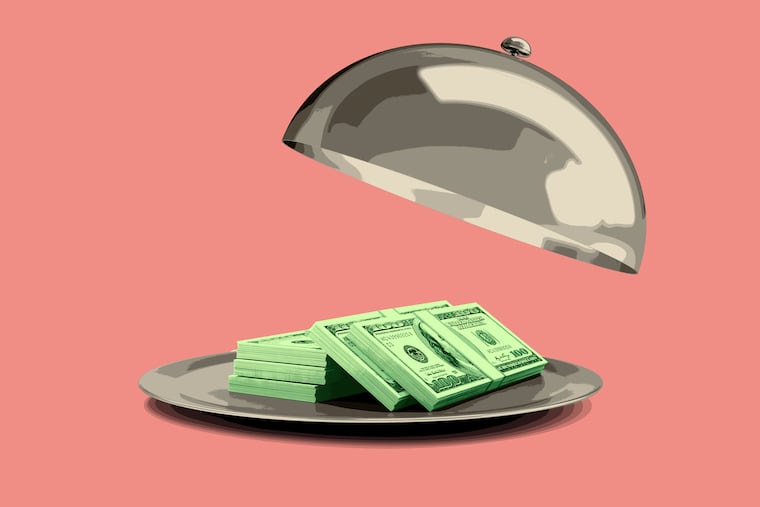
Flip a reservation and find out — or at least that’s how the warning goes at South Philly’s acclaimed Cambodian restaurant Mawn.
Last week, the restaurant’s owners, Phila and Rachel Lorn, took to Mawn’s Instagram to lambaste a woman attempting to sell coveted dinner reservations on the “Buy, Sell, Trade” section of Philaqueens, a private Facebook group with 75,000 members.
“Selling a Mawn dinner reservation for this month and February if anyone is interested,” read the since-deleted post, which did not specify a price. Commenters were split on the unorthodox offering. Three people immediately replied to say they were interested, while another didn’t mince words.
“Selling a free reservation?” she wrote. “Horrible.”
The Lorns agree.
“Eww. Gross … Don’t play with us,” they wrote, sharing a screenshot of the Facebook post that included the seller’s name. “All 11 of this person’s reservations are canceled.”
The interaction was a glimpse into the burgeoning underbelly of restaurant reservation scalping, in which enterprising individuals can make a lucrative side hustle using bots and other means to snap up free reservations at in-demand restaurants, then selling them at a premium.
The reservation black market is more established in New York City, Chicago, and Miami, where tables at celebrity-favorite Italian restaurant Carbone or Ralph Lauren’s notoriously exclusive Polo Bar can fetch between $350 and $1,700 on the third-party website Appointment Trader. One Brown University student told the New Yorker in 2024 that he made $70,000 just by using fake phone numbers and aliases to book reservations to flip on Appointment Trader. The website itself claims that sellers average $172 per reservation.
The practice has spread to smaller cities, too: During Super Bowl LIX weekend in New Orleans, a once-free reservation for a table at the French Quarter restaurant Antoine’s went for $2,138.
As reservation scalping becomes more widespread, so has legislation attempting to guard against it. Philadelphia City Council unanimously passed a law in December that would prohibit third-party websites from selling reservations without a restaurant’s consent, fining platforms such as Appointment Trader $1,000 per violation. The bill was signed last week by Mayor Cherelle L. Parker, who joined leaders in New York, Louisiana, and Illinois in banning the practice.
» READ MORE: Philly expands outdoor dining and cracks down on ‘reservation scalpers’ ahead of expected 2026 tourism
Still, these bills do not prevent savvy foodies from making under-the-table reservation deals in, say, a Facebook group.
‘Nobody should be making money off a free reservation’
Rachel Lorn said that she and husband Phila found out about the offending Facebook post from several back-to-back direct messages tipping her off.
“It’s disrespectful. Nobody should be making money off a free reservation. … We felt like we had a responsibility to [say to] all the people who can’t get a reservation, ‘This is not OK,’” said Rachel Lorn, who oversees front-of-house operations for Mawn, including the restaurant’s packed guest book.
Nowadays, scoring a Mawn reservation is about as hard as getting off the wait list for Eagles season tickets. The Lorns, who met while working at Zama, opened the cozy, 28-seat restaurant at 764 S. Ninth St. in 2023 as an ode to Phila’s parents. It was an immediate hit and has only gathered steam, garnering accolades from the James Beard Foundation, Food & Wine magazine, and the New York Times in 2025 alone.
Mawn draws lines that wrap around the block for its first come, first served lunch service, but dinner reservations are the hotter commodity. Rachel Lorn uses OpenTable to drop reservations at noon on the first of every month, making roughly 650 total tables available at once. Customers are allowed to book multiple reservations, Lorn said, and many regulars manage to do so. It’s a pain point for would-be diners who miss out, whom Lorn said she hears from nonstop.
» READ MORE: How a Cambodian noodle shop became one of Philly’s most impossible reservations
“I watch [the reservation drops] from our computer. They sell out in seconds,” she said. “We never imagined that this would be the response to our restaurant. … It’s amazing, but it’s also a really tough position to be in. There isn’t much I can do with our small restaurant and how many seats we have.”
Upon learning of the attempted black market deal, Rachel Lorn checked OpenTable and found that the Philaqueens poster had dined at Mawn six times prior and had 11 dinner reservations booked on different days throughout January and February. Lorn canceled them all immediately.
She also reached out to the seller directly, who Rachel Lorn said didn’t respond but did manage to change the name and email associated with her OpenTable account. The Lorns said they would ban the seller, if only they could figure out a way to do so; OpenTable currently does not allow for restaurants to prevent specific users from making reservations.
“It felt like she was trying to trick us further,” Rachel Lorn said. “She shouldn’t be coming to our restaurant.”
The reservation seller declined to comment to The Inquirer, citing privacy concerns. She said only that she “meant no harm and there was no ill intent,” and declined to answer questions about why she was selling the reservations. The Inquirer is not releasing her name since the attempted sale happened in a private Facebook community.
» READ MORE: From 2024: Why you suddenly need to look on OpenTable for reservations to the city’s hottest restaurants
$221 for a table at Barclay Prime?
For the most part, the Mawn incident is an anomaly in Philly. Reservation scalping has yet to take off here, according to Ben Fileccia, the senior vice president of strategy for the Pennsylvania Restaurant and Lodging Association, which worked with at-large Councilmember Isaiah Thomas to draft Philly’s anti-reservation scalping bill.
Fileccia said that this was the first time he had ever seen someone try to sell a reservation on Facebook, and that he had only seen a smattering of reservations for Philly restaurants on third-party platforms before working on the bill. Free trades are more common, he said, likely because cost is more top of mind for diners in Philly, a city with large wealth inequality.
“When you have an audience of folks to which prices are no object, [reservation scalping] becomes more of a problem,” Fileccia said. “Whereas when I discuss this issue and ask people [in Philly], ‘Would you pay $500 for reservation at 7:30 p.m. at X restaurant?’ … They usually laugh and roll their eyes.”
That doesn’t mean scalping doesn’t happen here.
A recent search on Appointment Trader found prime-time Saturday night reservations at Kalaya averaging $113 and 9 p.m. reservations for any day at raw bar Tesiny for between $107 and $360. A 7 p.m. Saturday table for six at Stephen Starr’s Barclay Prime steakhouse, or a reservation for two for literally any day or time at Pine Street Grill, Amanda Shulman and Alex Kemp’s new spot? That will cost at least $241 or $124, respectively, on Appointment Trader.
Until recently, Appointment Trader functioned similarly to StubHub, where buyers could purchase reservations that scalpers had already acquired. Now, founder Jonas Frey is shifting the model to a concierge system: Buyers request a certain reservation and an algorithm spits out an average price based on demand. Once a bid is placed, Appointment Trader matches you with a seller whose job it is to secure the reservation by any means possible. There’s a 100% refund guarantee if the request goes unfulfilled.
Representatives for the restaurants The Inquirer recently found on Appointment Trader were initially unaware they were listed on the platform.
“We do not have experience with guests utilizing this platform,” said Kalaya chef and co-owner Chutatip “Nok” Suntaranon. “All reservations for Kalaya run through Resy.”
Tesiny owner Lauren Biederman called the discovery “concerning.”
“There isn’t too much we can do in terms of figuring out if the reservation is scalped really, though,” she said, noting that Tesiny requires customers provide a credit card upon booking and charges $25 per person for late cancellations and no-shows.
When Shulman and Kemp opened Pine Street Grill last month, they designated half the nightly seats for walk-ins, in part to keep it a neighborhood restaurant. “We were especially surprised to see Pine Street listed for such a hefty price since it’s by far our most casual restaurant,” the couple wrote in a statement. “Oftentimes a dinner for two at Pine Street is less than the reservation cost you shared.”
Rachel Lorn said she feels “powerless” against platforms like Appointment Trader. She often finds out after the fact when a reservation has been resold. She also tries to hide her suspicion when a guest shows up and struggles to recall the name a table is under.
“What am I going to do in that moment?” she asked, exasperated. “Accuse them?”
» READ MORE: Google review scammers target some of Philly’s top restaurants
Why exactly is reservation scalping bad?
Chief among the concerns reservation scalping has raised in the restaurant industry: It overinflates the demand for a restaurant.
Often, scalpers will sit on hundreds of reservations that go unused, leading to no-shows that can hurt a restaurant’s bottom line and lead to less tips for servers. At COQODAQ, an upscale fried chicken joint in New York that’s popular on Appointment Trader, the no-show rate more than tripled after the website took off, Fox Business reported.
Fileccia said it’s hard for some establishments to make that business back.
“The types of restaurants that have reservations being sold are not restaurants that are going to get walk-ins to refill those seats,” he said. “These are places that people know they need a reservation for.”
Frey, who founded Appointment Trader in 2021 after he struggled to get an appointment at the DMV, has pushed back against that narrative repeatedly in interviews. He argues that the site has gone to great lengths to tamp down on no-shows by penalizing reservation sellers for a low “sell-through rate.” If less than 50% of an account’s reservations go unsold, he has said, those accounts can no longer upload new reservations; if that rate dips below 25%, those accounts are banned altogether. (Between 2023 and 2024, Frey reported Appointment Trader did $6 million in reservation sales.)
It’s unclear if reservation scalping will find a foothold in Philly. But at Mawn, at least, it’s deeply unwelcome.
Rachel Lorn said the practice reminds her “of when everyone went and bought up all the toilet paper during COVID. There was nothing left for anyone else,” she said. “It boils down to a human decency thing.”
Correction: An earlier version of this article stated City Council’s unanimously passed bill banning reservation scalping had yet to be approved by Mayor Cherelle L. Parker. Mayor Parker signed the bill into law on Friday, Jan. 9.
Inquirer Food Festival
Get your ticket to Philly’s ultimate food party! Join top Philly chefs and bakers for one unforgettable day of food.