Google review scammers target some of Philly’s top restaurants
The scam — impossible to thwart and difficult to overcome — is part of what one online watchdog calls a widespread cottage industry based mainly in Pakistan, India, and Bangladesh.
Update: Hours after this story was published, Google removed the fake one-star reviews this story addresses. Read our full followup here.
When chef Nicholas Bazik went to sleep Wednesday night, Provenance, his boutique restaurant in Society Hill, carried an enviable rating of 4.8 stars out of 5 on its Google page.
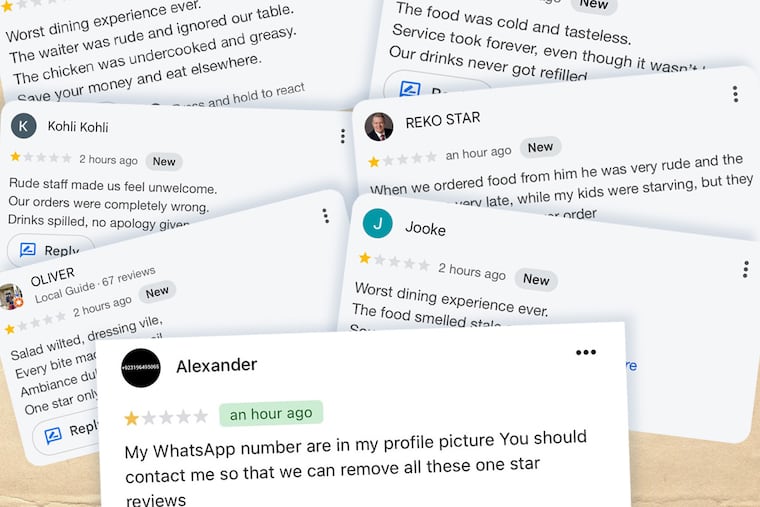
On Thursday, Bazik woke up to a 3.9 — the result of 39 one-star reviews posted overnight. A 40th one-star review contained a chilling offer from a Google user who called himself Alexander: “My WhatsApp number are in my profile picture. You should contact me so that we can remove all these one star reviews.”
“Alexander” also posted removal offers on the Google pages of at least a half-dozen other high-rated Philadelphia restaurants that had been similarly blasted, such as Ambra, Her Place Supper Club, Kissho House, Lacroix, Mish Mish, Palizzi Social Club, and Southwark, dragging down their scores, as well.
Some of the reviews are obviously false. One dinged Provenance because delivery “came cold and soggy” — although it serves only $225-a-head tasting menus in Bazik’s hushed atelier. A Mish Mish dissenter cited “burnt” taco shells, which the Mediterranean restaurant in South Philadelphia does not offer, just as Kissho House, a Japanese restaurant in Rittenhouse, does not put out “undercooked” pasta — or overcooked pasta, for that matter.
This scam — impossible to thwart and difficult to overcome — is part of what is believed to be a widespread cottage industry based mainly in Pakistan, India, and Bangladesh, out of the reach of American authorities. The scammers blast small businesses that depend heavily on online reviews, such as contractors, retailers, and restaurants, hoping they will pay a ransom to restore their ratings. Meanwhile, it is difficult for business owners to remove the bogus reviews from Google and other platforms.
Why Google reviews matter
“Businesses live and die by these reviews,” said Kay Dean, who keeps tabs on the online-review industry on Fake Review Watch, which includes a YouTube channel. Dean, a former criminal investigator for the federal government, said she began investigating reviews and their impact eight years ago after a bad experience with a medical provider that she had chosen based on reviews. She said she does this work as a volunteer.
Lower ratings harm a business’ online reputation, potentially steering away customers. “Nobody clicks and reads each review,” said Alex Tewfik, owner of Mish Mish in South Philadelphia, whose rating dipped from a 4.5 to 3.8 over one recent night. “They just see a number, and once that tanks, they just skim by. We’re in 2025. You have 50 [browser] tabs open on different restaurants you want to go to. Then you see one has 3.5 stars, so you’re just going to move on.”
Further, Tewfik said, “what does that 3.5-star [rating] mean? Is it actually going to affect my business? Do people care about Google reviews?”
Clearly, people do. Google Maps, where the reviews are found, claims 2 billion monthly active users. High ratings are currency.
People do look at Google as their first impression of what a restaurant is.
“People do look at Google as their first impression of what a restaurant is,” said Bazik, at Provenance. “Right now, we have the positive press of Bon Appetit. I worry about people who read about us in publications and then go to our Google page and they just see we’re at a 4.2. They could discount what they read on a publication and just take Google at face value without looking at it.” With a wave of out-of-towners expected in Philadelphia next year for the Semiquincentennial, Bazik fears a long-term impact since Provenance and the other restaurants would require many five-star reviews to mitigate the damage.
Dean blames the online platforms for creating “such a lax environment that it makes it very easy for these unscrupulous marketers to extort small businesses.” She said each may hit hundreds of businesses a day in the hopes that even one might pay up. She did not know why Philadelphia restaurants were targeted last week.
Google, by far the largest platform for reviews, allows business owners to flag spam reviews but offers no way to speak with anyone from the company directly. “It’s this black hole, and Google’s clearly not on top of the problem,” Dean said.
Interview with a scammer
“Alexander” — who seemed to be behind the rash of Philadelphia one-star reviews — is exploiting this. His Google profile is locked, so it does not show his activity on the platform and lists a WhatsApp number with a Pakistani country code.
Identifying himself as a journalist, an Inquirer reporter messaged Alexander to ask how the one-star reviews could be removed. “Don’t worry, brother, I can delete them all in 10 minutes,” came the reply. (In some subsequent messages, he said it would take 20 minutes for removal.)
You send me a check mark on one of the stars and I delete it first, then you pay me and I delete everything.
Alexander said his fee was $250, paid via Remitly, a U.S.-based money-transfer service.
Asked how he could guarantee results, Alexander offered a free taste: “You send me a check mark on one of the stars and I delete it first, then you pay me and I delete everything.”
When asked, Alexander said he did not know who had placed the one-star reviews. “Deleting one-star is my business,” he replied. “I am a professional one-star removal provider.” For the same $250, he said, he could change the one-star reviews to five-star, and “add very good content.”
How to fix fake one-star ratings
Dean, the watchdog, said scammers often claim that a competitor has paid them to post negative reviews, which can trick businesses into engaging with them. “I’ll just tell the business, block them,” Dean said. “Don’t engage with them whatsoever. Block them, flag the reviews, and document everything.” Paying the ransom can encourage the scammers to return, she said.
Google’s appeals process requires businesses to flag each bogus review one by one — a laborious task — and wait for Google to act, if it does at all. The onus is on the business to disprove the review. Meanwhile, Google seldom, if ever, updates owners about the appeal.
“Businesses are in the dark and just hoping for the best,” said Mish Mish owner Tewfik. He said on Saturday that Google had removed four flagged reviews.
Google replied Friday night to an Inquirer request for comment, seeking the names of affected restaurants and promising to investigate. The representative had not answered questions about the company’s handling of complaints by Monday evening, and most of the bogus reviews were still online. At Provenance, Bazik said Google removed 11 reviews last weekend, edging up its rating to 4.3. He said he did not pay a ransom.
this massive problem,” she said.
Regulatory efforts
Last year, the Federal Trade Commission set in place rules prohibiting the sale or purchase of fake reviews. “What really fell short is that there were no requirements for the review platforms like Google,” Dean said. Under Section 230 of the Communications Decency Act, platforms are largely protected for content that appears on their sites. “Essentially there’s no teeth in [the new rules],” Dean said. Although she said it was a step in the right direction, “the reality is, with no accountability for platforms like Google, the fake-review problem will never be solved, because in large part, they have all the information.”
Complicating matters, Dean said, is most scammers are small-time and based offshore, operating outside U.S. jurisdiction. To draw concerted attention, a large criminal enterprise would need to be identified, she said.
“There should be something like an Uber or Airbnb model where both parties have to opt in to get a review [so that] there’s a guarantee that you’ve experienced the restaurant,” Tewfik, of Mish Mish, said. “Now, anybody can leave any review about anything. The people who leave reviews have way too much power in this situation, and it’s bad for business.”
After Tewfik announced Mish Mish’s predicament on social media, more than 85 customers responded with five-star reviews, and the restaurant’s rating inched higher, to 4.3.
“The outcry of support from fans of Mish Mish and industry people has been damn near revelatory,” Tewfik said. “It’s really easy to get stuck in the mud and be completely immersed in the [everyday drama] of running a restaurant, but seeing all these people leave good reviews, it’s really soul-affirming.”