After 50 years devoted to a Logan Square landmark, Cherry Street Tavern’s owners have decided it’s time to sell
The Loughery brothers made a 124-year-old bar a fixture beloved by countless regulars.
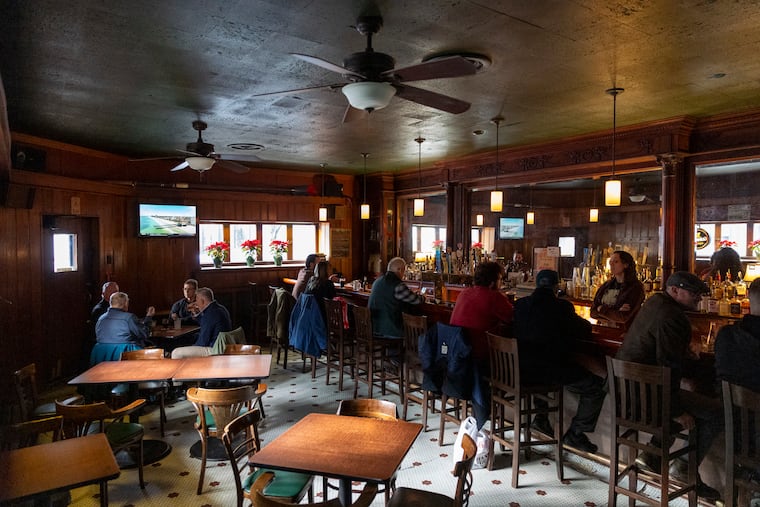
In 1976, when Bill Loughery was a rookie bartender at Cherry Street Tavern, the old-world saloon seemed as abandoned as the neighborhood around it. Back then, the streets around 22nd and Cherry in Logan Square were littered with abandoned warehouses, rusting textile mills, and crumbling body shops.
First operated as a bar around 1902 and surviving Prohibition as a barbershop — at least one where regulars swilled hooch in the back room — the tavern had retained much of its bygone charms into the ’70s. It had an elaborately carved mahogany backbar, vast beveled bar mirrors, pearly white tiled floors, and an old-timey phone booth. Even the tiled water trough running the length of the floor under the bar — a no longer operational relic from the barroom’s pre-World War II days designated for fedora-sporting patrons to spit tobacco juice and relieve themselves — had survived the decades.
But like the neighborhood, business had faded.
Bill Loughery, then 24, and his younger brother, Bob, had scored the bartending gigs from their former coach and mentor, legendary La Salle High School football coach John “Tex” Flannery, who purchased the bar in the early 1970s. Serving 25-cent Schaefers, rocking their favorite Grateful Dead tunes, and warmly greeting the newbies filling the barstools, the Lougherys brought life to Cherry Street Tavern, eventually buying it from Flannery in 1990.
While burnishing its old-world grace, they had transformed the timeworn taproom into a thriving, in-the-know spot for eating and drinking, with a diverse, dedicated, and colorful cast of regulars from all over. Everyone from construction workers and electricians to lawyers and bankers to art students and professors came to the bar — even rock icons like Jimi Hendrix, who, as the legend goes, knocked on the side door wearing a cape in 1968 after playing a show at the original Electric Factory, just blocks away; he palmed the bartender $100 for a case of Bud and a bottle of Jack Daniels. There were also visiting sports legends like Larry Bird, who would drink at Cherry Street with his staff when he came through town as a coach in the 1990s and 2000s.
“He’d say, ‘Billy, let me know when you’re closing that kitchen,’” Bill Loughery remembers. “And then he would go back to the Four Seasons with bags of roast beef and roast pork.”
And always, there were Bill and Bob Loughery, either toiling in the tavern’s tiny kitchen before dawn to prepare steaming cauldrons of Irish potato soup and huge slabs of beef for the bar’s signature sandwiches, or working the wood until closing.
After 50 years devoted to a tavern that always felt more like a labor of love — and bearing witness to the change all around it — Bill and Bob Loughery have decided it’s time.
“Time to take off the apron,” said Bill Loughery, taking a quick break on a recent afternoon to sit in the soft sunlight slipping through Cherry Street’s bottle-height barroom windows. “It’s just time.”
History, for sale
It’s been time for a few years, but the Lougherys — wanting to preserve the understated elegance and identity of the shot-and-a-beer saloon, especially after revitalizing the bar once again as a popular meeting spot for locals after COVID-era restrictions dried up lunchtime and commuter crowds — have never officially listed the tavern and its upstairs apartment for sale. They began whispering to friends and regulars about selling around 2024.
“People were always asking us to let them know when we were ready,” Bill Loughery said.
After months of talks with prospective purchasers, the Lougherys are now in talks with a buyer who they say is interested in expanding the bar’s kitchen and making other renovations.
The Lougherys’ efforts to find a buyer committed to keeping the spirit of the bar alive have eased the worries of regulars old and new, and loyal staff.
“There’s just something sacred about the place,” said Kira Baldwin, 27, of Ardmore, who tends bar at Cherry Street Tavern, along with her brother, Jack, 24, and her mother, Juanita Santoni, with whom she sometimes shares a shift.
For Baldwin, it’s personal. As a child, she cherished special occasions when her mother allowed her to visit the bar. (Santoni has worked nights and weekends at Cherry Street Tavern since 1991, when she was a part-time child life therapist at CHOP.) On those nights, Baldwin would do her homework in the quiet of the ancient phone booth and swing from the brass dining rails. At the annual Christmas parties, when Bill Loughery hired Moore College of Art & Design students to paint the windows for the holidays, she and her brother received gifts from a regular dressed up as Santa.
Now, she watches new regulars fall in love with a bar she’s been coming to since “the womb.”
“People treat it with reverence,” she said. “When they come in, they understand it completely. They have a deep and profound respect for the place.”
Prohibition, the food, and the regulars
Little is known about Cherry Street’s earliest days, but by Prohibition, it was known as Dever’s, operated by John “Jack” Dever, a dapper barman who lived above the tavern with his wife and two children, and whose father, Joseph, had run it before him. (Like Flannery and the Lougherys after him, Dever happened to be a La Salle High alum.)
The barbershop speakeasy had been Jack Dever’s idea, said his grandson, Michael Dever.
“The story always went that, when Prohibition came about, he closed the front door and opened the back door,” said Dever. “It became dangerous. The story was that you were either buying from the mob or dirty politicians.”
Dever reopened the bar after Prohibition, sponsoring a bar baseball team. But dangers persisted. In 1940, two robbers broke into the bar while Dever and his family slept upstairs, briefly making off with 25 quarts of high-quality whiskey before their bulging bag of booze crashed to the pavement. Nearby patrolmen ran to the scene, “their noses guiding them unerringly as the liquor spilled into the gutter,” The Inquirer reported.
Dever, who soon moved his family out of the upstairs apartment, ran Cherry Street until 1967, when he died of a heart attack behind the bar, according to granddaughter Maureen Ginley. At first, customers assumed her grandfather had just stepped down a hatch behind the bar, leading to a liquor cellar.
“But he didn’t,” she said.
After keeping the bar afloat for five years, Dever’s widow, Mary, sold the bar to Flannery. A local high school football legend who coached at La Salle for nearly 30 years, Flannery operated a no-frills, old-school establishment, refusing to allow a jukebox. Under Tex, the tavern’s old-world grace peeked out from behind a dusty veneer and faded Venetian blinds.
A 1981 Daily News article described the bar “as cave-dark, cave-cool, cave-quiet.”
“Let’s face it, a guy comes in here, he wants to drink,” the article quoted Flannery.
For a while, it was just the old-timers, said Bill Loughery.
“We had the senior citizens from the neighborhood who started drinking right in the morning and went home before lunchtime,” he remembered.
One Friday during Lent in 1977, Flannery summoned the brothers to a sit-down fish cake dinner and laid it out straight. “He said, ‘Listen, the future of the bar business isn’t 25-cent beers,’” remembers Bill Loughery. “‘You got to come up with a food angle.’”
With the help of a regular, Bill and Bob Loughery introduced the tavern’s signature hot roast beef and roast pork sandwiches, chili, and daily soups.
By the 1980s, when condos and townhomes and office buildings and new life began to fill the neighborhood, the Lougherys were ready.
Soon, the expanded back room was packed at lunch and the stools were filled with regulars who Bill Loughery blessed with nicknames: Happy Bob and Sleeping Charlie, Big Tom and Buddy Bud, Catfish and Canadian John (who eventually became American John). Joe Watson — a beloved old-timer who lived upstairs, and became a “patron saint” to the bar, said Bill Loughery — took a busload of regulars to a Phillies game for his 89th birthday. There were St. Patrick’s parties and fishing trips and softball teams and marriages and births and deaths. It was their “Cheers,” one regular said.
“What’s Cheers?” Bill Loughery would ask, unironically.
It was Bill and Bob who brought everyone back, said Frank Oldt, 81, who has been a Cherry Street regular since the days of Tex.
“They just made it such an easy place to be,” he said.
It’s bittersweet, said Santoni, who remembers how the bar regulars threw her not one — but two — baby showers when she was pregnant with Kira. She has been trying to get Bill and Bob Loughery to slow down for years. But she understands the special pull of the place.
“It gets in your bones,” she said.
Last call
It all took a toll on Bill Loughery’s bones, who still works 12-hour shifts, splitting days and nights with his brother. Bill’s back is hunched from those endless hours in the kitchen. He doesn’t want to become the second person to die behind the bar at Cherry Street. Sitting down, he flipped through photo albums from the bar’s heyday. They’ll be the last things he takes with him when he leaves, he said.
“It’s like the Old and New Testament,” Bill Loughery said, opening a near-to-bursting photo album.
For a few minutes, he allowed himself to recall the faces and the nicknames and the good times.
“So many nice people,” he said.
Then, he closed the book and went back to work.

- How FIRE, a Philly-based free-speech group, went from ‘cancel culture’ watchdog to Trump antagonist
- How to have a Perfect Philly Day, according to Habibi Supper Club’s Miled Finianos
- The best things we ate this week
- Was it weird to ask a man for ride or was it weird for his wife to treat us like a nuisance?
- Castellanos’ paper goodbye, Philly’s Super Bowl cameo, and a 40-degree heat wave | Weekly Report Card
- Citywide Quest: Do you know where in Philly these Valentine’s Day-themed photos were taken?
- Industrial bones and big flavors in Easton, Pa. | Field Trip
- They put $300,000 down to move up in Passyunk Square| How I Bought This House
- Letting the mind wander in snow-caused traffic
- She was raised as a queer kid by nontraditional hippies. Now she just wants ‘a guy who will commit.’