Federal Donuts & Chicken regroups after a major franchisee closes several locations
Founders Michael Solomonov and Steve Cook say they are resetting the brand and are taking control of some shuttered stores.
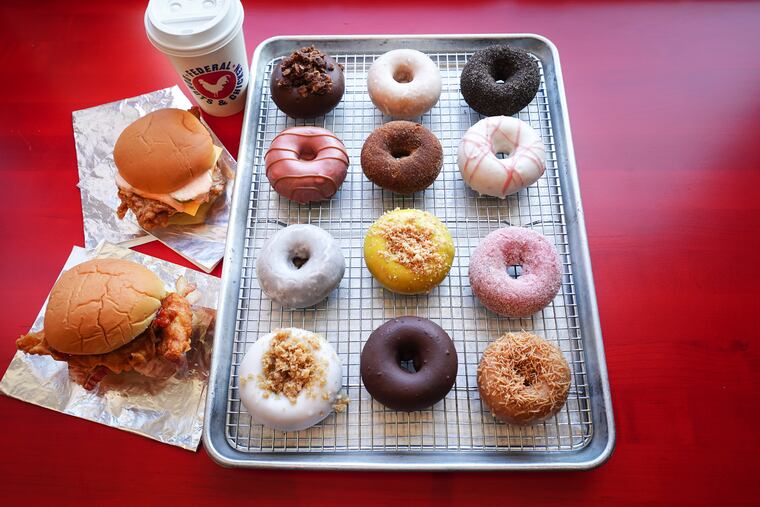
Federal Donuts & Chicken said it is working to regain its footing after its largest franchisee began closing stores in Philadelphia and the suburbs.
Chefs Michael Solomonov and Steve Cook, the eatery’s founders, are focusing on a reset, including reacquiring several of the shuttered shops to operate as company stores and reworking operations to improve food and service.
The closings have disrupted an ambitious expansion plan. Solomonov, Cook, and three partners opened Federal in 2011, turning their obsessions with fried food into one of Philadelphia’s most recognizable brands.
In 2022, Cook and Solomonov took on a majority investment from Radnor-based NewSpring Capital. At the time, Federal had 11 locations and arena stands, and executives hinted that as many as 150 new units could follow through franchising.
Two years later, Federal — rebranded as Federal Donuts & Chicken — began building around its first major franchise group, including Mike Sloane, a Montgomery County restaurateur, and Michael Heller, chief executive and chairman of the Cozen O’Connor law firm.
These franchisees bought seven locations — four existing stores and three new suburban shops. Earlier this year, they closed the long-running location on Benjamin Franklin Parkway as well as the newer locations they had opened in Radnor and Willow Grove. Their stores in North Philadelphia, East Market, and Conshohocken remain open.
Meanwhile in March, Federal closed the prominent Wolf Street location in South Philadelphia. Cook said at the time that the chain no longer needed a large production kitchen because the company was moving toward more on-premises cooking.
Sloane, speaking also on behalf of Heller, declined to discuss the reasons for the closures or the group’s relationship with Solomonov, Cook, and NewSpring. “These situations can be complicated, and not every partnership evolves the way people initially expect,” Sloane said, adding that he respects what the founders had built and wished the business well in its next chapter.
“Franchisees make their own decisions,” Cook said. “We both learned a lot making the transition from company-owned stores to franchising.” NewSpring executives did not respond to multiple messages seeking comment.
Not every franchise relationship has soured. Mark Heinz and Debbie Grady, whose store in Marlton Square is approaching its first anniversary, said they were “holding our own,” though they described suburban growth as slower and less predictable than Federal’s urban business. One challenge, they said, has been making customers aware the store is there; they’re hoping for better marketing. Another is its location, which shares a parking lot with Trader Joe’s and other businesses; however, Heinz described delivery business as strong.
A third franchisee, who operates the location at Gather Food Hall in University City and the Federal Donuts food truck, did not respond to a request for comment.
Private-equity investment has become a common tool for restaurant companies trying to grow beyond their original markets. NewSpring also invests with Turning Point, the breakfast-and-lunch chain. Other Philadelphia-area restaurant brands have had mixed results with outside investors: Spread Bagelry has expanded to 17 stores in four states after partnering with a Main Line firm in 2018, while Iron Hill Brewery, which took on private equity in 2016, filed for bankruptcy protection last fall, though it is planning a return under new management.
Federal’s own expansion ambitions predated the NewSpring deal. A Miami outpost, next to a Dizengoff location, opened in 2017 but fizzled within six months.
For Federal, the immediate task is regaining control of its footprint. Cook said he and Solomonov expect to reopen the Parkway store this month as a company-owned location and are working with landlords to regain control of Sloane and Heller’s still-open franchise locations in East Market and North Philadelphia. Other Federal locations, including 540 South St. and the game-day stands at Citizens Bank Park and Xfinity Mobile Arena, have remained under the company’s control and are also still operating.
At the center of Federal’s reset is the store at 1909 Sansom St., which Cook and Solomonov recently reacquired from the Sloane-Heller group. With the Wolf Street production kitchen no longer needed, Cook said the Sansom Street shop has become the company’s new flagship and test kitchen. There, Federal is trying a narrower menu, cutting doughnut varieties from nine to six, cooking chicken on-site, and looking into reviving bone-in chicken, the brand’s original format.
“There’s really no fireworks here,” Cook said of the changes. “It’s basic – trying to see what we can do to continuously improve what we’re already doing.”
Federal’s retrenchment has come during a difficult period for restaurant chains broadly. In the fried-chicken sector, competition among chains and independents has become especially intense. KFC’s U.S. same-store sales fell 1% in 2025, while Popeyes’ U.S. comparable sales dropped 2.9%.
“I haven’t seen anything quite like it since we opened Zahav in 2008,” Cook said of the overall climate. As CookNSolo, he and Solomonov separately own Laser Wolf, Dizengoff, Goldie, K’Far, Jaffa Bar, Aviv, and the catering venue Lilah.
Still, Cook said that NewSpring remains committed to Federal. He described the departure of former chief executive Jeff Benjamin several months ago as a natural transition after Benjamin helped move Federal from a company-operated business to a franchise system.
Cook, now the chief executive, said franchising remains Federal’s path forward, with locations planned to open soon in Lancaster, Princeton, and at Atlantic City’s Hard Rock Casino. “We’re relatively new at this, and I’ve learned some lessons along the way,” he said. “We’re trying to incorporate what’s worked, fix what hasn’t, and make sure the brand stands for what we always intended it to stand for.”

Open locations
- 300 Route 73 South, Marlton: opened April 2025; franchise-operated
- 200 Ridge Pike, Conshohocken: opened June 2025; franchise-operated
- 3025 Market St. (Gather Food Hall), University City: opened October 2025; franchise-operated
- 701 N. Seventh St., Philadelphia: opened June 2014; franchise-operated, though the company intends to take it over
- 21 S. 12th St., Philadelphia: opened October 2020; franchise-operated, though the company intends to take it over
- 1909 Sansom St., Philadelphia: opened March 2022; formerly franchise-operated, retaken by the company in March 2026
- 540 South St., Philadelphia: opened October 2018; company-owned
- Philadelphia International Airport: opened June 2025; operated by a third party under license
- Xfinity Mobile Arena: operated by a third party under license
- Citizens Bank Park: operated by a third party under license
Closed locations
- 1776 Benjamin Franklin Parkway, Philadelphia: opened November 2021; closed in early 2026, but company intends to reopen it
- 22 Wolf St., Philadelphia: a company location that opened March 2024, closed March 2026
- 232 N. Radnor-Chester Rd., Radnor: opened September 2024 as the first suburban Philadelphia-area franchise; closed in March 2026
- 4021 Welsh Rd., Willow Grove: opened January 2025, closed in March 2026
Future franchise locations
- MarketFair, 3535 Route 1, Princeton
- 621 Harrisburg Ave. (College Row at Franklin & Marshall), Lancaster
- Hard Rock Hotel & Casino, Atlantic City