After 41 years, Center City’s longest-operating Japanese restaurant has closed
Robert and Patti Moon believe that they won the right to buy Shiroi Hana, founded by Sun Myung Moon and the Unification Church, because of their last name.
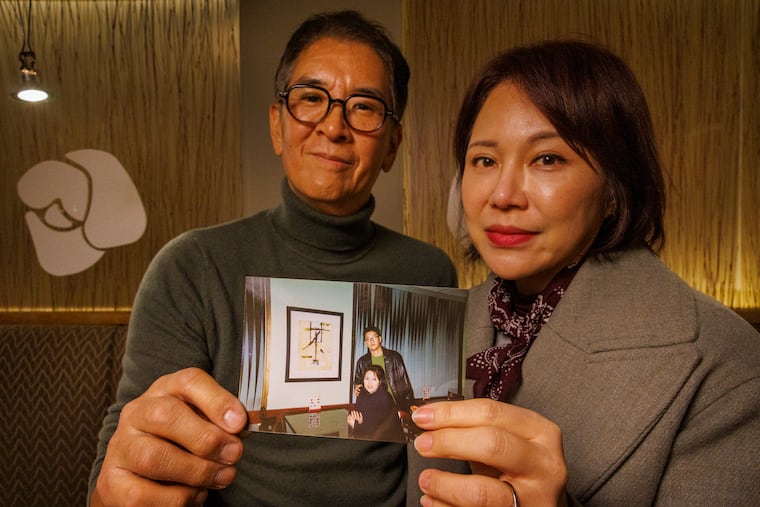
At Shiroi Hana last Thursday at noon, plates, bowls, and ramekins filled the dining room tables. But this was not lunchtime at Center City’s longest-operating Japanese restaurant. It was a tag sale.
Owners Patti and Robert Moon were cleaning out the place in advance of the building’s sale in coming weeks. The kitchen was silent and the sushi bar cleared out.
Shiroi Hana served its last meal in January after 41 years. “It’s sad. Very sad,” said Patti Moon, who with her husband, Robert, took over in 1998. In 2010, the couple also opened Doma, a Japanese-Korean restaurant, at 1822 Callowhill St.
The modest Shiroi Hana opened in 1984 at 222 S. 15th St. — across from what was then Bookbinders’ Seafood House — as part of a nationwide group of restaurants owned by Sun Myung Moon and the Unification Church. (Many of the restaurants shared the name “Hana,” meaning flower.)
In the late 1990s, Patti and Robert Moon, in their early 30s, were running Grill Master Deli at 17th and Spruce Streets when they heard that the restaurant was for sale. Given their last name, “for some reason that mattered to [the church],” Patti Moon said. “There were other people trying to buy it, but they gave it to us. We were young. I guess it was luck. It was meant to be.” (Robert Moon said he was not related to the self-proclaimed messiah, who died in 2012.)
The restaurant, modest at first but bearing a quiet elegance after the Moons gave it a 1999 makeover, had a small brush with fame under its original ownership. In 1989, Mick Jagger and Jerry Hall rolled in with a bodyguard and manager, “gobbled about $100 worth of sushi,” signed autographs for the staff, and left a 25% tip, according to a Philadelphia Daily News account.
Shiroi Hana was a favorite among Inquirer critics. Shortly after its ’84 opening, Elaine Tait praised an offering called sushi heaven — “a generously and artistically filled lacquer tray crammed with sushi and sashimi” — and proclaimed it “almost too much of a good thing.” It was priced at $20 (about $61 in today’s dollars).
Last week, critic Craig LaBan said Shiroi Hana “remained a favored hideaway for an intimate lunch until the end, especially beloved by Elizabeth,” his wife. “My kids grew up eating there, and it was always her choice for lunch with a particular friend because the food was great and they knew just how we liked it, down to the tiniest details. She’ll forever miss their chicken katsu bento box.”
Patti Moon said they closed because of shifting trends. Japanese dining has increasingly moved toward chef-owned omakase restaurants, she said, a model that is difficult for non-chef operators to sustain. “For a long time, we were lucky,” she said. “Our head chef, Hiroshi Abe, had been there since 1984. He stayed almost 35 years. When he left about three years ago, people noticed. Business wasn’t the same.”
Longtime manager Michiko Kadekaru — who started in 1990 and became, in Robert Moon’s words, “the heart and soul of the restaurant” — has indicated that she would retire, though the Moons hope that she will continue working for them at Doma.
“She started in her 30s and now she’s in her 70s,” Patti Moon said. “She was crying on the last day — and so were we.”
