After 20 years on Girard Avenue, Tiffin begins a new chapter five blocks away
The pioneering Indian restaurant founder Munish Narula has relocated his flagship to Northern Liberties.
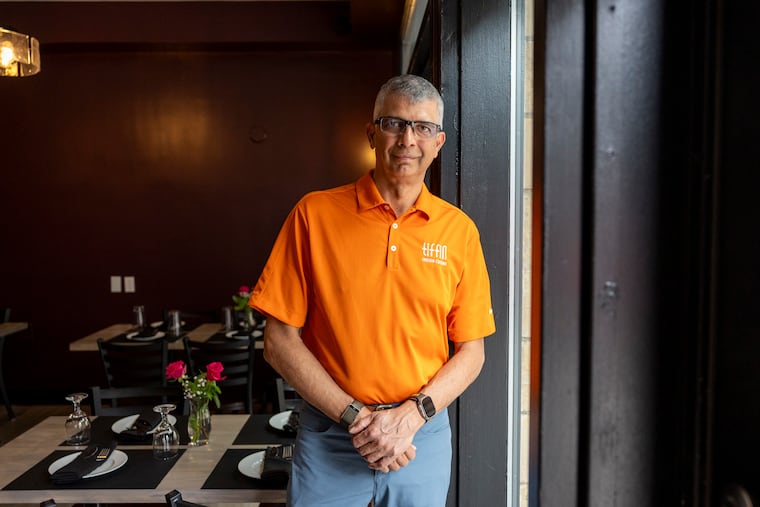
Munish Narula did not expect Tiffin, his Girard Avenue restaurant, to become a destination when he opened it in 2006.
He didn’t expect customers to come there at all.
The idea was delivery only — web orders only, no phones, no walk-ins — a bold bet at a time when restaurant delivery still mostly meant pizza and Chinese food. Tiffin’s drivers, dressed in neckties, headed to customers’ doors with tandoori chicken, lamb roganjosh, and chana masala.
Then customers began asking why they couldn’t pick up their orders. So Tiffin added takeout. Then they asked why they couldn’t sit down and eat. So Narula added a small dining room.
Twenty years later, Narula has closed the flagship that grew from that experiment into a 12-location brand stretching from Cherry Hill to Malvern.
Narula said the Girard Avenue lease had run out, and the landlord plans to redevelop the double-wide property on the commercial strip just west of Northern Liberties.
But Tiffin is not leaving the neighborhood. Earlier this month, Narula opened a new restaurant, with dine-in, takeout, and delivery, five blocks away to Liberties Walk in Northern Liberties.
For Narula, leaving Girard Avenue means letting go of the storefront where, he said, he feared his car might not be there when he returned to it after his first meeting with the landlord.
The neighborhood may have changed, but Tiffin’s best sellers have not: vegetable samosas, chicken tikka masala, saag paneer, and garlic naan. “There was a time when we used to joke that we should scrap the whole menu and just sell those four items,” Narula said.
The road to Tiffin
Narula, 55, came to Tiffin by way of Delhi, Denny’s, Wharton, and Wall Street.
He started working in hospitality at 16, picking up banquet shifts at five-star hotels in Delhi, then moved to the United States to study hotel and restaurant management at Johnson & Wales University. After graduating in 1994, he joined Denny’s as a management trainee and rose quickly to regional manager, overseeing restaurants in New Jersey and New York while still in his 20s.
The numbers side of that job led him to the Wharton School at the University of Pennsylvania, where he earned an MBA. From there, he went into investment banking and private equity in New York — a move he says was motivated largely by money, and one he quickly regretted.
“I’m looking at it and going, in two years out of grad school, I could be making maybe $700,000,” he said. “That was my sole motivation. That was a bad motivation.”
The morning of Sept. 11, 2001, Narula was taking his Series 7 licensing exam, given to entry-level brokers, in a hotel beside the World Trade Center. Narula and his wife, who lived in Battery Park City, could not return home for three months.
Eventually, the Narulas moved back to Philadelphia and he returned to the business he had known since he was a teenager: restaurants.
‘A man, a pan, and a GPS scan’
Narula founded Karma in Old City, then began thinking about a delivery-only Indian restaurant. The name came from “tiffin,” slang for a light lunch served in metal pans, a term tied to colonial India. In Bombay, office workers who found English fare too bland turned instead to meals cooked at home — by wives, mothers, or servants — and delivered through an intricate system of trains, bicycles, and famously reliable foot couriers known as dabbawallas.
Narula got plenty of attention for Tiffin. Initially, Narula set a 10 a.m. deadline for lunch orders and 2 p.m. for dinner so he could manage deliveries, which he plotted out by GPS. (“A man, a pan, and a GPS scan,” the Philadelphia Daily News quipped.)
Tiffin also became a training ground for chefs and managers. By Narula’s count, 11 Philadelphia-area restaurants are owned by Tiffin alumni, including Ekta, Saffron Indian Kitchen, and IndeBlue Modern Indian.
Narula said he takes pride in that rather than resentment.
“If you open a restaurant and you do well, it makes me happy,” he said. “I’m not jealous. I quit my job to do this. So if somebody leaves a job and wants to do something, I’ll support you.”
That delivery-first mindset also shaped what Narula considers Tiffin’s most important innovation: its reusable-container program, launched in 2021. Tiffin offers takeout containers that are meant to be returned, sanitized, and reused up to 1,000 times.
At first, the city did not know what to make of the idea. The Health Department shut it down because there was nothing in the code that clearly allowed restaurants to reuse takeout containers. Tiffin worked with officials to change the rules.
“We wash them, we sanitize them, the whole nine yards,” Narula said. “If there’s a legacy of Tiffin in Philadelphia, I would want that to be it.”
The new Liberties Walk location was not part of a grand plan. Narula had thought of simply closing Girard Avenue and walking away. But one of his chefs noticed that a former Indian restaurant there was for sale, and the timing lined up with the closure.
The site is more complicated for delivery drivers than Girard Avenue, he said, especially on weekend nights, when cars jam the narrow streets. Tiffin still uses its own drivers while also working with third-party platforms. Narula once sued Grubhub — alleging that it charged commissions for phone calls that did not generate food orders – but he said he has come to see the relationship as unavoidable.
“It’s damned if you do and damned if you don’t,” he said. “They do bring additional revenue. They do bring marketing.”
One thing is gone: the Tiffin drivers in shirts and ties. “It’s been awhile,” Narula said. “That was fun because you always knew there was a Tiffin driver.”
A painful lesson
Narula has had bigger ambitions before. In 2011, he opened Tashan, an upscale Indian restaurant at 777 S. Broad St. The Inquirer’s Craig LaBan called it “Tiffin’s big Buddakan moment,” praising its showpiece dining room, iPad wine list, and “thrillingly inventive kitchen,” led by chef Sylva Senat.
Narula imagined versions around the world. Investors were circling. “I went to Dubai four times because they wanted some version of Tashan over there,” he said.
But despite its acclaim, Tashan was not profitable and it was keeping him up nights, he said. It closed after four years.
“It was a very humbling experience,” Narula said. “After Tashan closed, we recovered fairly quickly, and by 2018 or 2019, we were doing very well. But I had decided, if I grow, I’m going to grow very, very slowly, very deliberately.”
That is where Narula says he is now: still operating, still adapting, but no longer chasing growth for its own sake. The original Tiffin is gone from Girard Avenue, but the company is still nearby, still delivering, and still built around the habits of customers who once asked if they could just come in and sit down.
“I’m in a happy place now,” he said.