Peace is declared in the Tun Tavern name dispute, which pitted Marine vs. Marine
The settlement ends a court fight over the name of a reproduction of the Marine Corps’ birthplace. The project is moving forward on Second Street in Old City.
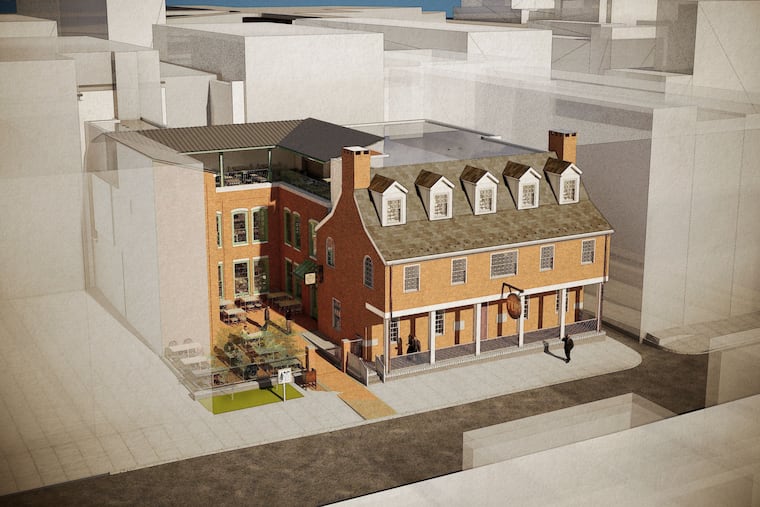
There will be one Tun Tavern opening in Old City, now that a long-running dispute over the name of one of Philadelphia’s most storied colonial landmarks has been resolved.
The settlement of a federal lawsuit, announced late Friday, has cleared the way for the Tun Legacy Foundation — a nonprofit led by Marine veterans and Philadelphia-area organizations whose origins trace back to the original Tun Tavern — to use the full name on its planned historic reproduction on Second Street.
Montgomery Dahm — who through his company Aljess owns the trademark as well as Tun Tavern, a brewpub in Atlantic City — has agreed to drop his lawsuit, filed in U.S. District Court in June 2024. Aljess will retain the right to open Tun Tavern restaurants in other locations across the United States.
Dahm told The Inquirer that he would no longer pursue plans to open a Tun Tavern at 207 Chestnut St. — just around the corner from the foundation’s proposed site, which is now a parking lot on Second Street just south of Market.
Last fall, Dahm and partners took over the Chestnut Street building, previously Lucha Cartel restaurant. They opened it as Tun Tavern for a party on Nov. 10 to celebrate the Marine Corps’ 250th anniversary — likely heightening pressure on the nonprofit. Terms of the settlement were made confidential, both parties said.
Tun Tavern history
The legal fight had become an emotional flash point among Marines, history advocates, and preservationists, and the truce removes the remaining obstacle facing the nonprofit’s effort to re-create a site that looms large in both local and national lore.
The original Tun Tavern — whose site is now beneath the southbound lanes of I-95 near Walnut Street — dates to 1686 or 1693, depending on the source, when English traders Samuel and Joshua Carpenter built a tavern at Water Street and Tun Alley along the Delaware River. At the time, Philadelphia rose sharply from the waterfront; taverns, warehouses, and wharves were accessed by stairs leading up to Front Street.
Over the decades, the Tun changed names with its owners and evolved into a gathering place for civic life. In the 1740s, under Thomas Mullan, it was known several nights a week as Peg Mullan’s Beefsteak Club, named for his wife. Located less than a mile from what is now Independence Hall, it became popular with members of the Continental Congress.
In 1775, the Tun served as the first recruiting station for what became the Marine Corps. That same year, John Adams drafted the Articles of War that helped form the U.S. Navy in one of the tavern’s upstairs rooms. In June 1775, George Washington was honored there at a banquet marking his appointment as commander of the Continental Army.
The tavern also hosted meetings of several colonial-era organizations that still exist today, including the Freemasons; the St. Andrew’s Society; the Society of St. George; and the Friendly Sons and Daughters of St. Patrick. Three of those charitable aid societies — St. Andrew’s, St. Patrick, and St. George — continue their work in Philadelphia more than two centuries later.
The Tun was demolished in 1781. Visitors seeking the tavern today are directed to a historical marker on Front Street near Sansom Walk, several blocks from where the building once stood. Multiple efforts have been made to restore or re-create the tavern as a living piece of history.
Incidentally, no one knows what the original Tun looked like. Artist Frank Taylor, whose 1922 drawing is the top hit in most online searches, was not born until 1846.
Latest effort to revive Tun Tavern
The most recent revival effort gained momentum in 2024, when the foundation purchased a surface parking lot on Second Street between Market and Chestnut Streets for $4.4 million. The foundation announced plans for a three-story reproduction combining a restaurant and museum, with all operating profits earmarked for charitable causes, including veterans’ initiatives and scholarships.
The group had hoped to open in time for the Marines’ 250th anniversary, but that timeline slipped as legal and logistical challenges mounted.
Complicating matters was the trademark. Dahm, who opened Tun Tavern restaurant and brewpub connected to the Atlantic City Convention Center in 1998, owns the trademark through Aljess. A Tun Tavern also operates at the National Museum of the Marine Corps near Quantico, Va.
In April 2024, the nonprofit applied to trademark “The Tun,” the historic name of the original tavern. Two months later, Aljess sued in U.S. District Court, arguing that use of “Tun” would create confusion with the Atlantic City restaurant.
The conflict escalated in September 2025, when Dahm announced plans to convert Lucha Cartel into his second Tun Tavern.
On Nov. 10, as Marines marked the Corps’ anniversary, the dispute played out in public. Thousands of Marines and their families gathered on the foundation’s parking lot site, while several hundred attendees and Revolutionary War reenactors celebrated at the Chestnut Street restaurant, which had been lightly redecorated for the occasion. Dahm closed the restaurant shortly afterward to begin renovations — plans that are now shelved.
“We’re charging the hill together, now that we’re no longer in a lawsuit,” Dahm said Saturday.
For the Tun Legacy Foundation, the settlement marks a turning point.
“This lawsuit was the last external obstacle to getting the project done,” said Craig Mills, the foundation’s board chair, a Marine veteran, and executive shareholder at the Center City law firm Buchanan Ingersoll & Rooney.
Mills said the foundation has secured the rights to plans and drawings prepared by architectural firm Ballinger, which he said donated a significant portion of its services. Those plans, he said, are complete and approved, with zoning and permits in place.
With the legal uncertainty resolved, the remaining challenge is financial. Mills said the foundation has raised just under $11 million toward a budget of about $21 million.
Mills said the foundation wanted to raise more before putting shovels into the ground. “We want to have enough reserves to weather the early months,” he said. “Restaurants don’t make much money right out of the gate, so we want to be prudent and break ground confidently.”
Mills said the settlement should help accelerate fundraising. While donations never fully stopped during the lawsuit, he said, some potential supporters were hesitant to commit.
The agreement also resolves the naming question that sat at the heart of the dispute. While the foundation had planned to operate as “The Tun,” Mills said the settlement grants the right to use the full historic name.
“This really could be a great thing for Philadelphia,” Mills said. “Every great historic city has a period pub — Alexandria, Williamsburg, you name it. Philadelphia hasn’t had one since the original Tun closed long ago. It would be meaningful to bring that back and give it to the city again.”