Expect a tree-pollen bonanza and a run on tissues as Philly temperatures flirt with records
Allergy sufferers may be rooting for a cool, rainy spring.
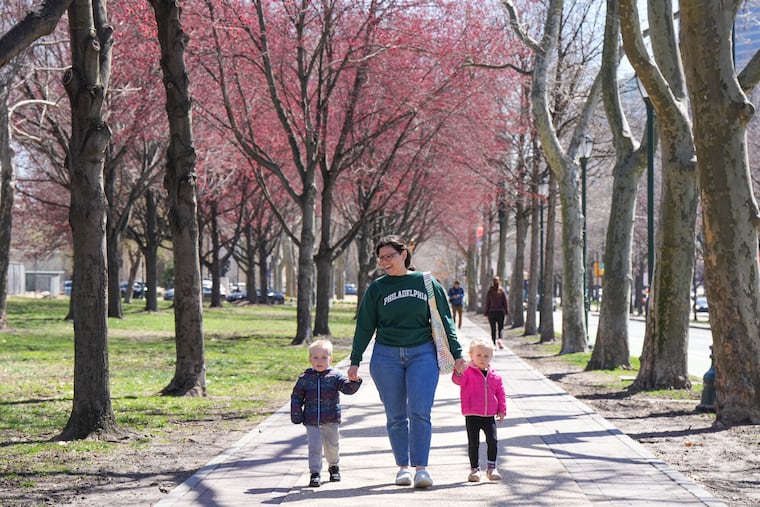
A likely record warm-up is underway this week with the onset of April, no doubt to the delight of the legions of spring-craving residents in the Philadelphia region — and millions of trees.
To the torment of allergy sufferers, the trees evidently have shrugged off the Arctic freezes and snow and ice and already have begun emitting their reproductive pollen, their form of arboreal spring fever.
“Tree season is in full swing,” said Corinna Bowser, an allergist with Bryn Mawr Medical Specialists.
And based on the weather forecast, it may become more swinging this week with temperatures due to crest past 80 degrees Tuesday and Wednesday. Warmer, dry, sunny weather “can drive a spike in allergy and asthma symptoms,” said Manav N. Segal, allergist and immunologist with the Chestnut Hill Allergy & Asthma practice.
Like Bowser and Segal, Marc Goldstein, allergist with the Asthma Center in Center City, expects the winter to have no impacts on the pollen season. He said the tree season has started right on time.
Nor should the overall dryness of the last several months, said Melissa Costanzer, a meterologist with AccuWeather Inc. Most of the region remains in moderate drought, according to the interagency U.S. Drought Monitor, but trees are rooted so deeply they “can pull water from other sources,” she said.
Tree pollen and allergy symptoms
The trees are the first to participate in an equinox-to-equinox pollen trilogy that will continue well into September, after the grasses and ragweeds have their turns. In all, about 80 million Americans suffer from pollen allergies, according to the Allergy & Asthma Network.
Bowser has observed that the tree season can be especially challenging because it comes after about six months of inhaling relatively pollen-free air.
While tree pollen grains, which are reproductive cells, may be invisible to the naked nose, they leave their signatures with a green sheen on the likes of car roofs, outdoor furniture, and other surfaces.
For an unfortunate but substantial minority, the body views pollen as an invader and counterattacks, setting off spasms of sneezing and unquenchable eye itchiness. It’s all a case of badly mistaken identity by the body’s immune system.
Are nasty pollen days predictable?
To a point, perhaps. The seasonal arcs are well-established.
The timetable has varied from year-to-year, but tree-pollen season typically peaks in late April into early May in the Philly region, before yielding to the grasses.
Online pollen forecasts essentially use pollen climatology and weather forecasts. Warm and breezy — temperatures in the 70s and above — expect high counts; expect the opposite for chilly and rainy.
Unfortunately, trees still are guarding behavioral secrets. Some days they throw pollen parties when the weather would argue against them; others, they hold their fire when they should be partying.
Plus, say pollen experts, the amount of effort they put into reproduction can vary from year to year.
Various research has documented that pollen volumes are increasing and the seasons lengthening due to warming and increased carbon dioxide levels. Plus, cities have been adding more trees to combat summer heat, and they produce pollen in their spare time while they wait for their protective shade to develop. As of 2014, the U.S. Forest Service estimated that Philly was host to 2.9 million trees, and that number likely has grown.
On any given day, the weather is prone to throw curves, especially in spring and summer, prime time for pop-up showers. “If there is lots of rain during the pollen season,” Estelle Levetin, a nationally prominent aerobiologist and professor emeritus at the University of Tulsa, “you get washout, and the pollen season seems less intense.”
In an analysis published in 2024, allergy experts scored publicly available pollen forecasts, matched against certified data from the National Allergy Bureau, in five U.S. cities — Atlanta; Seattle; Omaha, Neb.; Scottsdale, Ariz.; Seattle; and Washington, D.C. — and found them “low” on the accuracy scale.
How is pollen measured?
These days, evidently, not very well, which is an issue for both forecasting and forecast verification. Unlike the dense network of weather observations, the pollen network is sparse.
The nearest certified National Allergy Bureau station that has reported counts this season is in the Washington, D.C. area. The Asthma Center in Center City uses an automated sampler and posts daily counts, but so far the bureau has not approved the use of machine sensors, said program manager Pamela E. Gabrish.
Traditionally, the counts have been performed voluntarily by allergists who set pollen traps and then analyze them under a microscope. It is labor-intensive and requires training to identify different species of pollen.
The network has been shrinking. “Very, very few allergists want to get into this because of the time factor,” said Donald Dvorin, an allergist who collected samples in Center City and South Jersey for three decades until retiring last year. The doctors have other things to do, like, say, see patients.
AccuWeather is among those that posts daily forecasts, but actual data are sparse, acknowledged meteorologist Melissa Constanzer.
Pollen.com says on its site that the scarcity explains why it posts the same forecast for an area from West Chester to Winslow Township at the east end of Camden County, and from Marcus Hook to the south and Perkasie, Bucks County, to the north.
Having all those areas report the same levels of pollen would be “very unusual,” said Dvorin.
Weather.com, which does not identify the location of its sensors, reported on Monday that 456 pollen grains per cubic meter were present in the air over King of Prussia, 25 times more than what was in air in Philly. Yet, the forecast was the same — high — for tree pollen for both locations.
What to expect and what to do
High would be an excellent guess for Tuesday and at least the first part of Wednesday, but showers in the afternoon likely would depress pollen flight. Pollen-friendly conditions should back off some Thursday, but June-like warmth and dryness return Friday and Saturday.
Beyond taking medications, allergists advise:
Wear sunglasses; they keep pollen out of your eyes.
Wear a hat, which will keep it out of your hair.
Keep home and car windows shut.
After outdoor activities, shower and change clothes.
Keep the tissues handy.